
Local News
Early Years of Stephens City Boy Scout Troop 6
Bill Ewing, a Stephens City resident, is one of the few remaining folks around who can discuss the early days of Stephens City Boy Scout Troop 6. Ewing, 86 years old, enlisted in the Air Force in 1956, shortly after graduating from James Wood High School. He would graduate from Blue Ridge Community College in Weyers Cave, Virginia in 1970. Ewing worked in Stanton and Hanover County, Virginia before taking employment with the City of Winchester and served in the Finance Department before retiring as Director of Information Technology in 2000. However, before beginning his professional career, Ewing served as a Boy Scout reaching the enviable rank of Eagle Scout.

Bill Ewing is happily retired and recently moved back to Stephens City. He visited the Stephens City UMC office to provide some program insight about the beginnings of BSA Troop 6 which was previously thought to be lost to time. Courtesy Marty Barley.
“To the best of my recollection, Troop 6 was established by Scout Master Harold Preston Teets in 1946-47. Teets was a champion for Stephens City youth and spent many hours and personal expense providing insightful leadership and productive activities for the students in town, especially after Stephens City High School closed in 1950. Teets not only established Troop 6, but later formed and directed the Stephens City Drum and Bugle Corps known as the ‘Scarlet Rebels in 1953,” said Ewing.
Ewing began attending Scout meetings in the old cabin located behind the Stephens City fire hall originally built in 1941 on Mulberry Street. The Scout Cabin was relocated near the town ball field by the Town of Stephens City in 1956 to make way for the new community center and kitchen addition in the back of the fire hall in 1957.
Ewing experienced Scout meetings in both buildings. He was part of a team that assisted in the remodeling of the cabin to make it available for both boy and girl scouting. Troop 6 averaged about 10 to 15 scouts for the years Ewing participated during 1949 to 1955. “I joined Troop 6 with the rank of Tenderfoot in in 1949, received Scout 2nd Class in 49, Scout 1st Class in 50, Star Scout in 52, Life Scout in 53 and Eagle in June, 1954,” Ewing said.
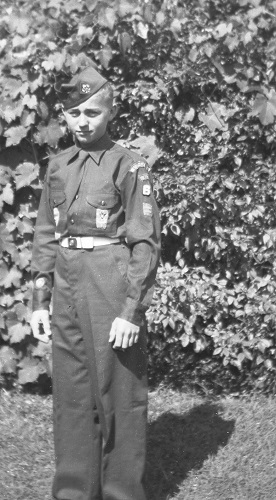
Thirteen-year-old Bill Ewing in smart looking Boy Scout uniform in 1952. Courtesy Bill Ewing.
Harold Teets left as Scout Master and was replaced by Roy Lemley for a short period. Ed Ambrose became Scout Master in 1951. Ewing said Mr. Ed Ambrose was a motivational Scout Master and I personally owe him a lot. I was a recipient of the Eagle Scout award due to his leadership and encouragement and am so thankful that he was there to lead and really push me hard to reach my goals.
Ambrose was a carpenter by trade; however, he became well known for his folk-art wood carvings after he became a Scout Master. Ambrose held the position for twenty years, teaching the interested boys to carve wooden neckerchief slides for themselves. The scout’s favorites to carve to earn merit badges were Native American Indian Heads or Paul Bunyan. Ewing said the wood carving that Mr. Ed Ambrose made for me is a neckerchief slide that we wore with our uniforms. He presented it to me as a gift for making Eagle. “I was the first to receive Eagle Scout under Scout Master Mr. Ed Ambrose. I am very proud of the wooden slide and I will never get rid of it, Ewing said.”

Scout Master Edward Ambrose, far left, scout leaders, and Troop 6 circa 1956. The scout on the far right in the green Explorer uniform is Scout Master Ambrose’ younger son, Donnie. Second in from left, back row is Gary Strickler. Third in from left, back row is Charles Gossard, and first in from left, back row is William Orndorff. Courtesy Stone House Foundation, Stephens City, VA.
Ambrose carved a twenty-four-foot-high totem pole which stood in front of the Scout Cabin before it was stolen and never recovered. As a folk artist, he lived on Main Street and maintained a workshop in his backyard in a small shed. He carved his figures; ceramic painted each one and sold them mostly to out of towners. The carvings are now collector items and some are exhibited at the Museum of the Shenandoah Valley.
“Gregory (Butch) Orndorff and William (Bill) Zirkle were the first two in Troop 6 to receive the Eagle Award, I was the third. Gregory Orndoff would go on to graduate from Virginia Tech and start his own construction business, Master Maintenance Inc. and reside in Manassas City, Virginia. William Zirkle would graduate from Virginia Tech and receive his master’s degree from Southern Illinois. Zirkle was an Air Force veteran attaining the rank of Lieutenant Colonel, serving in the Vietnam War, and then resided in Hayfield, Virginia,” Ewing concluded.
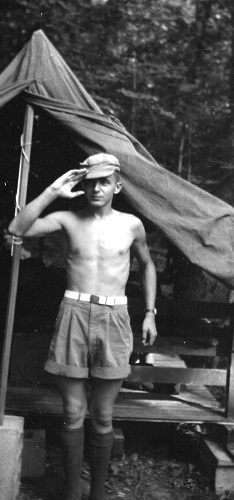
Eagle Scout, Gregory (Butch) Orndorff at Camp Rock Enon, circa 1954. One of the first Troop 6 scouts to receive Eagle. Courtesy Bill Ewing.
Edgar (Eddie) Ambrose, the older son was also an Eagle Scout and Explorer, and resides in Front Royal Va. Eddie is an Army Veteran and retired from Warren County Public Schools as a former teacher and administrator in 1995. He currently volunteers at St. Luke Community Clinic supporting programs managed by Executive Director, Vicki Davies.
Donnie Ambrose, class of 1960, was later inducted into the James Wood Athletic Association (JWAA) Hall of Fame in 2013 for his athletic versatility in high school. The JWAA website cites that Donnie excelled in football, basketball, baseball, and track and lettered in all four sports. Ambrose played football four years as a running back and linebacker and was co-captain of the team his senior year. He played basketball three years for the Colonels and threw the shot and discus in track for three seasons. In baseball, he was an outstanding catcher for three seasons.
Ambrose recalls that he and his brother Donnie, Charles Gossard, and Gary Strickler all made Eagle Scout at the same time in 1955. Edgar Ambrose said as an Explorer, he held the position of staff instructor in the Pioneering area of Camp Rock Enon during the summers of 1955, 56, and 57. Ambrose has fond memories of those years with his father, and younger brother Donnie scouting in rural Stephens City and camping at Rock Enon, near Gore VA. “After I graduated from James Wood High School in 1957 and Donnie in 1960, my father continued as Scout Master of Troop 6 until the 1970s. He really liked working with scouts and teaching them new skills like wood carving, if they were interested,” Ambrose said. For additional information about Edward Ambrose wood carvings, see Contemporary American Folk Artists, by Elinor Lander Horwitz, Lippincott Williams & Wilkins, 1975.
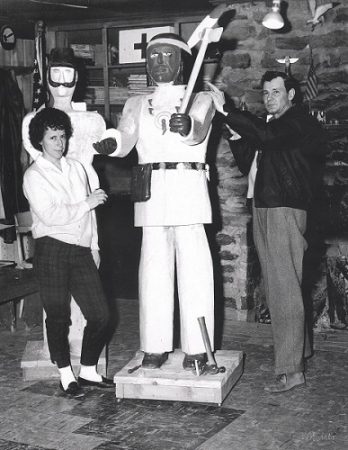
Betty Ambrose, Native American Indian with tomahawk, and Ed Ambrose, circa 1963. Courtesy Stone House Foundation, Stephens City, VA.
In a Northern Virginia Daily, news brief, Three Made Eagle Scout, dated 13 February 1962, a description of a Troop 6 Scout meeting was provided. “The rank of Eagle Scout was presented at the Court of Honor held in the Stephens City Boy Scout Cabin on Saturday night to three scouts from Troop 6. Larry Gregory, son of Mr. and Mrs. Julian Gregory; Peyton Borden, son of Mr. and Mrs. Wilson Borden of Middletown and Jack Pinner, son of Mr. Roy Pinner of Alexandria and the late Mrs. Pinner.
W. C. Gleason, Scout Executive of Winchester, made the presentations before approximately sixty scouts and their parents. Mr. Gleason commended the boys on their achievement and remarked that this brings the total number of scouts attaining Eagle in this troop to ten. All in the eleven years under Scout Master Mr. Edward Ambrose’s fruitful leadership.”
The Scout Cabin continued to receive additions and upgrades in the 1970s and 80s. Troop 6 became inactive in the 1980s. According to Stephanie Short at the BSA Shenandoah Area Council in Winchester, Troop 6 was sponsored by the Lion’s Club through 1983. In 1986, after gaining permission from the Lion’s Club, Shenandoah Valley Baptist Church restarted Troop 6 at their location. The troop was then dissolved in 1993.
Troop 17 was relocated from Kernstown to Stephens City and became Troop 15 after receiving sponsorship from Stephens City UMC in February, 1978. Lou Boyer, as Scout Master, was later invited to relocate Troop 15 to the Scout Cabin. The building, located on Locust Street, contains scouting memorabilia (where historical artifacts are maintained) from the past and continues to display the rich history of the scouting movement in Stephens City.
Bill Ewing served on the Stephens City Town Council from 1988 to 2004. He resigned when elected to the Board of Supervisors, Opequon District where he served from 2004 to 2013. Ewing recently moved back to Stephens City from Winchester, and serves as Treasurer of the Lions Club and volunteers for the Route 11 Yard Crawl every August. He has been a Lions Club member since 1989.

From Panama to Tehran: Big Stick Diplomacy Then and Now

Business Growth Series: Why Customers Call Your Competitor First

Local Governments Race to Attract Data Centers, Often In Spite of Concerns From Their Constituents

Mini Quiches with Ham and Swiss Cheese

April Showers Can Also Bring Roof Leaks

US Justice Department Downgrades Risk of State-Licensed Medicinal Marijuana

US Senate GOP Adopts Budget Blueprint Laying Path for Billions for ICE, Border Patrol

County Proceeds Toward FY-27 Budget Final Approval With 9-Cent Real Estate Tax Hike and Other Variables in Play

Virginia Lawmakers OK Governor’s Tweaks to Major Energy Bills, Reject Health and Labor Bill Amendments

Virginia Lawmakers Recess Special Session Without a Budget Deal

Warren County School Board Tackles Policy Changes, Budget Pressures at April 22 Meeting

Barbara Elaine Deale-Herrold (1949 – 2026)

John William “Johnny” Dehart (1956 – 2026)

GOP’s Hope to Undo Virginia’s New Redistricting Power Grows After Judge Halts Maps

Buying a Cemetery Plot: What You Need to Know

Study Links Coffee Consumption to Lower Dementia Risk

When Everyone Swims: Water Equality at Alamo Drafthouse Cinema

State Bus Line Debuts New East-West Route That Connects 10 Cities Across Virginia

Virginia Voters Back Redistricting Amendment After Months of Legal and Political Battles

Hazel J. Brown Cornell (1929 – 2026)

James Henry “Radar” Ashby (1949 – 2026)

Trees Keep Time: What Growth Rings Reveal Each Arbor Day

Funeral Professions Play Vital Role In Helping Families Honor Loved Ones

Virginia’s Redistricting Amendment Trends Positive as Count Continues
