
State News
Local Governments Race to Attract Data Centers, Often In Spite of Concerns From Their Constituents
Data centers — proposed beside town centers, on generational farmlands, in view of cemeteries, and next to Civil War battlegrounds across Virginia — are testing local governments’ ability to regulate industrial land use.

Marvell data center is one of eight newly approved data center campuses in Culpeper County. (Photo by Evan Visconti/Virginia Mercury).
Concurrently, the digital facilities are tripling energy demands in Dominion Energy’s portion of the grid, resulting in the transformation of large swaths of land not only for the construction of data centers, but also for the massive infrastructure overhaul that is required to supply them with enough power and water to operate.
Localities have tools at their disposal to control some of the harms associated with data centers, like noise and pollution coming from air conditioners and backup generators at their facilities, the strain on power and water resources, and proper zoning challenges.

When enacted, those regulations can make data centers an investment that actually benefits communities, said economist João Ferreira, acting director of the Center for Economic and Policy Studies at the University of Virginia Weldon Cooper Center.
But research has shown local governments can be tempted to give up some of those regulations in order to attract the huge increase in local tax revenues the industry can provide.
This “race to the bottom” is a problem because “data centers will locate in the places that are more financially convenient for them,” Ferreira said.
As more information about the operation of data centers becomes publicly available, communities are sounding the alarm on an industry that stands to have a far greater impact beyond the walls of its warehouses.
Some environmental advocates and land preservationists in Virginia, including the Piedmont Environmental Council, are now pushing for a pause or a moratorium on new data center proposals.

Virginia has “three to one more data centers than any place in the world,” said Christopher Miller, president of the Piedmont Environmental Council, and if we want to move forward with the ones already approved, “we have a lot of work to do.”
But Ferreira warned that “pushing data centers to places where regulations are less relevant or strict doesn’t seem like a good outcome of all this.”
As the backbone of modern artificial intelligence and technology, data centers will not stop building if Virginia or the United States forces them out, experts say.

“It will continue,” Ferreira said, adding that local communities in Virginia can still benefit from data centers with the proper regulations and oversight in place.
No data center developers who were contacted for this story responded to requests for comment.
A vast footprint
When you take into account the infrastructure needed to supply data centers with enough electricity and water to operate, the total land required can be 100 times the size of the footprints of the buildings themselves, “which are already pretty big,” said Miller.
The Piedmont Environmental Council created a map of data centers in Virginia in the absence of any such overview from the state, showing an estimated 370 million square feet of existing and proposed data centers.
Dominion Energy is processing applications to add 70 gigawatts of electricity to the grid, largely to supply new data centers at a level of growth they called “unprecedented” in an application submitted to the Virginia State Corporation Commission earlier this year.
The proposals would nearly triple Dominion’s all-time peak energy load, which experts say will require enormous additions to the energy infrastructure, “at costs that will be in the billions of dollars,” said Mark Christie, director of the Center for Energy Law and Policy at William & Mary Law School.

“Ultimately, the General Assembly must decide such major policy issues as whether to continue tax subsidies for data centers and whether to allow or incentivize more generation to be built in Virginia,” Christie said.
State budget negotiations are stalled over the Senate’s pitch to end data centers’ controversial exemption from the sales and use tax, which provided $928 million in tax savings to data centers in 2023. House lawmakers and Gov. Abigail Spanberger are working to preserve the exemption but also make data centers pay their fair share in terms of energy consumption.
Without a comprehensive statewide plan for the growth of data centers, land preservationists and community advocates are scrambling to make sure they are sited properly, a battle often played out in courtrooms and at highly contentious local rezoning hearings.
Historic battlefields
The American Battlefield Trust has joined local landowners in suing two counties in Virginia over rezoning land for data centers beside preserved Civil War battlefields, claiming the localities did not follow proper zoning procedures.

A view of the Confederate trenches dug during the 1864 Battle of the Wilderness. (Photo by Evan Visconti/Virginia Mercury)

The Virginia Court of Appeals struck down a rezoning in Prince William County in March that would have permitted the development of the largest proposed data center campus in the world, the Prince William Digital Gateway.
Va. Court of Appeals stops major data center development in Prince William County
The rezoned land was adjacent to the Manassas National Battlefield Park, which commemorates the battles of First and Second Manassas, or Bull Run.
The Prince William County Board of Supervisors passed a resolution on April 7 directing the county attorney and outside legal counsel not to file a petition for appeal for the two Digital Gateway rezoning lawsuits, said Nicole Brown, the director of communications for the county, marking a major win for local landowners and the American Battlefield Trust.
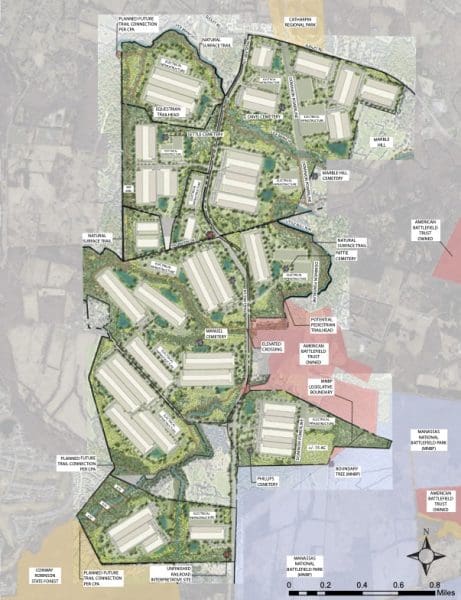
A map of the proposed Digital Gateway data center complex in Prince William County. (Photo courtesy of the American Battlefield Trust)
Developers for the Digital Gateway project had plans to construct 37 data center buildings, about the size of 144 Walmart Supercenters, with a power demand roughly equivalent to over two million homes and no plans for generating it, according to the American Battlefield Trust.
“You had a local government rushing to make a final decision without knowing answers to these questions,” said Miller, who warned against “catastrophic” impacts to the land, the watershed, and the power grid if data centers are not sited properly.
Ashley Studholme, executive director of the Prince William Conservation Alliance, said she recognizes that data centers are part of our modern reality. “We have YouTube, we have websites, we have cell phones,” she said, but there is still a need for “accountability and transparency.”
“We have this wealth of National Parks and protected land,” said Studholme, “and they were being targeted by this industry, and our elected officials were seemingly allowing them to do that.”
In a similar case, the American Battlefield Trust and local landowners sued to stop the Wilderness Crossing development in Orange County, a plan to build residential housing and commercial developments bordered by a large data center complex, over a “lack of transparency and adherence to proper legal process during Orange County’s zoning vote,” said David Duncan, president of the American Battlefield Trust.
Being the site of 28,000 casualties and the first battle where Generals Ulysses S. Grant and Robert E. Lee squared off, Duncan said, “we would hope these types of developments could be moved to a place where they are not so visually intrusive on these key parts of our national history.”

An aerial view of the preserved Wilderness Battlefield in Orange County. (Photo by Evan Visconti/Virginia Mercury)
An Orange County Circuit Court judge is currently considering a motion by the county to advance the case to the higher court of appeals before it reaches a circuit court trial.
Farmland to town centers
In Brandy Station, a small farming town in Culpeper County, two data center proposals met resistance from a community that said they threatened one of Virginia’s newest state parks, the Culpeper Battlefields State Park, established in 2024 to protect several battlefield sites, including one where North America’s largest cavalry battle played out.
“Why would we want to see that industrialized when we just made this huge investment?” said Sarah Parmelee, the Piedmont Environmental Council’s land use field representative for Culpeper County.

The Battle of Brandy Station took place on June 9, 1863, and was the largest cavalry battle ever to occur in North America. (Photo by Evan Visconti/Virginia Mercury)
After the county planning commission unanimously recommended denying the proposal, the data center applicant withdrew the plan.
The “crowd swell of resistance” led to most new data center proposals being approved in the Culpeper Tech Zone, which was limited to an area beside the town of Culpeper, said Parmelee.
But concerned Culpeper town residents quickly created the Coalition to Save Culpeper to advocate for mitigating impacts like noise, air pollution, a lack of energy and water as well visible changes to their town’s landscape.
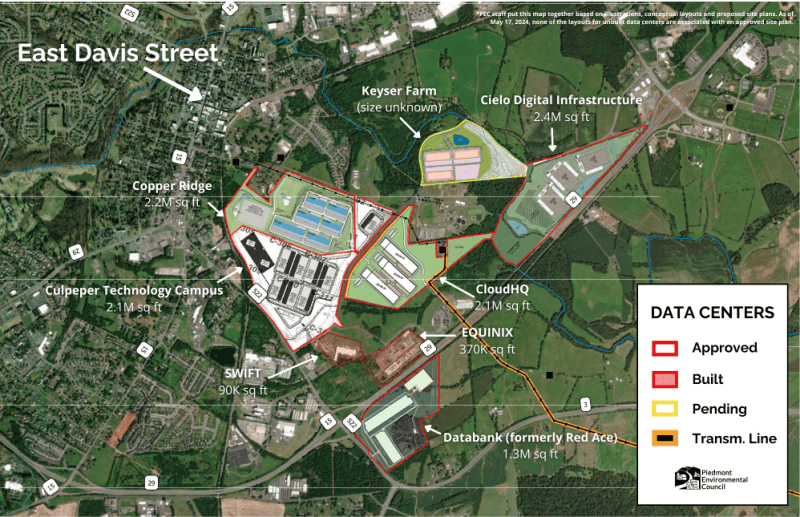
A map of built, approved, and pending data centers around the town of Culpeper and a proposed transmission line to fuel them. (Map courtesy of the Piedmont Environmental Council)
The town of Culpeper also has its own Civil War history that local residents have fought to protect, representing a “very personal issue” to those who question “putting big, noisy warehouse buildings so close by” to a national cemetery, said Andrew Dowdy, a member of the Coalition to Save Culpeper.
Those concerns have been largely ignored by town officials, said Dowdy, who has resorted to submitting Freedom of Information Act (FOIA) requests to find more details about the developments.
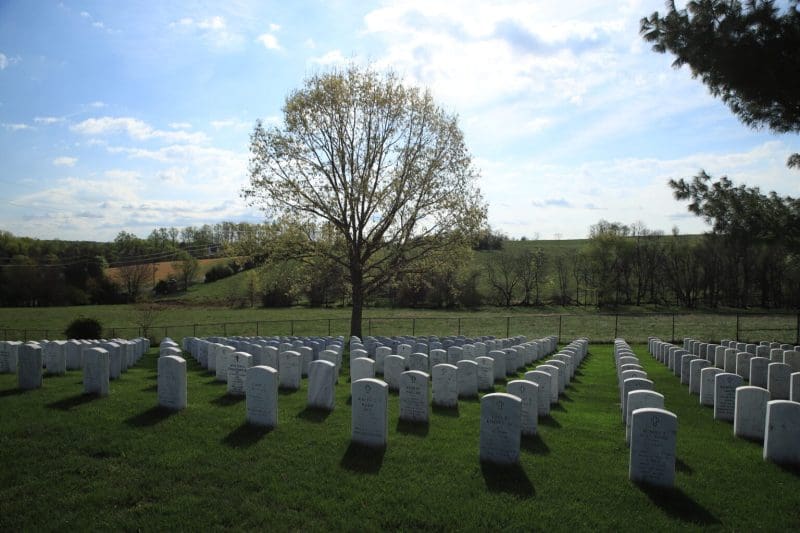
The Copper Ridge data center development site is located on the hill in view just behind the Culpeper National Cemetery. (Photo by Evan Visconti/Virginia Mercury)
Dowdy said emails between town planners uncovered private coordination with data center developers outside of usual public forums.
The chairman of the town planning commission even questioned this “unprecedented access” in an email obtained by FOIA requests.
Research by University of Mary Washington professor Eric Bonds and his students found evidence that non-disclosure agreements are commonly signed between localities in Virginia and data center developers, allowing projects to move forward with little to no public participation.
As the public learns more about data centers, some politicians are beginning to feel “backlash” from voters who disapprove of signing non-disclosure agreements or approving data centers without involving the community, said Ferreira.
Data centers take 18 to 24 months to be built on average, according to Ferreira, but enacting policies that mitigate their impacts on local communities and the environment is a much longer process.
“Unfortunately in the current framework at the local or the state level, (it) can take years,” Ferreira said.
by Evan Visconti, Virginia Mercury
Virginia Mercury is part of States Newsroom, a nonprofit news network supported by grants and a coalition of donors as a 501c(3) public charity. Virginia Mercury maintains editorial independence. Contact Editor Samantha Willis for questions: info@virginiamercury.com.




“Can’t We Just Watch the Movie at Home?” A Question About the Future of Movie Theaters

Two Front Royal Churches Plan Joint Oct. 25 Gathering Focused on Faith and Virginia Ballot Issues

Robert Arthur Babineau (1961 – 2026)

Here’s Where Doctors Diverge on Virginia’s Pending Reproductive Rights Constitutional Amendment

Virginia Teachers Balance AI Innovation with Student Creativity Amid Rising Academic Pressure

Donna Kersey Deavers Smith (1945 – 2026)

William Franklin “Rocky” Walker (1959 – 2026)

Measles Cases Reach 4,080 for the Year — the Highest in Decades

Data Center Backlash Set to Sway Midterm Elections

Mary Ann Williams (1942 – 2026)

Winston Richard Summers (1946 – 2026)

With Mother Nature’s Cooperation Festival of Leaves Draws Another Huge Crowd to Greet the Fall Season

Turning Off an Airbag Is Allowed in Limited Circumstances

A Retirement Account for a Grandchild Starts With a Summer Job

Your Photos Survive A Lost Phone, But Not A Wrong Tap

Walking Malls Don’t Solve Problems

Festival of Leaves 2026 Wraps Up a Successful Day in Downtown Front Royal

Autumn Delights: Spotlight On Pumpkins!

Lord Fairfax Health District Receives $5,000 Grant To Support Local EMS Crews

Why an AI Bubble Could Reach Your Savings

The Platypus: A Truly Amazing Animal!

A Thing of the Heart: Two-Fold Outreach to Children and Award Presentation Brings Hike Kidz to Stone Branch Arts Center

Virginia State Police Seize Drugs Valued at More Than $830,000, Recover 13 Firearms

Commentary: We Hate Technology. Please Like and Share
