
State News
GPS Technology Legend and Virginia Native Gladys West Reflects on Her Career and Contributions
Spring break is drawing closer for students statewide and many Virginians are gearing up to visit familiar and lesser-known locales throughout the commonwealth.
Travelers will likely get some help navigating their journey with technology developed by Virginia native Gladys West, who was key in creating the Global Positioning System (GPS). While sharing insights from her groundbreaking career, West, like many Virginia school kids, also had spring break top of mind. She said her favorite place in the state to visit with her late husband Ira West was Williamsburg.

Gladys West adjusting the settings on her car’s navigation system. (Courtesy of Carolyn Oglesby)
“It has history to discover, outlets for shopping, good food and a quiet atmosphere,” 94-year-old West said in an interview.

Born in Sutherland in Dinwiddie County, West is a pioneering mathematician who made valuable contributions to several technological advances that helped transform the way humans navigate the world and understand its dimensions. The state honored her with a resolution passed by the Virginia General Assembly in 2018.
Beginning in 1956, West began to carve out her most notable work at the Naval Proving Ground, now called Naval Support Facility Dahlgren in King George County.
The second African American woman hired at Dahlgren and one of only four African American employees at the time, she was known for her skill in calculating complex mathematical equations and computer programming.
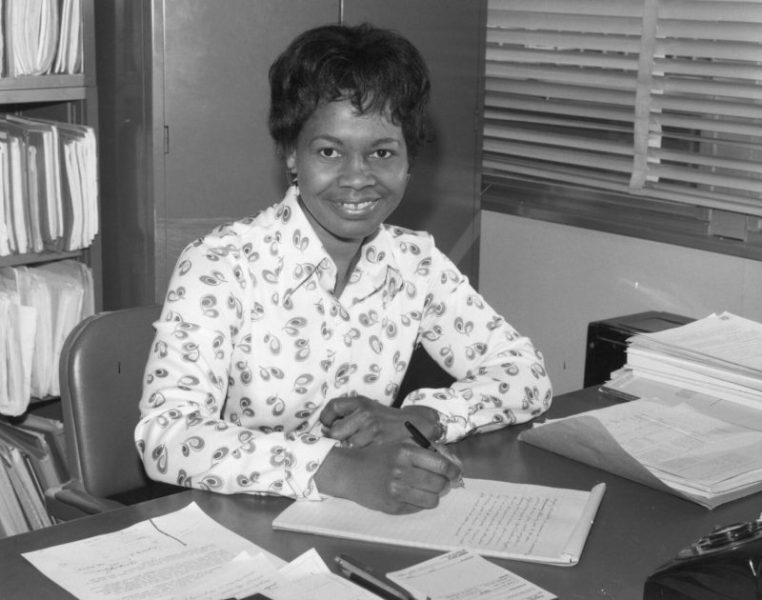
Gladys West was known for her skill in calculating complex mathematical equations and computer programming. (Courtesy of Carolyn Oglesby)

West excelled working on satellite geodesy, which is used to make measurements of the Earth, and other satellite measurements that contributed to the accuracy of GPS. The technology is now used in cars and on devices globally.
She also received commendation as the project manager for the radar altimetry data processing project of Seasat, the first satellite designed for remote sensing of the Earth’s oceans.
West retired with 42 years of service.
One of her earliest motivations to be successful was simple: keeping tidy. When West was young, she had to help out on her family’s farm even if it meant getting dirty, which she despised.

“I aspired to do something outside of farm work and I knew that having a good education would be the key,” West said. “That motivated me to do well in school so that I could get a scholarship and go to college. I had a great support system and many mentors along the way who kept me motivated.”
She graduated from Virginia State University with a bachelor’s degree in mathematics, and earned her masters of public administration from the University of Oklahoma and a doctorate in public administration from Virginia Tech. Between her studies, West also taught in Sussex County. Today, she continues to be recognized for her work. She published her memoir “It Began with A Dream” in 2020.
Spring break travel outlook
Motoring around Virginia during spring break should be a relief to drivers, compared to a year ago.
According to AAA, the state average for a gallon of gas has dropped from last year’s $3.45 to $2.96. The national average is $3.15 as of Thursday.

Clean car drivers are subject to paying an average of 34 cents per kilowatt hour for electricity in Virginia and nationwide.
Juliana Thomas, a spokeswoman for Virginia Tourism Corporation, home of Virginia Is For Lovers, said “Virginia absolutely shines in the springtime.” Thomas touted several areas as great spring break destinations including Alexandria, named one of the Top Spring Travel Destinations by NBC, and Williamsburg, home to Busch Gardens — one of two theme parks in the commonwealth.
“From vibrant cities to charming historic towns, breathtaking outdoor escapes, and family-friendly coastal getaways, the commonwealth offers a diverse array of getaway options, with something that will appeal to every traveler,” Thomas said.
West said it’s always refreshing to hear how her work is now being used outside of the government and said she is still amazed by the technological advancements navigation has made since the GPS Project began in 1973.

“It never gets too old,” West said. “I am just so pleased that I was able to make a contribution. When I was working, I never imagined that the GPS would be used in the civilian world. I love seeing all the ways that it can be used and I probably have no idea how vastly used it is.”
by Nathaniel Cline, Virginia Mercury
Virginia Mercury is part of States Newsroom, a nonprofit news network supported by grants and a coalition of donors as a 501c(3) public charity. Virginia Mercury maintains editorial independence. Contact Editor Samantha Willis for questions: info@virginiamercury.com.




In Enthusiastic Agreement with Supervisor Jamieson

States Move to Limit Classroom Screen Time

Even Without a New Map, Buttigieg Says Virginia Dems Can Win With Focus on Healthcare, Affordability

Virginia Hospitals Predict $31B Reduction in State’s Medicaid Funding If Proposed CMS Rule Passes

Business Growth Series: Trying to Do Everything Yourself Is Limiting Your Growth

Agritourism Offers a Fresh Way to Enjoy Summer Close to Home

Congressional Report Says Virginians Have Paid $1.8 Billion More for Gas Since Iran War Started

UVA Study Shows How Housing Affordability Policy, Civic Engagement and Voter Turnout Connect

More Than a Futbol Rivalry

Scott’s Turn: A Conversation About Building Stronger Communities

The Power of Words: A Lesson From Calvin Coolidge

Excel to Perform July 23 at Gazebo Gatherings

Michael Ray Santmyers (1971 -2026)

Oatmeal: Why Some Swear by It and Some Swear at It

This Week’s Showtimes at Royal Cinemas as of July 24th

Marcelene Fay “Marci” Pinion (1958 – 2026)

Buford “Bo” Lynn Kibler (1942 – 2026)
A Path to Fiscal Responsibility and Public Wellness

Moving Data Center Regulations and Permitting Forward a Dominant Topic of Conversation for County’s Elected Officials

Screen Rules That Actually Work

Blue Ridge Wildlife Center Patient of the Week: American Barn Owl

After Taking Off in Charlottesville, Feds Plan National Electric Aircraft Charging Network Rollout

POLICE: 7 Day FRPD Arrest Report 7/20/2026

FDA: Taylor Farms iceberg lettuce sample produced a false positive for cyclospora
