
State News
GMU Energy Report Shows Need for Education on Energy Projects, Efficiency Focus
A George Mason University report released Friday looks at how Virginia can meet its mandatory goal of decarbonizing the state’s utility providers while also getting more localities on board for certain energy projects. It comes as Virginia faces critical energy demands as ratepayers and lawmakers consider how to meet those needs and make utility bills more affordable.
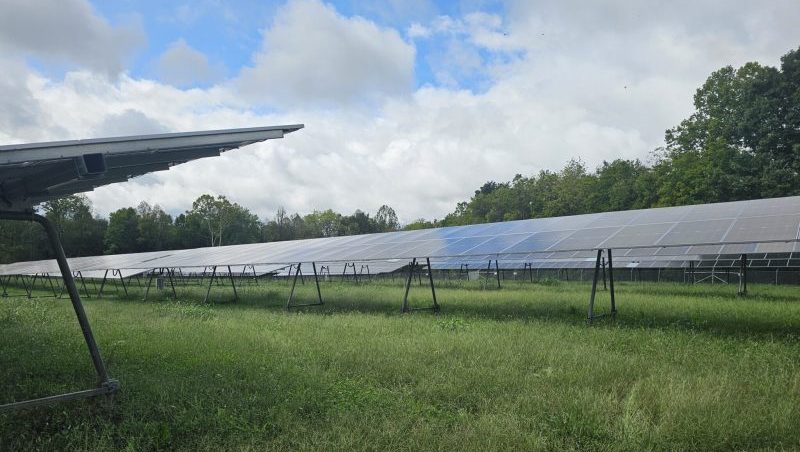
The solar panels at Dominion Energy’s Black Bear solar project. (Charlie Paullin/Virginia Mercury)
The report projects that Virginia will see an 8%increase in energy demand by 2030 and a 20% increase by 2035, driven largely by the growth of data centers and manufacturing. In 2023, the commonwealth was the top energy importer from other states. Nuclear power is providing the heaviest lift of energy production in the state, with natural gas and solar increasing the most in bringing power online.
Adjunct Professor Paul Bubbosh of the Schar School of Policy and Government at George Mason said the report is meant to be practical in light of the state’s energy needs. He said with challenges like the loss of federal incentives for renewable energy projects and supply chain holdups, the state will have to rely on natural gas in part during the interim.

“The complicating factor is that solar and wind are on a levelized cost of energy basis cheaper than natural gas and coal and nuclear power,” Bubbosh said. “However, with the added cost of supply chain issues, it further complicates the picture.”
Natural gas is also facing supply chain challenges for proposed gas plants and with fossil fuels continuing to be a scarce commodity, it will add to the steadily increasing fuel costs, Bubbosh said.
Bubbosh encourages utilities to ramp up their efficiency efforts and consider data center advancement that will allow them to pull less power off of the grid. Under the VCEA, Appalachian Power was expected to make a 2% reduction in energy consumption by 2025, while Dominion was told to reduce by 5%. Dominion has not met those goals and additional reductions will be determined by the State Corporation Commission every three years.
“Virginia has not met its targets in energy efficiency, so it needs to do a lot more in terms of getting consumers to reduce consumption during peak periods,” Bubbosh said.

States nationwide are struggling to fully understand how much power data centers will actually need in the coming years. Many projects are often thrown into the queue before financing or other permits are secured; some data centers may not actually materialize. The GMU report suggests requiring more details of a project to be locked in before the energy demand begins to be calculated.
“One of the key difficulties with a lot of these large load centers is the financing. So they now need to demonstrate that they have the financing in place and that they’re ready to go and that should improve things,” Bubbosh said.
The regional grid operator PJM has taken heat from most of the governors in the coverage area for slow walking the approval of connection permits, largely for solar and wind projects. Some of the leaders believe this is leading, in part, to higher utility bills because energy projects are waiting to be put on the grid.
PJM has pointed to supply chain issues slowing down certain projects already in the queue and delaying their actions. They have also made some reforms to ramp up their permitting process.

But Bubbosh said the real focus should be put on rural Virginia communities, to educate them on renewable energy projects, their own energy needs, and how they can meet their own demand while respecting the local culture.
“The pathway to energy security in Virginia runs through rural Virginia. It’s imperative that the Commonwealth’s government understands that to achieve lasting results, we need to bring those in Virginia, whom we’re asking so much of, such as their land, to be part of the conversation,” Bubbosh said.
There have been efforts to create a framework for statewide assistance for local regulations around energy projects. Currently, it is up to local boards of supervisors to vote if a solar, wind, gas, or nuclear project can move forward and what the related ordinances will entail. In some counties, the boards have approved a power-hungry data center project application and denied a solar farm proposal the same night.
The GMU report urges local grassroots movements to aid in creating community energy-need assessments to help rural communities understand which projects need to be built out to keep their own lights on, rather than sending power up north to Data Center Alley.

“The problem with Virginia is legislators are trying to ram through siting requirements at the state level. That will backfire, and you will get greater resistance to large scale solar deployment,” Bubbosh said. “So what we’re trying to do is to say, if you really want to achieve lasting results and energy security, you’ve got to bring on rural Virginians.”
The report suggests expanding solar projects in Northern Virginia where the power need is the greatest. Then the energy will be right at the source of the need. Once the northern parts of the state’s infrastructure has been sufficiently expanded, it would be easier to ask other communities to build out their energy infrastructure.
“Then I believe it would be appropriate for Virginia legislators to turn around and say, ‘Look, we all want to keep the lights on. We have exhausted the full potential in Northern Virginia and now we want to turn our attention to, let’s say, the Southside, or Tidewater’,” Bubbosh said.
Their goal with the report and recommendations is to aid state and local governments in moving forward with solid plans on how to meet the growing energy demands, no matter which party is dominant in the legislature or who occupies the Governor’s Mansion. That will help move the needle on siting issues, researchers hope.

“One administration is gonna come in and they’re gonna want to favor these technologies, A, B, and C. Four years later, another one’s gonna come in, and you’re gonna go back and forth,” Bubbosh said.
Bills spelling out how the state may aid communities in their energy plans are expected to be filed in the next regular legislative session, beginning in January.
by Shannon Heckt, Virginia Mercury
Virginia Mercury is part of States Newsroom, a nonprofit news network supported by grants and a coalition of donors as a 501c(3) public charity. Virginia Mercury maintains editorial independence. Contact Editor Samantha Willis for questions: info@virginiamercury.com.




Is It Too Late to Sign Up for the All About Trees Class This Year?

The Envelope That Decides Next Year

The Emergency Fund You’ll Actually Build

Stronger, Not Bigger: Rethinking Economic Development in Warren County

Kenneth Lewis Smith (1939 – 2026)

Strong Families Build a Stronger Warren County

The Science Prizes That Make You Laugh, Then Think

Grill the Perfect Corn on the Cob, Then Dress It Up

The Famous Last Words No One Wrote Down

US Supreme Court Again Urged to Permit Trump Vote-by-Mail Restrictions

President Trump’s Beef Policy May Help Food Prices, But At What Cost?

Virginia Attorney General Creates Worker, Federal Accountability Units as Office Highlights Meta Settlement

VDOT: Warren County Traffic Alert for September 7 – 11, 2026

Twenty-Five Years Later, Remembering When We Stood Together

U.S. Adds 162,000 Jobs in August as Manufacturing and Construction Hiring Rises

Spanberger Taps Daniel Young to Lead Government Watchdog Office

Update: Cline Appears Without Democratic Opponent at Winchester Congressional Event

UVA Health Experts Urge Athletes to Recognize Concussion Warning Signs as Fall Sports Begin

Bumblebees Solve Puzzle Without Training, Study Finds

Business Growth Series: “What If” Thinking Is Costing You Money

Blue Ridge Area Food Bank Calls on Community to Take Action Against Hunger in September

Virginia State Police Seize Guns, Nearly $200,000 in Cash During Weekly Crime Operations
The Queen is Gone. There Will Never Be Another

WC Public Schools Gets Engineers Status Assessment on E. Wilson Morrison Physical Plant Issues
