
Local News
Blue Ridge Wildlife Center Patient of the Week: Central Ratsnake
Every year, we treat snakes that have swallowed ceramic “fake” chicken eggs. Many backyard chicken keepers use these eggs to encourage hens to lay in nesting boxes or discourage egg-eating, but to a hungry ratsnake, they are indistinguishable from the real thing.

This Central Ratsnake found its way into a chicken coop and swallowed four chicken eggs. Unfortunately, one of those eggs was ceramic.
Fortunately, the finder recognized what had happened and brought the snake to us almost immediately. That quick action made all the difference, allowing us to intervene before the fake egg traveled too far through the digestive tract and caused the severe tissue damage we so often see in these cases.
As you can see on this radiograph, with the snake’s head on the left and tail on the right, the first egg swallowed had already been crushed farther down the digestive tract while the remaining eggs were still intact.

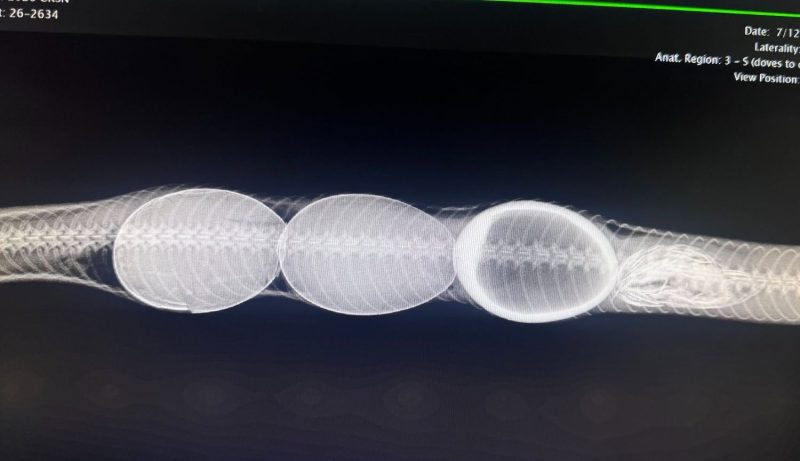
The bright white mass closest to the tail is the crushed shell of the first real egg swallowed. The two eggs on the left are also chicken eggs, while the egg with the brightest white outline is the ceramic egg. To a snake, they all look exactly the same, but three are excellent nutrition and one is potentially deadly.
If a ceramic egg remains in the stomach too long, it cannot be digested or passed. Over time, it creates constant pressure against the stomach wall, cutting off blood supply and causing tissue damage. Adhesions develop, portions of the stomach may begin to die, and in severe cases even the skin overlying the stomach can become necrotic. These patients often require major surgery to remove the egg and sometimes even sections of the digestive tract. Without treatment, they eventually succumb to dehydration and secondary infections.
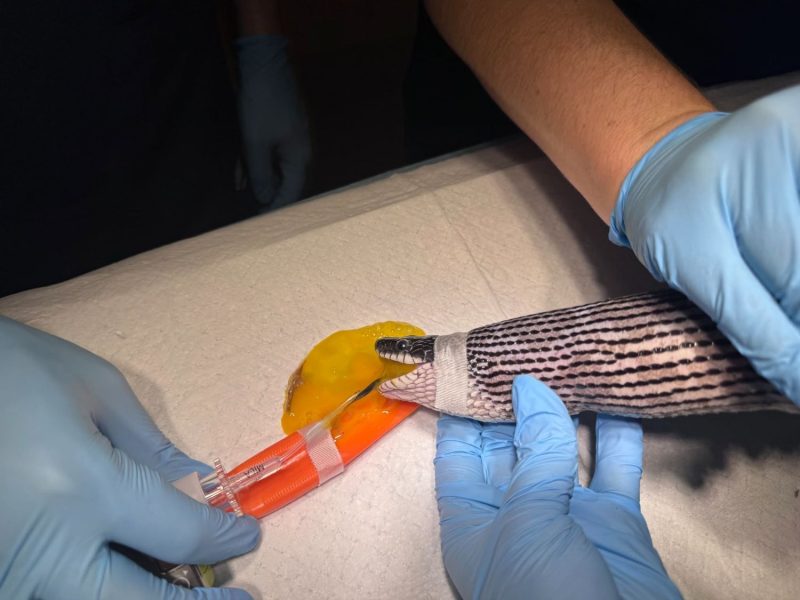
This patient was heavily sedated and intubated to protect the airway before we carefully assisted him in regurgitating the eggs. This was only possible because the eggs had been swallowed very recently and the snake was well hydrated. Please never attempt this with an alert snake or one that may have swallowed a ceramic egg hours or days earlier. Once the egg has remained in the stomach for an extended period, attempting removal without veterinary care can cause severe injury.
Unfortunately, removing the ceramic egg also meant sacrificing the three real eggs that would have provided an excellent meal.

This patient also suffered a small laceration, which was surgically repaired. He is now recovering well while we monitor his gastrointestinal tract and allow it time to rest before hopefully releasing him back where he belongs.
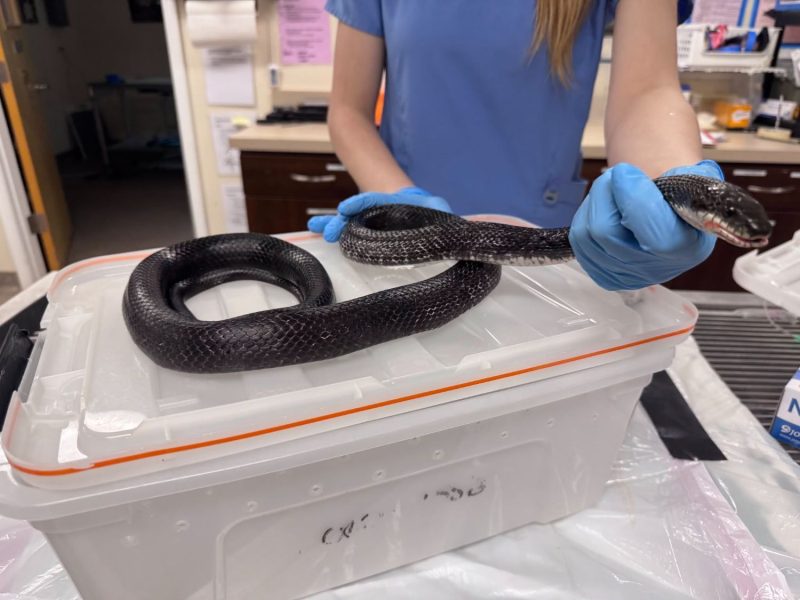
After the eggs were removed, this patient recovered well from the procedure, although he was understandably disappointed to lose the meal he thought he had found!
If you keep backyard chickens, there are simple ways to prevent tragedies like this:
- Secure your coop. Regularly inspect it for gaps and use ½-inch wire mesh to prevent snakes and other predators from entering. A secure coop protects both your chickens and local wildlife.
- Avoid using single ceramic eggs. If you use ceramic eggs to encourage laying or discourage hens from eating their own eggs, glue three together into a cluster so they cannot be swallowed.
- Or consider using a hard-boiled egg instead. Mark it clearly and replace it periodically. Unlike ceramic eggs, hard-boiled eggs can be safely digested if accidentally eaten by a snake.
We’d like to thank the finder who recognized the problem immediately and ensured this patient received prompt medical care! Their quick action spared this snake from a much more painful outcome, and we hope to return him to the wild very soon.

Looking for an easy way to help native wildlife? Become a monthly BRWC donor! For as little as $5/month, you can provide year-round, sustainable support that helps us fulfill our mission.




GOP Senate Hopefuls Face Long Odds in Race to Challenge Mark Warner

John G. Pennell (1941 – 2026)

Kid Saturday Brings Water Games and Family Fun to Bentonville

Christman Wood to Perform July 16 at Gazebo Gatherings

SCC Considers Making Data Centers Shoulder More of the Cost of Transmission Lines

Strawberry and Rhubarb Frozen Dessert Offers a Cool Taste of Summer

Doing Business by Sail: When an Order Took a Year

Annexation From 1997 Resurfaces at Town Council Work Session

Cardinals Host New Market Rebels Tueday, July 14 at Bing Crosby Stadium – Make Up Game

Warren County High School Prepares for New School Year with Community Events, Student Opportunities

Blue Ridge Wildlife Center Patient of the Week: Central Ratsnake

Wolford v. Lopez Rightly Arms Permit Holders, Business Owners

“Into the Vault” Card Show to Be Held at Warren County High School

Cash App Parent Company to Pay $45 Million in Multistate Fraud Settlement, Virginia AG Says

Virginia Joins Rooftop Solar Initiative to Help Residents Trim Electric Bills

Don’t Bet Against Virginia — But Don’t Coast on a #3 CNBC Ranking Either

Welcome Home: Getting Settled in Front Royal and Warren County

One Test of Working Fitness

Warren Heritage Society Opens Exhibit on Little League and Baseball History
Constitution 101: Bankruptcy Clause

Feds Launch Groundbreaking Electric Plane Pilot Program in Virginia

Lieutenant Colonel (Retired) Jeffrey Stephen “Steve” Willis

Cardinals Host New Market Rebels Wednesday, July 15 at Bing Crosby Stadium

Callais is a Great Decision for Freedom — Including Education Freedom
