
Crime/Court
Juvenile murder case certified to Circuit Court Grand Jury
At the end of a 3-1/2 hour probable cause hearing on Thursday, May 25, the murder case against a juvenile accused of killing his girlfriend on March 25 in Front Royal was certified to the Circuit Court Grand Jury. That jury convenes on June 5. While the Probable Cause Hearing in Juvenile Court was open to the public, reporters were cautioned against YET releasing the now 18-year-old suspect’s name because he is still technically charged as a juvenile.

Leah Adams, dead at 19. Social media photo
Juvenile Court Judge Kimberly Athey heard testimony from 12 witnesses, either police officers or eyewitnesses to what transpired on Kerfoot Avenue shortly after 8:30 p.m. on a Friday evening. Those witnesses painted an ugly picture of a suspect thrown into acute paranoia after ingesting LSD, a psychotropic drug, and deciding to flee 19-year-old Leah Adams’ Cherrydale Avenue home in her vehicle.
Adams attempt to regain control of her car after it struck a parked car on Cherrydale, while being driven without lights on, ended about 3 blocks away. The suspect later told investigators that Adams threw the car into park from the passenger seat, stopping it mid way on the 100 block of Kerfoot.

After the car came to a stop on Kerfoot, Adams exited the passenger side, circled behind to the driver’s side and attempted to take the driver’s seat. Witnesses described the car accelerating with Adams hanging out of the driver’s side with her feet being drug along the street. When the car lurched right, knocking over two mailboxes, Adams fell into the street fatally wounded. She rose screaming for her life – “HELP ME! HELP ME! GOD HELP ME” before collapsing at a driveway at 104 Kerfoot. Residents, including a nurse and off-duty town policeman, assisted her until EMT units arrived.

Looking north on Kerfoot Avenue where Adams’ attempt to regain control of her car from her drug-addled boyfriend ended. Photos/Roger Bianchini
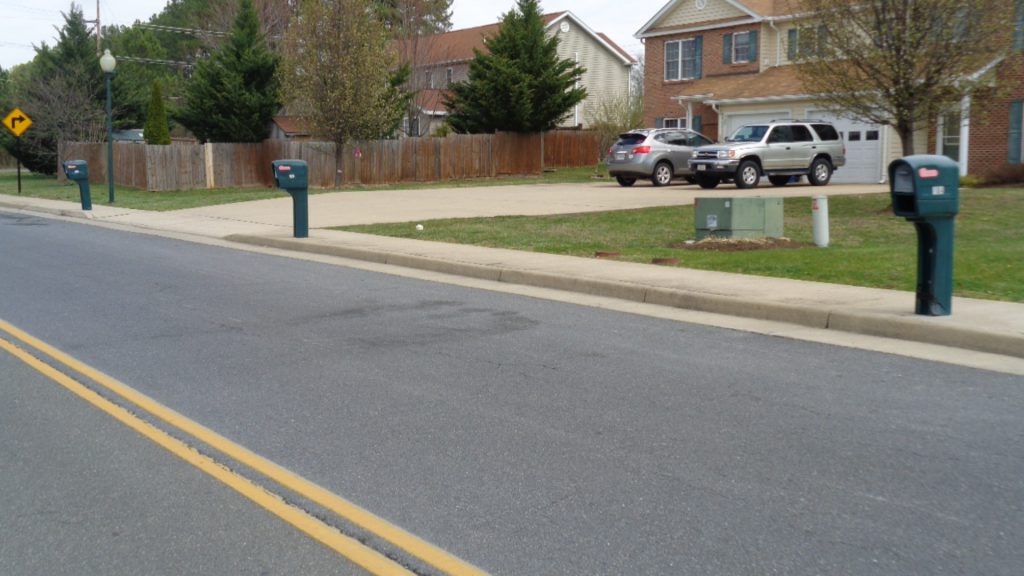
One of those residents had been outside working on his car and began running to assist Adams. He testified emotionally that as Adams walked toward him, she said three times, “Please help me,” before falling silent.
During cross examination by the defense team of David Hensley and Beau Bassler, the off-duty FRPD officer who lived on Kerfoot and aided in Adams’ initial assistance described the scene before EMT’s arrived.

“Did she speak to you?”
“She was unable to speak at that time,” he replied. He described her breathing as “very shallow”. Asked what he meant, he said, “She took a deep breath every five to 10 seconds.”
“Did you speak to her?”
“Yes.”

“What did you say to her?”
“I told her to stay with us.”
Multiple witnesses have expressed the belief Adams was dead before she was transported from the scene. She was pronounced dead on arrival at Warren Memorial Hospital some 15 blocks away.
The murder weapon was described as a spring-assisted folding knife found in the center console of Adams car, which was abandoned nearby on West Main Street. Testimony indicated Adams died of two stab wounds to her upper chest.

Investigators testified the suspect alternately told them he didn’t remember stabbing Adams; that he didn’t stab her; or that it was an accident. He was discovered about a block away near South Shenandoah Avenue where several witnesses say he asked them if they had a pistol and if they would kill him.
The suspect was apprehended following a confrontation with a Sheriff’s deputy and off-duty town officer during which he was described “acting crazy” with a masonry brick in his hand. Two more FRPD officers arrived, one with a gun drawn, the other with a taser. Hit with a flashlight the suspect was described as having a “deer in the headlight look” at which point he dropped the brick. The off-duty officer who had been engaged with him for some time was then able to take him to the ground at which time he was apprehended.
Several officers who interviewed or were present with the suspect the evening of the murder at WMH, said the suspect repeatedly asked, “Is she dead?” or “Is she really dead?” Asked about his reaction to the repeated information that Adams, whose body was initially in an adjacent hospital room, was dead, multiple officers described the suspect as variously emotionless, not remorseful and even at times laughing.
It was a very different description from witnesses who encountered the suspect in the immediate aftermath of the incident before he knew the end result of what had just transpired on Kerfoot Avenue.

“Someone shoot me – kill me, kill me!!!” he was heard yelling.
One woman testified that when she, her husband and sister went to their door in response to a commotion outside, they found the suspect at the open door of her car. “Can I help you?” she asked.
“Do you have a pistol?” the defendant replied.
“No,” she responded.
“Then you can’t help me.”




Your Next Cereal Spoon Might Be Part of Breakfast

Front Royal Cardinals Host Staunton Braves – June 18

Smart Connectivity Is Changing the Future of Boating

Moving Day: Tips for Keeping Your Pet Comfortable

Simple Changes Can Help Older Adults Stay Independent at Home

Trump Administration Touts May Job Growth, New Investments in Weekly Briefing

Front Royal’s Monthly Through November ‘Vintage Market’ Event Attracts Shoppers Despite Light Rain Intrusion

Does Your Teen or College Student Need to File Taxes?

Building a Rental Property Can Offer Investors More Control and Long-Term Value

Fair Estate Planning Can Help Prevent Family Disputes

Chelsea Academy Announces Summer Sports, Academic, and Activity Camps

VA250 Mobile Museum Experience Coming to Front Royal June 18-21

Trump Touts Farm Policies, Trade, and Rural Priorities During Wisconsin Visit

US Senate Blocks Trump’s SAVE America Act, Thwarting Restrictions on Voting

The Ocean Is Fighting Back

Simple Ways to Personalize a Father’s Day Card

Careful Planning Helps Keep Livestock Safe During Transport

The People’s Power Begins with the Ballot
Front Royal Cardinals Host Woodstock River Bandits, Sunday – June 7

New Economic Development Director Shares Modus Operandi At Joint Town Council and Board of Supervisors Work Session

Topography Complicates Automobile Graveyard Application at Town Planning Commission Work Session

VDOT: Warren County Traffic Alert for June 8 – 12, 2026

Virginia State Police Report Firearms, Narcotics Seizures in Weekly Crime Suppression Operations

Warren County APS Urges Residents to Watch for Elder Abuse, Financial Scams
