
Local News
“A Date Which Will Live in Infamy”: Remembering the Attack on Pearl Harbor, December 7, 1941
On the morning of December 7, 1941, the skies over Pearl Harbor, Hawaii, filled with the roar of Japanese fighter planes. The surprise military strike by the Empire of Japan shattered the calm of a Sunday morning and changed the course of history.
In just under two hours, the attack killed 2,403 Americans, wounded over 1,100 more, and sank or damaged 21 U.S. Navy ships, including eight battleships. The devastation reached far beyond Hawaii—it jolted a nation and marked the United States’ official entry into World War II.
President Franklin D. Roosevelt, addressing Congress the following day, called it “a date which will live in infamy.” That phrase has since become a solemn reminder of the day the U.S. homeland was attacked without warning.
The Attack
At exactly 7:48 a.m. Hawaiian time, the first wave of Japanese aircraft descended on the U.S. naval base at Pearl Harbor. A total of 353 Japanese planes, launched from six aircraft carriers, struck in two waves. Torpedo bombers, dive bombers, and fighter planes targeted battleships, airfields, and military infrastructure in a carefully coordinated assault.

The USS Arizona (BB-39) burning after the Japanese attack on Pearl Harbor, 7 December 1941. USS Arizona was sunk at Pearl Harbor. The ship is resting on the harbor bottom. The supporting structure of the forward tripod mast has collapsed after the forward magazine exploded.
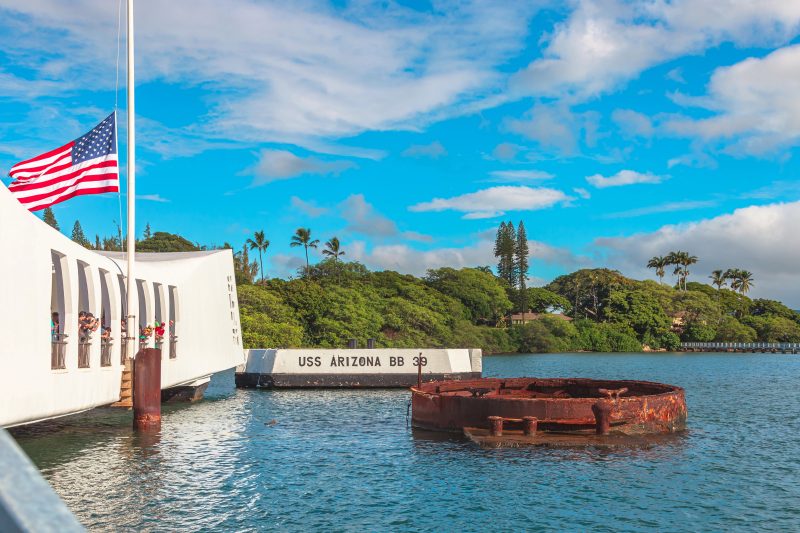
USS Arizona Memorial at Pearl Harbor
The Japanese military referred to the mission as Operation Z, part of a broader strategy to secure dominance in the Pacific. Japan’s goal was to eliminate the U.S. Pacific Fleet as a threat while advancing into territories in Southeast Asia, including the Philippines, Guam, Malaya, and the Dutch East Indies, rich in oil and other resources vital to Japan’s war effort.
Despite the scale of the attack, three U.S. aircraft carriers—USS Enterprise, USS Lexington, and USS Saratoga—were out at sea and survived. Many base facilities, such as oil storage tanks and repair yards, were also left untouched. These oversights would prove critical in the U.S. Navy’s recovery and ability to strike back in the months that followed.
A Nation Transformed
Before the attack on Pearl Harbor, the United States had remained officially neutral, though tensions with Japan were high. Japan had invaded China and taken control of French Indochina, prompting the U.S. to impose sanctions, freeze Japanese assets, and halt oil exports.
While negotiations were underway, Japan was simultaneously preparing for war. Its attack on Pearl Harbor, though intended as a quick strike to weaken the U.S. and force a peace settlement, had the opposite effect. The very next day, December 8, 1941, Congress declared war on Japan with near-unanimous support. Just days later, Germany and Italy declared war on the U.S., and the United States found itself fully engaged in World War II.
Across the country, Americans rallied. Enlistments surged, war production ramped up, and unity became the nation’s strength. For the young men and women of the time, Pearl Harbor marked the end of peace and the beginning of sacrifice.
The Human Cost
Among the ships hit hardest was the USS Arizona, where 1,177 sailors and Marines lost their lives. The ship remains submerged in the harbor to this day, now a national memorial and final resting place for many who perished.
In total, the attack claimed the lives of 2,403 Americans, including civilians, and wounded 1,178. The Japanese lost 29 aircraft, five midget submarines, and 130 personnel—a small cost compared to the destruction inflicted.
The attack also devastated over 180 American aircraft, many destroyed before they ever left the ground.
Why We Remember
For today’s generations, December 7 serves as more than a history lesson. It is a powerful reminder of the cost of freedom, the dangers of complacency, and the resilience of a nation in crisis. It honors the bravery of those who fought back, the civilians who answered the call, and the lives lost in a moment that shook the world.
Across the country, Pearl Harbor Remembrance Day is marked each year with solemn ceremonies, flag tributes, and moments of silence. Survivors are now few, but their stories—and the sacrifices of their fallen comrades—live on.
As we reflect on this solemn anniversary, let us remember that peace is never guaranteed, and history must never be forgotten.