
State News
After Bills Passed, NoVa Lawmakers Urge SCC to Consider Burying Transmission Lines
Two legislators representing a sprawling county in the northern region of the commonwealth asked the State Corporation Commission last week to consider burying high-voltage transmission lines, after bills that would initiate a pilot program for the proposed lines passed the General Assembly.
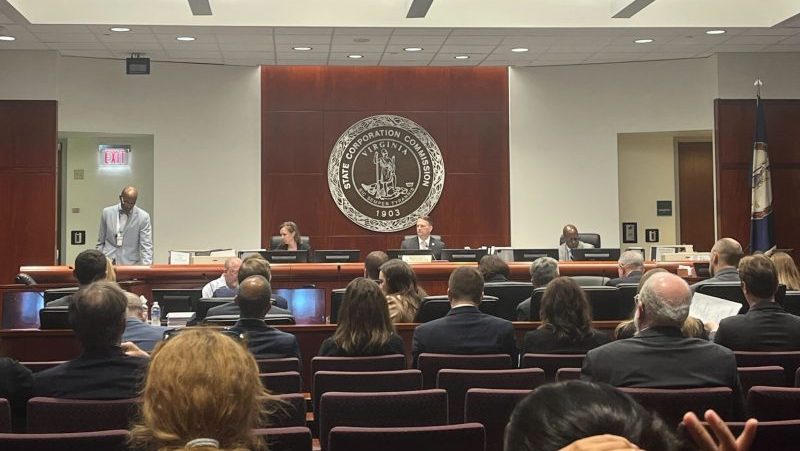
Virginia State Corporation Commission members hear testimony concerning Dominion Energy’s proposed rate increase and plan to create a new rate class for data centers on September 2, 2025, in Richmond. (Photo by Shannon Heckt/Virginia Mercury)
Ashburn residents in Loudoun County are waiting for state regulators’ final decision on which route will be used for the 500-kilovolt transmission lines in the project, dubbed Golden to Mars.
Democratic state Sen. Kannan Srinivasan and Del. JJ Singh, who both represent Loudoun, submitted testimony in the original Golden to Mars SCC hearing. In their most recent letter, they acknowledged the lines are necessary for energy reliability, but said community health, safety, and quality of life should be prioritized — a goal they think could be accomplished by burying the lines.
“The legislation passed by the General Assembly reflects the General Assembly’s recognition that innovative approaches—including hybrid solutions that incorporate underground transmission where feasible—should be seriously considered when evaluating projects of this magnitude,” the letter read.
Project background
The Golden to Mars project by Dominion Energy is the final piece of the “reliability loop” of energy sources in Ashburn, just outside a major cluster of data centers. The project is critical to bring energy to the power-hungry facilities, Dominion has said, and to complete the connection of multiple substations that is already two-thirds approved and under construction.
If the Golden to Mars portion of the loop is not completed, the utility has warned, existing infrastructure could be damaged and penalties for violations could be levied by the regional grid operator PJM.
There has been fierce community opposition to all of the proposed routes. The Loudoun County School Board has also rejected proposals for the transmission lines to be placed on school properties; some of the originally proposed routes would cross near Rock Ridge High School and Rosa Lee Carter Elementary School.
Homeowners in the nearby Loudoun Valley Estates neighborhoods are worried about diminishing property values, health risks, and potential loss of their land due to the proposed routes cutting close to their properties.
With these limitations posed by the county and school board, two routes are still viable in the plan, 1F and 3a, according to Dominion. Community members have urged the SCC to order at least portions of the lines to be buried underground to mitigate many of their concerns.
A feasibility study by Dominion found that it would be much too expensive to bury the lines, the utility reported. But Loudoun officials had their own study conducted that concluded it could be feasible to bury parts of the lines, even with the financial challenges.
The SCC will ultimately determine whether it would be within the public’s interest and financially reasonable to move forward with the project and bury the lines.
Legislators take action
The General Assembly passed two bills from Srinivasan and Singh, which, if signed into law by Gov. Abigail Spanberger, would set up a pilot program to allow the SCC to identify four qualifying transmission projects to be buried, which could include Golden to Mars.
The proposed pilot program allows the additional cost of undergrounding 500kV transmission lines — compared to keeping them overhead — to be shared with the locality where the project is built.
The locality would have to pass a resolution that agrees with paying 50% of the cost, with caps on how much of an increase in energy taxes can be placed on residential customers. The allocation of the other portion of the cost would be subject to SCC review and recommendation.
A final order in this case is anticipated in the coming days or weeks. The passed legislation would not be available to the commission to implement if not signed by the governor.
by Shannon Heckt, Virginia Mercury
Virginia Mercury is part of States Newsroom, a nonprofit news network supported by grants and a coalition of donors as a 501c(3) public charity. Virginia Mercury maintains editorial independence. Contact Editor Samantha Willis for questions: info@virginiamercury.com.

AI Tools Could Give Phishing Scammers a New Advantage

Cline Targets Virginia Policies in New Immigration Enforcement Bill

Seconds That Saved a Life: Chester Gap First Responders Show Value of Rural Coverage

Spanberger Creates New Cabinet Position, Appoints SELC’s Josephus Allmond Chief Energy Officer

Debra M. Wolford (1958 – 2026)

Vacant Lots on Grand Avenue Keep Their R-1 Designation at Town Council Meeting

Redistricting, Legislative Issues Discussed at GOP Gathering

Front Royal Welcomes New Wellness Studio Focused on Mind, Body, and Community

On 16th Anniversary of Affordable Care Act, Virginia’s Federal Lawmakers and Health Leaders Weigh Risks

Your Age Shouldn’t Stop You From Changing Careers

World Cheese Day Celebrates One of the World’s Favorite Foods

Blue Ridge Wildlife Center Patient of the Week: Mourning Dove

POLICE: 7 Day FRPD Arrest Report 3/23/2026

Documentary Screening at Laurel Ridge Highlights Hidden Struggle of Student Hunger

US Senate Confirms Mullin as Next Homeland Security Boss

Dominion Produces First Power From Coastal Virginia Offshore Wind Project

Rebecca Joy Knight Pucher (1953 – 2026)
Clarence Patrick “Stinker” “Wooley” Deavers (1957 – 2026)

Four Weeks Before April 21 Referendum, Early Voting Shows Stronger Turnout in GOP-Leaning Areas

After Bills Passed, NoVa Lawmakers Urge SCC to Consider Burying Transmission Lines

Next Generation of Conservation Leaders Selected for Shenandoah Valley Fellowship

Using an Exfoliant to Care for Your Skin: Beneficial at Any Age

Airport Chaos: TSA Agents Skip Work, Security Lines Expand, Trump Sends in ICE to Assist

Spotlight on Beekeeping: The Sweet Work Behind Honey
