
State News
America’s 250th Birthday Prompts Rethinking of Historical Markers
Most Revolutionary War history buffs know the story of Francis Marion, the Continental Army officer called the Swamp Fox for his guerrilla-style attacks that bedeviled British forces in South Carolina’s backcountry. But volunteers and historians have identified 560 Revolutionary War battle sites and other places of interest with connections to the state’s role in the nation’s founding.
“While we all love Francis Marion, let’s talk about some other people,” said Molly Fortune, executive director of SC250, the commission charged with restoring the public memory of the state’s Revolutionary War legacy. To do that, they’re reviving forgotten historical markers as well as installing new ones and making them all easier to find from the highway or online.
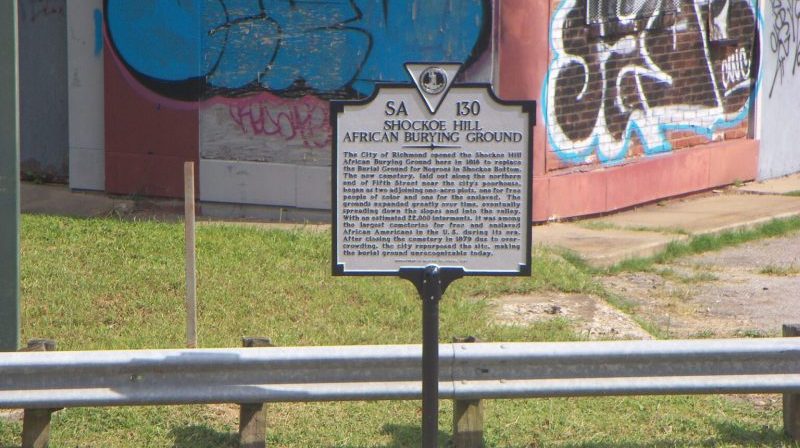
A state historic marker installed in 2023 now identifies the Shockoe Hill African Burying Ground, where over 20,000 formerly enslaved and free Black people are believed to be buried. (Lenora McQueen)
As the United States prepares to commemorate the 250th anniversary of the Declaration of Independence in 2026, many states are inventorying, mapping and repairing old historical markers, as well as installing hundreds of new roadside signs, plaques and interpretive panels. In South Carolina, the focus is on sharing lesser-known stories of women, children, Native Americans, enslaved and free Black people and even the Loyalists who sympathized with King George III.

Beyond re-engaging with lesser-known stories, many states see the national commemoration, known as America250, as an opportunity to refresh their heritage tourism offerings. But it’s also an occasion to reexamine markers or monuments with questionable historical facts or outdated language.
The Virginia American Revolution 250 Commission (VA250) was established in 2020 and enshrined in the state’s legislative branch by the General Assembly in 2023 to “commemorate the 250th anniversary of the American Revolution, the Revolutionary War, and the independence of the United States.” In addition to the state’s Department of Historic Resources recently unveiling new markers that represent a more diverse historic narrative, the VA250 commission and its mission have inspired several localities to establish local historic markers that spotlight people and places in Virginia that are significant to America’s origin story. Last month, the Northampton Board of Supervisors “adopted a new Historical Local Marker Program (LMP) in collaboration with the Virginia 250 Celebration,” Shore Daily News reported Dec. 11.
The commission — whose chair is Del. Terry Austin, R-Botetourt County, co-chair is Sen. Mamie Locke, D-Hampton, and national honorary chair is Carly Fiorina — is composed of over 30 Virginians including legislators, historians, representatives of educational institutions and others. The group works under the theme “To form a more perfect union.”
In 2023, the commission hosted the first event in America tied to the nation’s official semiquincentennial celebration, unveiled a VA250 exhibition in the State Capitol, spurred the creation of Local VA250 Committees in nearly every locality statewide and held four full commission meetings, according to its annual report, among other achievements. Citizens who would like to learn more about their local VA250 committee may find more information here.

The commission is hosting a series of signature events through July 2026. The next one will be a commemoration of the 250th anniversary of the Fincastle Resolutions, “A Salute to Southwest Virginia,” at the O. Winston Link & Roanoke History Museum on Jan. 18. The VA250 Mobile Museum Experience will launch on the same day. Find the full list of signature events here, check out this interactive map to find out which events and activities are available in your area, and visit this page to learn about volunteer opportunities. — Samantha Willis, Virginia Mercury editor-in-chief
The renewed interest in the accuracy or cultural sensitivity of the nation’s historical markers is part of the wider discourse over who or what belongs on a pedestal or a bronze plaque, and where they should be sited. Since the 2020 murder of George Floyd, those efforts have led to the removal of Confederate monuments as well as the toppling of statues honoring Christopher Columbus and artwork that extols westward expansion without telling the story of the effects on the Indigenous people displaced by settlement.
Markers that reflect more inclusive stories make history relevant to more people, said Jason Hanson, the chief creative officer of History Colorado, which operates museums around the state and administers Colorado’s register of historic places. When history is incomplete or told only by those with the money or power, it strips complexity and nuance from the American story, rendering it less accurate and vibrant. The roadside panels and bronze plaques affixed to buildings are how many people encounter the nation’s history, Hanson said.
“They really are some of the most accessible and valued history lessons that we have,” he said.

Satanic imps
That history can be lopsided, inaccurate or racist, according to an NPR investigation in 2024 that looked at 180,000 historical markers across the nation. For example, the investigation found that about 70% of markers for historic plantation homes failed to mention that its owners bought and sold enslaved people and used their labor to construct the mansions.
Among the problematic examples NPR found was a Michigan marker celebrating a woman who “successfully defied frenzied Indians who invaded the premises and lapped from the basement floor whiskey which she had emptied from the barrels.” In Texas, a marker praises Primus Kelly, an enslaved Black man, for demonstrating loyalty during the Civil War — describing him as “typical of most Texas Negro slaves. Hundreds ‘went to war’ with their masters.”
Many markers, especially those installed by private individuals, stretch the definition of “history.” A Massachusetts marker, for example, indicates the former site of a mill operated by a wizard who employed satanic imps to run it at night, while a sign in New Hampshire marks the spot where a Portsmouth couple had a close encounter with a UFO in 1961 — and experienced two hours of “lost time.”
In Colorado, the state found recently that 96% of listings on its state register of historical sites were places connected primarily to the history of white men, Hanson said. To mark the state’s 150th anniversary in 2026, Colorado will begin adding 150 new sites and markers highlighting the history of women, people of color, LGBTQ+ people and other historically underrepresented communities. The state will ask community groups to nominate who and what should be on the markers.

Markers or monuments often were paid for by people who wanted to tell a particular story, meaning that those with money were the only ones leaving a lasting mark. Even now, historical markers are expensive. In Michigan, for example, large markers cost $4,700, before installation. Some states appropriate money for new markers, but often, local communities must find the cash.
But an investment in heritage tourism can and does pay off, said South Carolina’s Fortune. She and other public historians have persuaded their state legislature not only to fund new markers but also to pay for new highway signs alerting visitors to historic sites. It’s an effort she says boosts the rural communities where many markers are located.
“People want to walk and listen and hear and connect with their ancestors,” Fortune said. “And so it allows us to find those accidental tourists. They’re like, ‘Oh, I’ve always wondered about that.’ And then they leave their money, and they go home. That’s basically it. It’s a vehicle for economic development.”
‘The whole story’
In 2023, Virginia’s Department of Historic Resources began adding dozens of historical markers signifying Green Book sites, places that accommodated Black travelers safely during the Jim Crow era. They’re also adding nine new markers that, among other things, tell the origin story of Mountain Dew soda, the discriminatory racial history of the first heart transplant in the state, and the backstory of lesser-known Virginians who participated in the Lewis and Clark expedition.

The Washington State Historical Society began taking a closer look at its markers in 2020, identifying 42 as potentially problematic. Most commemorate white settlement and were placed by a handful of individuals who “just decided that these were the places that they were going to put monuments up,” said Dylan High, the statewide partnerships coordinator for the agency.
In recent months, the historical society has hosted public meetings to examine how the markers portray the history of westward expansion. Among those under review is a 1925 marker with a statement asserting that the “civilization of Washington started at Vancouver,” the site of an 1806 fort on the Columbia River for the Lewis and Clark expedition, and a subsequent Hudson’s Bay Company fur trading post.
Such statements erase the presence of Indigenous people who lived in the area for thousands of years before the arrival of European explorers. The narratives weren’t created in consultation with tribal people of the land, said Polly Olsen, who is Yakama and the tribal liaison for the Burke Museum in Seattle. It comes from a settler narrative of “the first schools, the first church, these civilized practices or, you know, ‘civilization began here,’” Olsen said in an interview with KIRO Newsradio.
As they’ve traveled the state of Washington, High said, they’ve found that most people don’t want old markers removed. Sometimes, it’s impractical: The Vancouver marker sits in a traffic island, unnoticed by most passersby, and would be costly to move. Instead, High said, people want to add new interpretive panels or new markers nearby to tell “the whole story of the history.” Most people are wary of anything that seems as though it is “rewriting history,” a phrase the state agency tries to avoid.
“That kind of implies that the history of what happened somehow is somehow changed,” High said. “What we are really interested in saying is that there is more to the context of that history of what happened than just what that monument represents or implies.”
“And to be very specific about it,” High added, “what is not represented is very often the tribe’s perspective and the experience of our tribal communities around the state.”
Sometimes, states must point out hard truths, Fortune said. She points to Henry Laurens, a wealthy South Carolinian planter who was president of the Continental Congress in 1777 and 1778 and the only American to be held captive in the Tower of London. He was also a partner in a Charleston firm that brokered the sale of more than 8,000 enslaved Africans.
“We’re in the business of telling history the way it was,” Fortune said. “So it can be good, bad and ugly. Henry Laurens owned slaves. That’s just a fact. Just say it’s a fact.”
This story originally appeared in Stateline, a nonprofit newsroom which, like The Virginia Mercury, is part of States Newsroom.
by Erika Bolstad, Virginia Mercury
Virginia Mercury is part of States Newsroom, a nonprofit news network supported by grants and a coalition of donors as a 501c(3) public charity. Virginia Mercury maintains editorial independence. Contact Editor Samantha Willis for questions: info@virginiamercury.com.




This Week’s Showtimes at Royal Cinemas as of October 9th

Samuels Public Library to Expand ‘Library of Things’ With $2,000 Grant

Ask Stewart: Why Do Leaves Turn Different Colors in the Fall?

After Statewide Tour, Virginia Lt. Gov. Hashmi Officially Opposes Dominion-NextEra Merger

Virginia Republicans Urge Spanberger to Call Special Session for Fuel-Tax Holiday

Kratom, 7-OH Laws Diverge Amid the Spread of Potent Synthetic Products

WCHS vs. Manassas Park – Varsity Football – October 9, 2026

A Golf Hazard With an Appetite

Lantern Tours Bring Stories Of New Market Battlefield To Life Oct. 24

Pork And Apples Have A Long-Standing Romance

Israel from Saul to Rome

Front Royal Council Weighs ACES Role, Cannabis Rules and Riverton Sewer Project

Bob Cullers To Share Family’s Civil War Story at Warren Rifles Museum

Bruce Rappaport Seeks Second Term, Calls for Smart Growth and Protection of Front Royal’s Character

I-81 South Lane Closure Near Staunton Tuesday Night Through Wednesday Morning

Festival of Leaves, Not Just a Festival
What Will We Do with What We Know?

Blue Ridge Wildlife Center Patient of the Week: Barred Owl

POLICE: 7 Day FRPD Arrest Report 10/5/2026

William Robert Swiger (1939 – 2026)

Hilda Foster Cornwell (1934 – 2026)

Workforce Training Program Earns Another No.1 Ranking for Virginia

Virginia Board of Education Reinstates Adult Education Advisory Committee After 3 Years

WCHS vs. Skyline HS – Girls Volleyball – October 8, 2026
