
Local News
Army Security Agency Veterans Enjoy Fellowship at Monthly Luncheons
The history of Military Intelligence in this country originates during the American Revolutionary War with spies, scouts, informants, and such. Since then, technology has dictated just how intelligence on the enemy is collected, where today, spy satellites are used extensively – in addition to the continued use of “spies, scouts, and informants.”
Over the years, the U.S. Army Security Agency (ASA) was a very significant player for the nation in collecting intelligence on actual and potential adversaries by intercepting radio signals. The ASA existed between 1945 and 1977 and was the successor to the Army Signals Intelligence Service/Agency, with operations that date to World War I. Initially, this involved the interception of radio transmissions used by enemy forces communicating, sometimes by happenstance, but this capability evolved to very sophisticated collection means as technology improved, to include virtually all types of electronic signals.

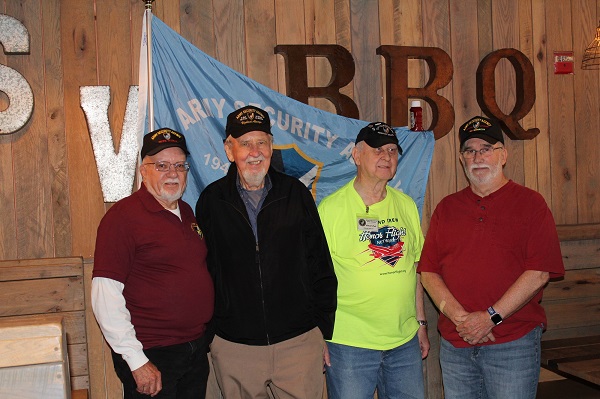
Army Security Veterans lunch together at Mission BBQ in Winchester on Friday, November 3, 2023. L to R: George Trogner, Harry Newman, John Dick, Ken Noffke, Rodney Cowley, Karen Terry, Dick Henson, Ernest Puls, Tom Thompson, Jim Tillery, Richard Terry, John Campbell, Mark Gunderman, Mike Thompson, Gary Leopold, Bill Campbell, Bill Jacobson, and Dick Cook. Courtesy Harry Newman.
Tens of thousands of ASA soldiers have been employed over the years to conduct these operations, playing a significant role in WW I, WW II, the Korean Conflict, and Vietnam, and during peace time, significantly contributing to the winning of the Cold War. Following WW II (with compelling contributions to the breaking of German and Japanese communications codes), the Army established a direct link between the Army Security Agency (ASA) with the newly created National Security Agency (NSA) when it was created in 1952. Note also, that the Navy and Air Force later developed their own “signal interception” capabilities and organizations.
With an Army Intelligence reorganization, the ASA was integrated into the U.S. Army Intelligence and Security Command (INSCOM) organization in December 1976. While the ASA disappeared as an organization beginning in 1977, there continued to be “some” ASA designated units as the reorganization was completed. And today, there remain many Veterans still alive and well (mostly) throughout the country that chose to identify as proud “ASA Veterans.”
The comradery of this group of men and women is strong. Much of what they did over the years serving our country was highly classified but is now declassified, at least in part, and they are now able to discuss some of what they did and are reconnecting with fellow service members. This is therapeutic in many ways, especially for those of the Vietnam era, never welcomed home and never able to discuss the very highly classified work they performed for our nation. Now all should be recognized for what they accomplished, and not just in Vietnam. Note that during Vietnam, the ASA units had the “cover name” of Radio Research units, and all major tactical units were assigned such support – technically, ASA was “Never officially in Vietnam,” however, ASA was the first into Vietnam and among the last to leave. During ASA’s 12-year tour of service there, ASA units were awarded more than 120 U.S. decorations and 60 foreign citations.
The United States military is truly a brotherhood and sisterhood. Because military men and women are required to make sacrifices well beyond anything expected of their civilian counterparts, it is understood that the friendships established may also be much stronger. The reality is that the needs of the armed services come first, and personnel change duty locations at the direction of the military. During an individual’s time in the service, there are always fellow military members to rely on for support. Military families have a unique understanding of the challenges and can relate in ways that civilian support systems cannot.
Those who serve together form a common sense of purpose and devotion to duty. These military friendships last forever. But when people leave the military, they often lose touch with those dear old friends.
Harry Newman, Bob Chase, Ernest Puls, and Bill Jacobson provided brief biographies of their time served in the Army Security Agency. Courtesy Harry Newman.
Across the country, groups of these Veterans are gathering, to the benefit of the individuals wanting to reconnect with fellow members of the ASA of years past. These groups include those that made a career in the military, those that served their four years and returned to civilian life, and both enlisted and officer ranks. One such group is the Winchester/Northern Virginia ASA Luncheon Group that meets for lunch once per month.
Pre-COVID, fellow ASA members, Bill (“Jake”) Jacobson (residing near Leesburg) and Harry Newman (Stephens City) connected via an ASA Facebook Group, the National Army Security Agency Association (NASAA), and met for lunch one day. During discussions, it was realized that many more ASA Veterans were probably located in the area, and they needed to get together. So, it was decided that they would try to organize a monthly gathering, a lunch, perhaps. A notice was put out on the NASAA Facebook Group, and it was astounding how many of this relatively unheralded group of Veterans responded and joined the luncheons.
Today, there are 38 members that periodically join for lunch, sometimes five, sometimes as many as 18, depending on individual schedules. More than simply getting together to “share war stories,” these gatherings have more to do with demonstrating the bond of this mostly obscure group of intelligence professionals with a “shared CLASSIFIED experience and history,” that few outside of the military can understand.
Members of this lunch group include individuals exemplified by such as Jake Jacobson, living near Leesburg, VA. He was drafted in 1967 as a Private after a stint at Montana State College. After the “normal” battery of tests for new recruits to determine their strengths and aptitudes, Jacobson was offered (by a “special” recruiter) an opportunity to avoid the draft status by enlisting in the ASA for four years. Note that most recruiters of the time had no clue what the ASA’s mission was, because it was so classified. Enticed by the prospect of learning a marketable trade/skill, he joined, and following Basic Combat Training, Jacobson attended a lengthy school at Fort Devens, MA to learn and copy Morse Code along with Special Identification Techniques and radio direction finding.

In February 2019, former Army Security Agency (ASA) members Bill Jacobson and Harry Newman connected via an ASA Facebook Group, the National Army Security Agency Association (NASAA), and organized monthly luncheons that alternate between Smokin Willy BBQ in Purcellville and Mission BBQ in Winchester. Courtesy Bill Jacobson.
Although ASA was not technically in Vietnam, that is where he was deployed following school for the needs of the Army. Jacobson was assigned to a “Radio Research” unit (the cover name for ASA there! It was classified that ASA was in Vietnam, and all major tactical units were assigned such ASA support units) in the field intercepting low powered radio Morse Code and locating Viet Cong (VC) units. One had to be “close to the enemy “to hear the enemy.” Jacobson is remembered as mentioning that one day he and his team heard Vietnamese voices on the other side of a tree line as they were deploying and determined it was the very same VC they were intercepting at the time. He is fond of saying, “I’ve never had friends like the friends I had in Vietnam!”
Like the majority of Vietnam Veterans, Jacobson returned to the U.S. with virtually no recognition except from family and friends. Assigned to Fort Bragg, NC and then Vint Hill Farms, VA, he met his future wife and extended his enlistment two years until she graduated from Nursing school – of course, with the “needs of the Army” intervening, he was deployed to Germany and a border intelligence collection site for almost two years. Jacobson separated from the Army as a Specialist Fifth Class in 1973, and after getting married, he returned to Eastern Montana College (now Montana State University, Billings) for a teaching degree in 1976. He completed a 43-year teaching career in 2020. He is a member of the National ASA Association Board of Directors and continues to push for more recognition of these unheralded Army Intelligence warriors and bring together groups such as this lunch group. Further, Jacobson is actively involved in having an ASA memorial established at Arlington National Cemetery.
Another member of this lunch bunch is Robert (Bob) Chase, from Manassas, VA. Chase, a 17-year-old from Tennessee, enlisted for four years with the ASA in 1961 as a Private and became a Warrant Officer at age 24. His overseas assignments during 20 years in ASA included Vietnam (twice, plus several temporary assignments there), Thailand, the Philippines, and Germany. Those assignments in the U.S. include Fort Devens, MA; Fort Huachuca, AZ, Fort Hood, TX, Fork Polk, LA, Fort Bragg, NC, Fort Meade, MD, and Vint Hill Farms, VA. His experiences include being the duty officer at the Headquarters US Army Europe when terrorists detonated two 500 lb. car bombs at that compound that killed three soldiers. Chase married a German lady, and he became a Chief Warrant Officer at 25 years old, retiring as a Chief Warrant Three (CW 3) in 1981. Interestingly, his first beer as a new Warrant Officer at the officers’ club was bought by Charles Schulz (creator of Peanuts cartoons).
Ernest Puls, from Hanover, Maryland, enlisted in ASA in 1961 as a Private, retiring 23 years later as a Master Sergeant. Puls was a TV repairman, taking an electronics course when he enlisted, and the recruiter, when he saw his test scores, told him he had the perfect job for him. His 23 years with ASA repairing electronic equipment will attest to that! Following Basic Combat Training at Fort Jackson, he attended school at Fort Devens, MA, then on to Menwith Hill, England. There he met and married his wife and reenlisted (beginning that 23-year career). Returning from England, Puls was assigned to Vint Hill Farms, VA, followed by an unaccompanied tour in Sinop, Turkey. Afterward, Puls was sent back to Fort Devens for further schooling and became an instructor for a year. Then three years in Germany and four years at Fort Meade, MD. Then it was back to Turkey for a year, followed by an assignment to Fort Meade where Puls retired as a Master Sergeant and spent 17 years as a civilian DOD employee, and five years as a DOD Contractor at Fort Meade. Puls is also a member of an ASA lunch group in Maryland.
Harry Newman, from Stephens City, enlisted in ASA in 1966 as a Private, knowing nothing about ASA (or Army intelligence, for that matter) but was convinced by a recruiter that it would be interesting. As it turned out, this was so true. Newman signed up for school at Fort Devens, MA to become an Electronic Warfare specialist, decided to apply for Officer Candidate School (OCS), was accepted, and attended Infantry OCS at Fort Benning, GA. Following the Basic Officers Course at Fort Devens, he spent 18 months in Vietnam, mostly in the field as a platoon leader of an ASA unit supporting an Infantry brigade of the 4th Division. Newman was also assigned to the 5th Special Forces Group Airborne School, completing the course, and being awarded both the U.S. and Vietnamese jump wings. He returned to the U.S. in 1969 to Fort Bragg, NC, serving in the Airborne ASA battalion supporting the XVIII Airborne Corps, met his future wife, married her, and was reassigned to the Military Intelligence Advanced Officer Course at Fort Holabird, MD. Following this nine-month course, he was back to Fort Devens for ASA training and then to Mount Saint Mary’s College (Emmitsburg, MD), completing his undergraduate degree in Political Science under the Army’s Degree Completion Program. Afterward, Newman was assigned back to Fort Bragg to be an ASA Company Commander in the 82nd Airborne Division for 18 months. Newman has said this assignment, commanding a company of over 200 soldiers, was the best assignment he had in the Army.
Interestingly, demonstrating just how small the ASA community was and is, Newman’s First Sergeant, Charles W. Smith (Big Smithy, as he was called behind his back) was also the first Sergeant of a member of this lunch group, Jake Jacobson. Although the two missed being assigned together by a few months in the 1970’s, both have fond memories of Big Smithy. Newman remembers Smithy saying there was no way he would jump out of a perfectly good airplane, while never acknowledging that there was not a parachute harness large enough to fit him! He was 6’ 3” and over 320 pounds! But both Jake and Harry agree that there was never a finer first sergeant in the ASA.
Newman’s following assignments included Germany, as an intelligence analyst in a Joint Intelligence Fusion Center; Fort Sill, OK, as a Special Security Officer (SSO); South Korea as Chief of Intelligence in a Combat Support and Coordination Team supporting the First Republic of Korea Army, and multiple assignments in the Army’s Training and Doctrine Command. He also attended the Army Command and General Staff College (CGSC) while completing his Master’s Degree in Military Arts and Science in 1979. Newman served more than 20 years in the Army, retiring in 1986 as a Lieutenant Colonel. Retirement from the Army was followed by 15 years with a defense contractor. He continues to seek out those of ASA he served with over the years. As with Jacobson, Newman is a member of the National ASA Association Board of Directors and is also working to establish an ASA memorial at the Arlington National Cemetery.
The plan is to receive approval to establish an appropriate memorial within Alington National Cemetery (ANC) as agreed upon by the Secretary of the Army and ANC. At present, there are several dozen monuments and memorials, of various types and designs, that commemorate individuals, groups, military units, and battles.
While considered the Winchester/Northern Virginia Area ASA lunch bunch, ASA Veterans from Virginia Beach, Ashland, Richmond, Woodbridge, Front Royal, Manassas, Stanley, Emmitsburg, MD, Falling Waters, WVA, and even Fairfield, PA, have joined the group to share lunch and “stories from the past.” Friendships have been established, and in some cases, renewed – one of those, “I wondered what happened to you” moments.
The luncheon group meets the first Friday of each month at 11:30 a.m., alternating between Winchester’s Mission BBQ and the Purcellville’s Smokin Willy BBQ.
For more information regarding the monthly luncheons, and the ASA Memorial, contact Harry Newman at harry.newman@comcast.net or Bill Jacobson at wmjake01@gmail.com.

Business Growth Series: Why Good Businesses Still Struggle to Grow

Brownies with Mini Chocolate Easter Eggs

Shenandoah Downs Opens 11th Season April 11 with Tribute to Roger Hammer

We Don’t Know Everything About DNA

How PAAS Came to Dominate the Easter Egg Dye Tradition

Spanberger Signs Bipartisan School-Safety, Student Support Bills Into Law

Melanie J. Pomeroy (1958 – 2026)

David Benjamin Heller (1990 – 2026)

1776 Wasn’t Just About Independence

Three-Tiered System for Urban Agriculture Based on Lot Size Takes Shape at Town Planning Commission Work Session

Child Abuse Awareness Month Brings Focus to Reporting, Prevention in Warren County

National Dental Hygienists Week: Is Your Oral Care Routine Optimal?

The Coin That Traveled Through Time and Space

One “What If?” Question Is Changing the Future of Farming

AA Speaker to Explain Recovery Program at United Methodist Men’s Dinner
Jeannette M. Hyland (1944 – 2026)

Allen William Derflinger II (1959 – 2026)

Warehouse Clerk: A High-Demand Job—Even With Robots

FDA Cracking Down on Compounded GLP-1 Drugs

“Christmas in April” or Overspending? Budget Draws Criticism

Court Ruling Voids Prince William Data Center Rezoning, Raising Stakes for Local Debate

Spanberger Signs First Bills Targeting Healthcare, Housing and Energy Costs

Blue Ridge Singers Spring Concerts to Showcase Powerful Blend of Voices and Brass
What Counts as “Good Policy” Depends on Who’s in Power
