
Local News
Blue Ridge Wildlife Center Patient of the Week: Blue Jay
What is making these young birds sick?
This fledgling Blue Jay is one of dozens of sick birds we have admitted in the past couple of weeks with an unknown illness. This patient came in with its eyes swollen shut and showing discharge. Unfortunately, we don’t know what this illness is.
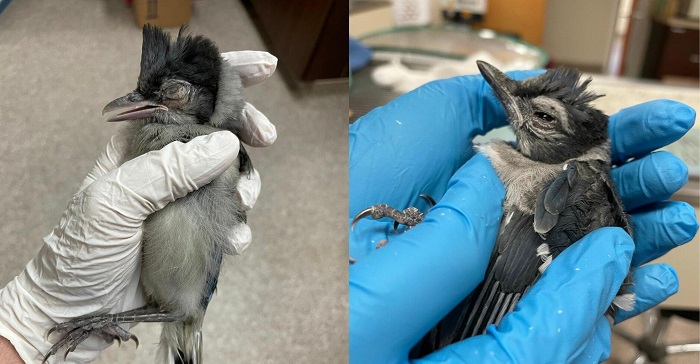
Photos courtesy of Blue Ridge Wildlife Center
What you need to know:
- Affected birds are most commonly blue jays, European starlings, and common grackle fledglings, though fledglings of other species have been seen in smaller numbers with similar signs. We have not yet seen this disease in adults.
- Affected birds most commonly appear like the blue jays pictured. Eyes are often shut, sometimes enlarged or showing discharge or reddening. Some affected birds have mild neurological signs (see the video below) while others are severely uncoordinated and stumbling or rolling. Birds may have neurological signs, eye issues, or both.
- Cases have been reported in our area and throughout northern Virginia, DC, Maryland, and many other states. We are working with multiple agencies searching for an answer. Until we know more our recommendation is to call the Center if you see a fledgling exhibiting signs.
- As we do not yet know if this is an environmental toxin or contagious disease, we strongly encourage you to wear gloves and a mask when containing these birds. We will recommend disposing of the container so don’t use anything you plan to keep. If you find a dead bird, please wear gloves and a mask and dispose of the bird in an outdoor trash can (ideally wrapped in a plastic bag) to avoid potentially exposing others to the disease.
This video shows the neurological signs in a young blue jay and grackle:

[spacer height=”10px”]Unfortunately, this disease appears to have 100% mortality. We did attempt treatment early on in the outbreak (as did other facilities) none with any significant success.
Given the data we have accumulated between centers, the lack of any treatment success, and the lack of knowledge of what is causing these signs and if they are communicable to other animals/humans, all of these fledglings are being euthanized on intake. This limits their suffering and the risk to other patients/staff/volunteers.
We know that not everyone is understanding of this and will choose not to bring these animals in when there is no chance of success. It is worth noting that these birds die on their own, very unpleasantly, in 24-48 hours if left in the wild. Also, leaving them in the wild could potentially expose others to the disease. We do recommend safely containing and bringing them in for care AFTER you have discussed the case with our staff and we have all determined that this is likely such a case.

4 Stimulating Activities for a Healthy Brain After 50

The First Amendment: America’s Unique Foundation of Freedom

How to Tackle Credit Card Debt

Summer Enrichment Camp Gives Teens Hands-On Learning Opportunities

VDOT: Warren County Traffic Alert for April 6 – 10, 2026

David Silek to Remain in Chairman’s Seat of WC Republican Committee Pending 6th District Appeal Decision

Sales Set to Bloom Like Daffodils This Spring

America 250: The Bookseller Who Helped Save the Revolution

Business Growth Series: Why Good Businesses Still Struggle to Grow

Brownies with Mini Chocolate Easter Eggs

Shenandoah Downs Opens 11th Season April 11 with Tribute to Roger Hammer

We Don’t Know Everything About DNA

How PAAS Came to Dominate the Easter Egg Dye Tradition

Spanberger Signs Bipartisan School-Safety, Student Support Bills Into Law

Melanie J. Pomeroy (1958 – 2026)

David Benjamin Heller (1990 – 2026)
1776 Wasn’t Just About Independence

Three-Tiered System for Urban Agriculture Based on Lot Size Takes Shape at Town Planning Commission Work Session

Child Abuse Awareness Month Brings Focus to Reporting, Prevention in Warren County

National Dental Hygienists Week: Is Your Oral Care Routine Optimal?

The Coin That Traveled Through Time and Space

One “What If?” Question Is Changing the Future of Farming

AA Speaker to Explain Recovery Program at United Methodist Men’s Dinner
Jeannette M. Hyland (1944 – 2026)
