
Local News
Blue Ridge Wildlife Center Patient of the Week: Eastern Screech Owl
This red-phase Eastern Screech Owl was found on the side of the road, likely after being struck by a vehicle. Fortunately, the finder acted quickly and brought the owl to us for evaluation.
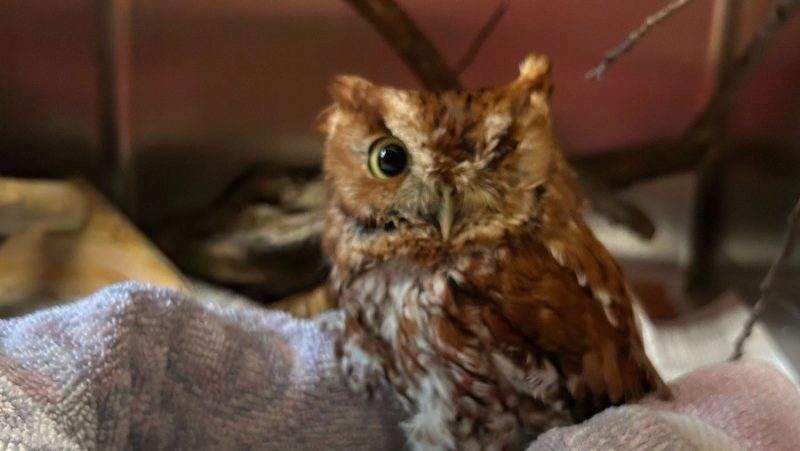
Upon examination, our veterinary team discovered that the owl had sustained injuries to both eyes. And sadly, the left eye was too damaged to save.
While we try to leave nonviable eyes in place whenever possible, this one was causing significant discomfort, so our veterinarians performed a surgical procedure called an evisceration to remove the painful tissue and prevent ongoing pain.

However, trauma severe enough to damage the eyes can also affect the brain or inner ear.
Because of this, each owl must pass live-prey testing before release to ensure that there are no hidden neurological or sensory impairments and that the remaining eye functions well enough for survival.
In the following photo, you can see our staff using a tonometer to measure the pressure within the owl’s eye. This tool helps us assess how the remaining eye is recovering after trauma or surgery and guides our treatment decisions.
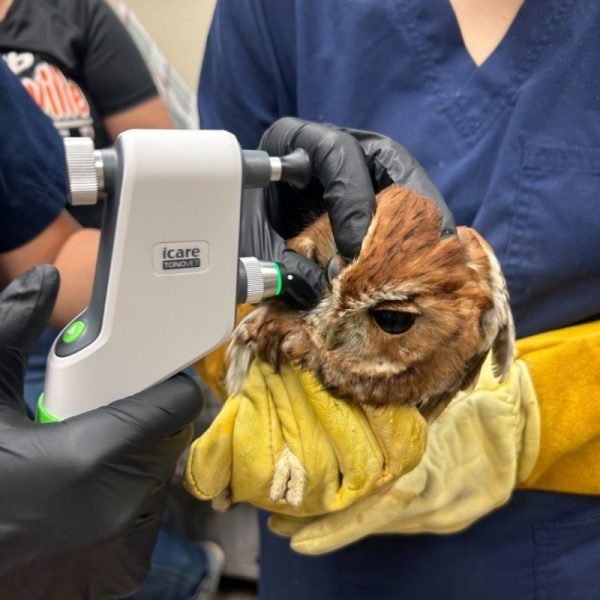
Abnormal pressure can indicate swelling, inflammation, or nerve damage, all of which are critical to monitor during rehabilitation.
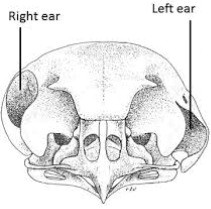
Unlike other raptors, owls have asymmetrically placed ears (one higher and one lower on their heads) which allows them to pinpoint the exact location of sounds.
While hawks, falcons, and eagles rely heavily on precise depth perception from both eyes to hunt, owls use their acute hearing to locate prey.
This ability means that some patients can be successfully released even with vision in only one eye.
We are happy to report that this owl is recovering well from surgery, eating independently, and will soon be moved to an outdoor enclosure for continued recovery and testing.

With time and care, we are hopeful that this little raptor will return to the wild where it belongs!
Looking for an easy way to help native wildlife? Become a monthly BRWC donor! For as little as $5/month, you can provide year-round, sustainable support that helps us fulfill our mission.

Uptick in Continued Virginia General Assembly Legislation Reflects Varied Motivations

Mini Quiches with Ham and Swiss Cheese

Tips to Help Employers Sort Job Applications More Efficiently

Town Council Finishes Retreat, Considers Memorandum of Understanding with Smithsonian for Water Conservation

Spanberger Amends, Signs Sweeping Gun Legislation Reshaping Virginia’s Firearm Laws

Governor Pitches Amendments to Prescription Drug Affordability Board Bill That Some Say ‘Nullify’ It

Debate Continues Over Tax Rate as Supervisor Offers New Option

Blue Ridge Wildlife Center Patient of the Week: Eastern Fence Lizard

Joyce Henderson Banks (1941 – 2026)
Accountability Before Adjustment

Supreme Court Ruling Revives Debate Over Conversion Therapy Bans, Including in Virginia

Growing Pains: Rising Diesel, Fertilizer Costs Spurred by Iran War Impact Virginia Farmers

Virginia, Other States Make It Easier for Physician Assistants to Practice

Working Part-Time After Retirement: For the Paycheck — and the Fun

Compressed Air Safety: Why 30 PSI Is the Limit for Cleaning

ORDER OF PUBLICATION: In the Circuit Court for Warren County, Virginia

Local NAACP Recalls Segregated Criser High/Elementary School During ‘Learn From the Past for a Better Future’ Event

Virginia Revenues Top Forecast, But Economic Concerns Remain

Governor Clarifies: Proposed Tax Changes Never Became Law

Driver Runs After Crash, Caught by Police Moments Later

Debate Continues Over Tax Rate as Supervisor Offers New Option

POLICE: 7 Day FRPD Arrest Report 4/13/2026

Spanberger Joins Other Governors in Push for PJM to Prioritize Ratepayer Protections

Cannabis Testing Challenges Persist as Virginia Retail Market Nears
