
Local News
DEQ’s Notice of ‘Enforcement Action’ to Christendom College Illustrates Complex Web of Wastewater Treatment Variables
As the new year of 2026 approached, the Royal Examiner was forwarded a 16-page notice of “Enforcement Action” by the Virginia Department of Environmental Quality (DEQ, VA DEQ) regarding ongoing efforts to bring or return Christendom College into State standards for the disposal of Solid Waste from its Front Royal/Warren County campus. Such efforts were first reported on by the Examiner in 2018/2019. During that period, the college was issued a civil charge of $15,783.66 for recurring compliance issues.
The new Enforcement Action notice signed by representatives of both VA DEQ and Christendom College is dated November 13, 2025. It tracks upcoming dates for submissions on the completion of remedial work on the college’s installed Sewage Treatment Plant (STP) system and a recounting of past or recurring issues with those facilities.
Here we will reference portions of the DEQ Enforcement Action notice for an overview of Christendom’s efforts and investments over the past eight years, circa 2018 through 2025, and the results of the system’s necessary upgrades during that period.
For starters, the college is reported to have initially invested $167,687 in contracted “Tier 1” construction of wastewater/sewage treatment facilities with an additional estimated $140,000 for a flow equalization chamber deemed necessary to address emerging problems. Those problems and their consequences are described in detail in the Enforcement Order. Near the outset of that order, its “Purpose” is explained:
SECTION A: Purpose
“This is a Consent Order issued under the authority of Va. Code § 62.1-44.15, between the Department of Environmental Quality (Department or DEQ) and Christendom Educational Corporation (Christendom) regarding Christendom College Wastewater Treatment Plant (Facility or Plant), for the purpose of resolving certain violations of the State Water Control Law and the applicable permit.”
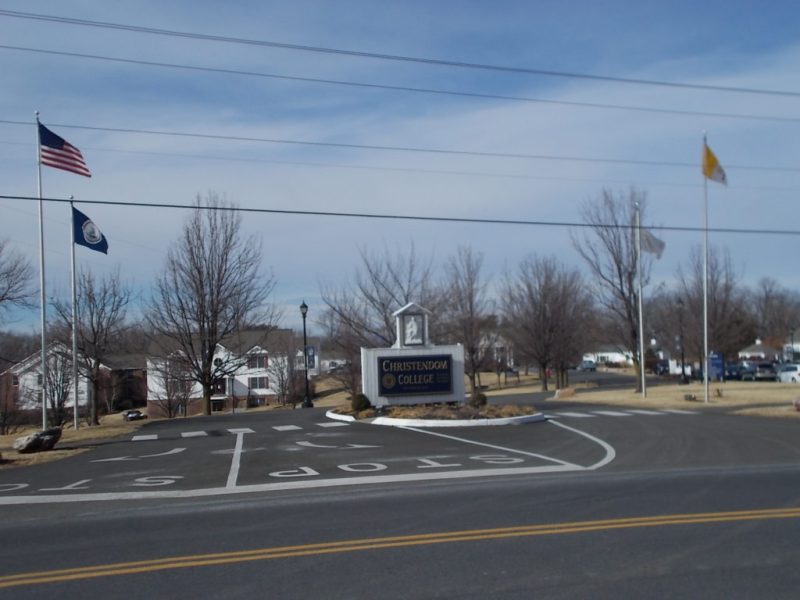
A Royal Examiner File photo of the main entrance to the Christendom College campus. It appears that VA DEQ, the college, and its contracted wastewater disposal consultant, EIS (Independent Environmental Services), will continue work to maintain a stable and successful campus wastewater solution into 2026.
Royal Examiner readers may recall that back in 2018/2019, there was some public controversy over the designation of the stream targeted for disposal of the Christendom campus wastewater as a non-active stream that only reached the Shenandoah River during times of extreme rainfall. It appears that enforcement agencies generally agree with Christendom’s designation of that stream.
Contacted for comment on the current Enforcement Action and relevant details, DEQ Communications Manager Irina Calos said this about the disposal stream: “I’ve attached the facility’s VPDES discharge permit fact sheet, which contains the dry ditch description as is used by the U.S. Geological Survey. The ditch typically only carries treated wastewater and rainwater from storm events,” Calos told us.
System Status Report
See below for a detailed account of the enforcement agencies’ observations regarding the wastewater disposal stream across the college campus.
- “The Stream, in the vicinity of discharge, is designated as a dry ditch, or effluent-dependent stream, and is not listed as impaired. The Shenandoah River at the confluence with the Stream (in HUC 02070005) is not impaired for TMDL (Total Maximum Daily Loads) construction due to specific pollutant contamination. TMDLs have been approved for the segment; however, the Plant was not addressed in the TMDLs because the applicable segment was previously not considered a PCB contributor.
- “On January 1, 2019, DEQ issued Christendom the Permit and reissued the Permit on January 1, 2024. The Permit allows Christendom to discharge treated wastewater from the Plant to an unnamed tributary of the Shenandoah River (Stream), provided such discharges are made in strict compliance with the Permit’s terms and conditions. The Plant is operated on behalf of Christendom by IES, Independent Environmental Services (IES or Operator).
- “Large flow variations were a continued challenge at the Plant; thus, IES recommended a Phase 2 equalization improvement. Specifically, IES recommended that Christendom replace the comminutor with a primary screening device to remove solids larger than 2mm; install a thick tank to fix the wet lift station and drain it to a clarifier led by an automation valve that could provide 20,000-30,000 GPD (Gallons Per Day) flow for equalization. The baffled tank and the chlorine contact chamber with a pair of Poly KL-6259 effluent filters will filter out the residual solids down to 1.2 micron; installation removes the Aerobic Sludge Clarifier system by bypassing the tank; system shall meet final regulations for Total Residual Chlorine disposal costs. Costs were estimated at $140,000 for the flow equalization chamber …
- “On April 4, 2024, in response to IR# 313158, DEQ Water Compliance staff conducted a follow-up inspection of the Facility. The following were the staff’s factual observations from the inspection:
“a. At the time of the inspection, the Plant’s effluent was clear at Outfall 001;
“b. An accumulation of solids in the Stream, from Outfall 001 to approximately 80 feet downstream.
“c. Staff noted the solids were dark brown and estimated a depth of 5 inches. No odor was observed.
“d. Staff asked IES if they were aware of any solids release since the last inspection in November 2023. IES indicated they were not aware of any.
“e. Staff Photographs documentation record noted in the inspection report includes photos of submerged solids, low and/or no flows. IES notes for March 30, 2024, and April 1, 2024, indicate visual inspections were conducted. Upon review of records, DEQ did not find notification of the discharge.”
DEQ Elaboration on moving forward
What do all the numbers, inspections, and consultant recommendations mean? As noted above, Royal Examiner contacted DEQ Communications Manager Irina Calos for added detail and background on the Enforcement Action. She told us this about Christendom’s efforts to upgrade and stabilize the college’s wastewater operations:
“The consent order you referenced covers issues noted from 2021-2024 and establishes a path to resolution for these issues. The order begins with a timeline of findings, then an assessment of civil penalties, and a schedule to return to compliance. By signing the order, Christendom acknowledged the findings and agreed to pay $16,916.38 in civil penalties and follow the schedule to return to compliance.
“DEQ previously issued a consent order to Christendom in 2018, for which the college paid $15,783.66. This consent order includes a timeline up until this point,” Calos noted of the movement on upgrades from late 2025 headed into 2026.
Royal Examiner also asked Calos about the extensively cited need for upgrades to the college’s wastewater treatment system in the Consent Order. She told us this:
Wastewater treatment plants require equipment that must be operated properly, maintained regularly, and periodically upgraded to ensure systems continue to function properly. As such, in January 2021, Christendom engaged an engineering consultant to evaluate its treatment plant and provide recommendations for maintenance, repairs, and upgrades. Upon DEQ approval, Christendom initiated the recommended upgrades, completing most of Phase I by August 2021. They completed construction of the pole barn-style building over the Facility’s treatment train in July 2022. Christendom began Phase II efforts in September 2022, which included the installation of an optional secondary clarifier.
In November 2022, DEQ referred Christendom to enforcement. The consent order dated September 27, 2023, required Christendom to complete Phase II Upgrades and included a civil charge of $15,783.86. The 2023 consent order was terminated in November 2023, upon Christendom’s completion of Phase II upgrades and payment of the civil charge.
The current order requires the installation of the secondary clarifier (complete) and an analysis of the plant’s operations to determine whether further upgrades may be necessary.
And so it goes at Christendom College moving forward, with EIS consultant input and DEQ oversight, toward a consistently compliant wastewater treatment operation with upgrades installed as necessary.

40 Winners Named in Front Royal’s 6th Annual Pot o’ Gold Hunt

French Earl Tolliver, Jr. (1960 – 2026)

5 Tips to Prevent Sports Injuries

Standardbred Owners Ainspan, McDonald Each Score Thoroughbred Wins at Colonial Downs’ Virginia Derby Meet

Most Dangerous Cycling Scenarios Involving Cars

VDOT: Warren County Traffic Alert for March 23 – 27, 2026

Virginia State Police Seize $22.4 Million in Drugs, Recover Firearms in Weeklong Operation

Virginia Home Sales Rise in February as Inventory Grows, Spring Outlook Uncertain

Bing Crosby Stadium Hosts Warren County–Skyline Baseball Battle Tonight

Warren Supervisors Address Audit Contract, Permits, and Property Sale at March 17 Meeting

Here’s How Virginia Lawmakers Suggest the Next State Budget Handle Federal Health Care Funding Fallout

Spring Essentials Checklist: Prepare Your Home for Summer

Virginia Joins National Push for Refunds After US Supreme Court Voids Trump Tariffs

Four Reasons to Consider Hiring a Professional Cleaning Company

Ask the Expert : We Are Applying for a Mortgage Soon. What Kind of Documents Will We Need?

Charles Michael “Rusty” “Chuck” Fischbein (1944 – 2026)

Jerrold E. “Jerry” Groves (1931 – 2026)

Town Planning Commission Moves Forward with Industrial Zoning, Holds Preliminary Discussion of Urban Agriculture

Schools Push for Budget Flexibility, Consistent Funding as Needs Grow

Skyline High Teams, Athletes Successful Seasons and Performances Acknowledged – Oh, and Those Roosters

School Board Seeks to Restore Meals Tax Funding for School Facilities

Wasting Drinking Water: 3 Habits to Eliminate From Your Daily Routine

Medicare Launches TEAM Program to Improve Recovery After Surgery

Izaak Walton League Promotes Conservation and Outdoor Programs at Community Forum
