
Local Government
Front Royal Council Weighs ACES Role, Cannabis Rules and Riverton Sewer Project
Front Royal officials wrestled with how environmental advisers should interact with town leaders, prepared for the arrival of legal retail cannabis businesses, and moved ahead with a major sewer project during a wide-ranging Oct. 5 Town Council work session.
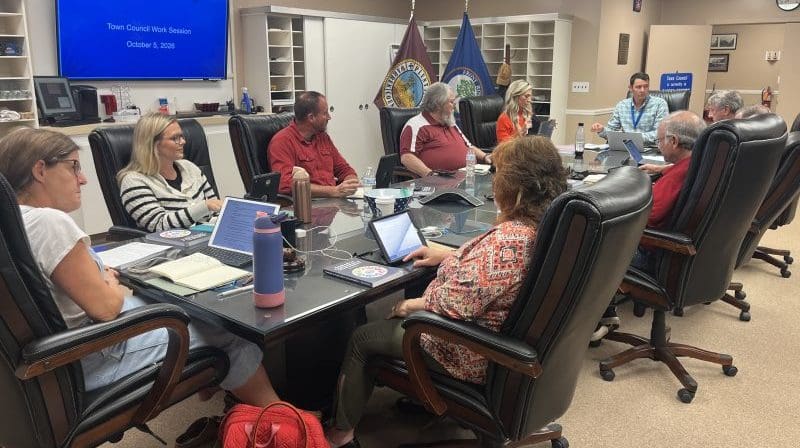
The Town Council met for a work session on October 5. Royal Examiner Photo Credits: Brenden McHugh
The discussion surrounding the Advisory Commission for Environmental Sustainability, or ACES, centered on a proposed ordinance intended to more clearly define the commission’s duties as its work continues to expand.
The conversation also highlighted a larger challenge for elected officials who routinely make decisions involving specialized subjects.

Vice Mayor Amber Veitenthal acknowledged that ACES members have environmental expertise beyond that of many council members. That expertise can be valuable because environmental questions can touch projects and policies that eventually come before council.
The question is how that knowledge should reach the people making those decisions.
Council reviewed a revised ordinance that removed language explicitly limiting the commission’s activities. Veitenthal supported striking that section, while Town Manager Joseph Petty also viewed the language as unnecessary.
But removing the language did not settle the larger issue.

Council members discussed whether ACES should generally wait until council, the Planning Commission or town staff asks for advice, or whether commissioners should be able to identify issues themselves and submit recommendations when they believe an environmental concern deserves attention.
Veitenthal favored giving ACES room to take that initiative. Under that approach, commission members could review upcoming town matters, reach a consensus when they identify an environmental issue, and forward recommendations to the appropriate decision-makers.
Petty emphasized that the town is still working out the internal process for how those recommendations move forward, including how material ultimately makes its way into meeting agenda packets.
The issue matters because council members cannot be expected to have the same specialized knowledge as residents appointed to advisory bodies.

Council ultimately agreed the proposed ACES ordinance was not ready to move forward and will continue discussing it at another work session.
Cannabis Rules Taking Shape
Another major discussion involved the expected arrival of legal cannabis businesses in Virginia.

Deputy Zoning Administrator John Ware presented to the council the situation surrounding the foreseeable arrival of cannabis on the local market.

Deputy Zoning Administrator John Ware outlined the town’s timetable as it works to establish zoning regulations before Feb. 1, when the Virginia Cannabis Control Authority is expected to begin accepting license applications.
Under the state framework presented to council, Front Royal cannot prohibit cannabis businesses or impose a moratorium. Instead, the town can regulate where the businesses operate and establish reasonable zoning and performance standards.
Cannabis businesses could begin operating July 1.
Ware explained that if Front Royal does not have its own regulations in place, retail cannabis businesses could be treated like other retail operations and permitted in zoning districts where retail businesses are already allowed.

That has put the Planning Commission and town staff on a tight schedule.
State rules establish a 1,000-foot buffer from schools, hospitals and child day programs. Localities may reduce that distance but cannot increase it. Front Royal is also considering additional “sensitive areas,” including locations associated with substance abuse treatment and recovery.
Council’s consensus favored requiring a special use permit for each type of cannabis business.
That would give the town an opportunity to examine individual proposals and impose reasonable conditions, but Ware warned that the process cannot be used to effectively prohibit cannabis businesses. Public opposition alone would not necessarily provide grounds to deny an application that otherwise meets the town’s requirements.
The regulations extend well beyond marijuana storefronts. State law creates categories for cultivation, processing, testing, transportation, delivery, pharmaceutical processing, and microbusinesses that may combine several operations.
Council members also supported considering agricultural zoning for all five tiers of cannabis cultivation.
The town will eventually have another decision to make: how much to tax retail cannabis sales. Localities will be permitted to establish a tax between 1% and 3.5%. Several council members supported the maximum 3.5% rate, although no formal decision was made.
The Planning Commission is expected to continue developing the ordinance before a public hearing in November. That would leave December and January for council to complete its review.
Downtown Group Gets Council Support
Council also unanimously backed Downtown Front Royal Inc. as the organization seeks an Advancing Virginia Main Street designation.
The application marks the third and final phase of a roughly two-year process. As part of the application, Downtown Front Royal needed an updated resolution showing continued support from the town government.
The designation is not guaranteed, but town officials described the application as another step toward strengthening Front Royal’s downtown revitalization efforts.
Riverton Sewer Project Moves Ahead
Council also reviewed several actions connected to the Riverton Sewer Lift Station upgrade.
The town is preparing a $1.8 million budget amendment to finance the project. Proposed financing would run for 25 years at an estimated interest rate of about 3.3%, with the resolution limiting the final rate to no more than 5%.
Staff recommended awarding a $1.694 million construction contract to CPP Construction Company of Maryland. The difference between the construction bid and the $1.8 million financing amount would provide approximately $106,000 for contingencies.
Town staff said the Virginia Department of Environmental Quality and the town’s engineer reviewed the bids. Several related actions will return to council, including budget matters requiring public hearings.
Other budget discussions included moving $244,500 previously set aside for the Shenandoah Avenue streetscape project to the Criser Road sidewalk project.
The town is also preparing to accept $10,609.15 connected with assistance Front Royal’s Department of Energy Services provided to Harrisonburg Electric Commission.
The Front Royal Police Department is set to receive $36,849.60 in Virginia Department of Motor Vehicles grant funding for alcohol and traffic enforcement. The funding will help pay for enforcement overtime and equipment, including traffic-counting equipment, replacement preliminary breath-testing devices, and radar units.
Council also reviewed a special use permit application for a short-term rental at 35 N. Marshall St. The R-1 residential property has off-street parking, and the Planning Commission recommended approval without additional conditions. The property would not be owner-occupied.
Data Centers Return To Council
Council ended the work session by returning to another closely watched land-use issue: data centers.
Following legal guidance, council agreed to hold a public hearing on the zoning amendment forwarded by the Planning Commission concerning data center definitions and zoning district regulations.
Council agreed to schedule that hearing for Oct. 26.
Because work at the Warren County Government Center will make council’s regular meeting space unavailable, town staff was asked to explore other locations, including a school auditorium, that could accommodate residents expected to attend several public hearings scheduled that evening.
Between environmental policy, cannabis regulations, major infrastructure spending, and data center zoning, the work session showed the range of technical subjects that can land before local elected officials — and the growing importance of how council gathers expert advice before making those decisions.
Watch the Front Royal Town Council Work Session of October 5, 2026




Kratom, 7-OH Laws Diverge Amid the Spread of Potent Synthetic Products

WCHS vs. Manassas Park – Varsity Football – October 9, 2026

A Golf Hazard With an Appetite

Lantern Tours Bring Stories Of New Market Battlefield To Life Oct. 24

Pork And Apples Have A Long-Standing Romance

Israel from Saul to Rome

Front Royal Council Weighs ACES Role, Cannabis Rules and Riverton Sewer Project

Bob Cullers To Share Family’s Civil War Story at Warren Rifles Museum

Bruce Rappaport Seeks Second Term, Calls for Smart Growth and Protection of Front Royal’s Character

I-81 South Lane Closure Near Staunton Tuesday Night Through Wednesday Morning

Festival of Leaves, Not Just a Festival
What Will We Do with What We Know?

Blue Ridge Wildlife Center Patient of the Week: Barred Owl

POLICE: 7 Day FRPD Arrest Report 10/5/2026

William Robert Swiger (1939 – 2026)

Hilda Foster Cornwell (1934 – 2026)

Workforce Training Program Earns Another No.1 Ranking for Virginia

Virginia Board of Education Reinstates Adult Education Advisory Committee After 3 Years

WCHS vs. Skyline HS – Girls Volleyball – October 8, 2026

Amber Veitenthal Seeks Another Term, Says Front Royal Should Be Selective About Growth

State Regulators to Allow Part of NextEra’s Political Past to be Examined in Dominion Merger Case

US House Dems’ Campaign Chief Predicts They’ll Gain Majority Control in Midterms

The Barrel Worked, the Business Plan Didn’t

Samuel’s Public Library Packs October With Programs for All Ages
