
State News
Governor amends bill ending subminimum wage for disabled workers
Gov. Glenn Youngkin recently recommended the General Assembly accept an amended version of a bill that ends the practice of paying a subminimum wage to certain Virginia workers with disabilities.
A certificate exemption under the federal Fair Labor Standards Act allows employers to determine pay for disabled workers based on a productivity calculation compared to other employees, according to the U.S. Department of Labor. These workers are currently listed within the “tipped employees” section of state code.
The original House Bill 1924 eliminated use of the certificate and increased the minimum hourly pay to $9.50 in July. This rate would continue to increase incrementally until 2027 when it reached Virginia minimum wage. The slow increase is meant to help employers adjust, according to Del. Patrick Hope, D-Arlington, who introduced the measure.
Hope’s bill passed the House unanimously on a block vote, meaning it was not discussed prior to voting. The bill passed the Senate 22-18.

The governor’s proposed amendment adjusts timelines. It would remove the incremental pay bumps of the original bill. Instead, the wages of all previously exempt employees would be raised to Virginia’s minimum wage when the use of the certificates ended in 2030.
Any currently certified employer would be grandfathered in until 2030, but no new certificates would be issued after July 1.
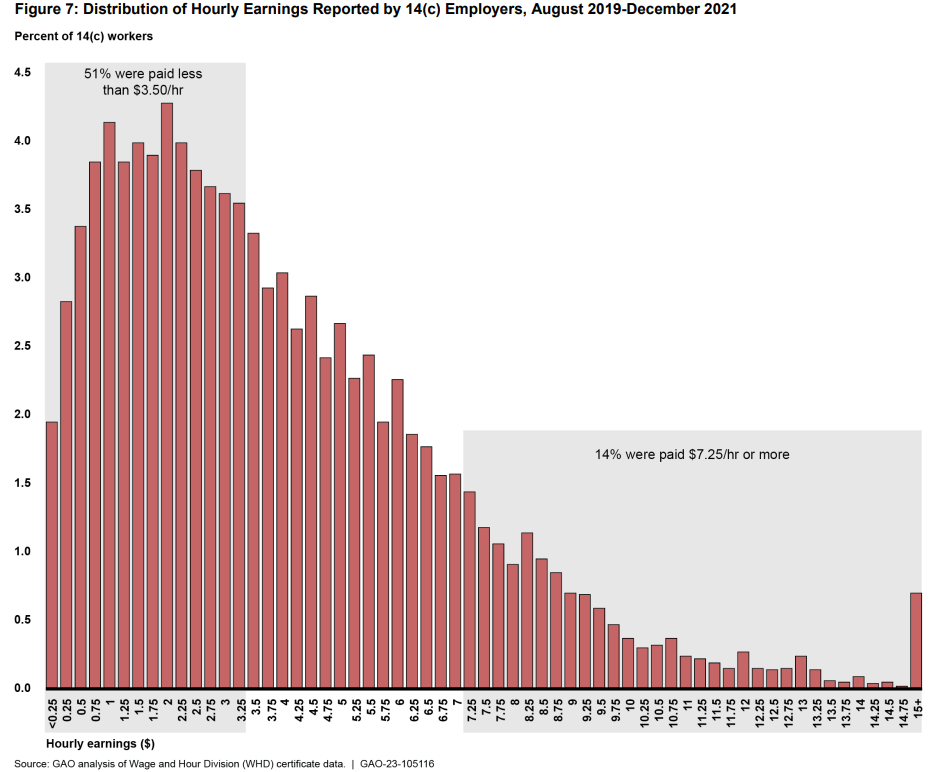
The national average for workers being paid subminimum wage is $3.34 an hour, according to the U.S. Commission on Civil Rights 2020 report.
“I don’t know how anybody could pay that and look themselves in the mirror,” said Sen. Richard Saslaw, D-Fairfax, when speaking to the Senate. “That’s disgusting. And there’s no other way to describe that.”

Disabled workers can encounter long Labor Department processing times that prevent them from getting back pay owed due to incorrectly calculated wages, according to a study by the U.S. Government Accountability Office.
The certificates gave disabled workers “an entry point” into the workforce in the 1930s, said Jewelyn Cosgrove, Melwood’s vice president of government and public relations. Such exemptions need to be reevaluated through a modern lens, she said.
Melwood is a nonprofit organization that provides jobs and opportunities for people with disabilities, according to its website. It held a certificate until 2014, Cosgrove said.
Disabled workers have access to more jobs these days versus when it used to be “get a job, any job,” Cosgrove said.

“People with disabilities should be and can be engaged in the workforce in meaningful ways in the careers of their choosing,” Cosgrove said.
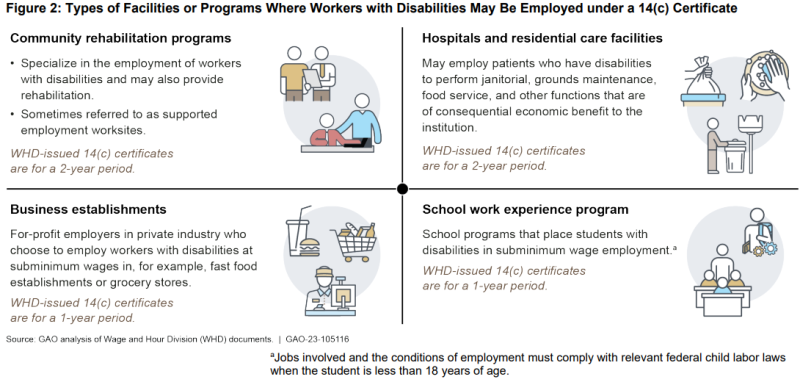
There are six employers in Virginia with active certificates as of January. These employers pay at least 286 total workers subminimum wage, according to the Labor Department. Four more employers in Virginia are pending approval for their certificates.

Active certificates are down 46% since 2018, according to a study by the Association of People Supporting Employment First. The same study found employment of disabled workers is on the rise across multiple states.
“I would never, ever accept a job where I was making $3 an hour,” said Virginia APSE lobbyist Matthew Shapiro. “You wouldn’t do that, so why is it OK for us to do that to more vulnerable … folks than me?”

Shapiro was born with cerebral palsy, a condition that affects almost every part of his life, he said. He is the founder and CEO of the consulting firm 6 Wheels Consulting.
Resources such as job coaches, at-home work, and self-employment render the certificate exemption no longer necessary, Shapiro said.
“What kind of Virginia do we want to be?” Shapiro said. “Do we want to be one that pays people fairly for the work that they do and at good wages? Or are we OK saying we’re going to pay somebody $10 a week?”
Thirteen states already have legislation in place to prevent employers from paying subminimum wage, according to the APSE study. Reforms are also being attempted at the federal level.

“This is a very demoralizing issue, and it shouldn’t really be an issue in the 21st century,” said Charlotte Woodward, the National Down Syndrome Society’s education program associate.
Woodward was born with Down syndrome, she said. Her advocacy work is important to her because she believes disabled voices provide needed visibility, she said.
“The doctor told my mom I would never learn to read or write,” Woodward said. “That, when I grew up, I would work in a sheltered workshop.”
A sheltered workshop is traditionally defined as a supervised workplace for adults who have a physical or intellectual disability.
“Of course, my mom didn’t take those words to heart,” Woodward added.
Opponents of the bill question if sheltered workshops and subminimum wage are harmful to disabled workers. Sen. Thomas Norment, R-James City County, spoke to the Senate about the disabled son of his former administrative assistant.
“He never once, never once, mentioned how much he was paid or what the compensation was,” Norment said. “It was the intangible reward and satisfaction and fulfillment of his day that he got going to work.”
Sen. Jill Vogel, R-Fauquier, also opposed the bill. It would take away opportunities for employers to provide “a haven, a place, a job for people where they do not pay them minimum wage,” she said.
Almost all of the workers originally employed under Melwood’s former certificate are still employed by the organization but now at “full wage,” Cosgrove said.
“It’s about recognizing that our employees’ voices, and their desire for that full wage, brought that dignity — brought that stability,” Cosgrove said. “It improved our employee morale immediately.”
To assume disabled workers will thrive in sheltered production does not account for individual ability and interest, said Tonya Milling, executive director of The Arc of Virginia.
“Think of it as the same way you approach things in your own life,” Milling said. “When I looked for a job, I looked for something that matched my skills, matched my abilities, and could hold my interest.”
Shapiro sympathized with concerns over disabled workers and their well-being.
“There is a ‘dignity of risk’ argument that can be made here,” Shapiro said. “Are we going to allow [them] to go out into the world and break a nail? Or are we going to keep [them] in a bubble their entire lives?”
The Virginia Department of Aging and Rehabilitative Services plans to aid transitioning employers with nearly $14 million in provided federal funding, according to the Disability Law Center of Virginia.
Youngkin’s amendment, in addition to codifying the funds, would require DARS to report to the governor’s office in 2024 about the transition away from certificates.
Lawmakers will vote on Youngkin’s changes when they reconvene on April 12.
By Ryan Nadeau
Capital News Service
Capital News Service is a program of Virginia Commonwealth University’s Robertson School of Media and Culture. Students in the program provide state government coverage for a variety of media outlets in Virginia.


Leisa Wood (1961 – 2026)

GO VOTE: Because Complaining Alone Isn’t a Good Strategy

The Third Most Important Gift Is Laughter

Skates, Treats and Safety: Warren County Sheriff’s Office Foundation Pack October with Community Events

Celebrate Kids Day Returns Sept. 27 With Family Fun, Activities and a New Train Ride

Survey Finds That More Than Half of Virginia Families With Children Face Food Insecurity

Could Virginia’s New Law Allowing 1% Sales Tax for School Construction Need a Fix?

Now They Want to Rein It In

From Oil Field to Gas Pump: What Really Determines What We Pay?

When Fields Flood: How Farmers Protect Crops and Plan for the Future

Draw Your Circles: A Map of the People Who Matter

A Heartfelt Farewell and Thank You
Data Centers Are Necessary. That Doesn’t Mean Warren County Needs One

Diesel Prices Shoot Upward as Top Farm-State GOP Senator Begs Trump for Export Embargo

From One Barrel of Oil: What Do We Actually Get?

CNN, MS Now, Politico Sue Trump Over White House Ban

Virginia-Made Marine Mattress Nominated for 2026 Manufacturing Cup

Virginia Works Plans October Job and Resource Fairs in Front Royal, Winchester

UVA Health Prince William Medical Center Earns Third Consecutive Magnet Recognition

Virginia Hunger Study Finds 37% of Blue Ridge Households Faced Food Insecurity

WCHS Volleyball Hosts Manassas Park on Sept. 22

ORDER OF PUBLICATION: In the Circuit Court for Warren County, Virginia

The Papers You Would Grab in Ten Minutes

Spanberger’s Carbon Tax Sets New Record, Could Add $1 Billion to Electricity Costs in One Year
