
Local Government
‘Grandfathering’ or not? County Planning Commission foresees the need to address Non-Conforming Properties
At its regular meeting on January 12, the Warren County Planning Commission confronted a nagging issue that members expect will increasingly come up in the future, that of property owners in older subdivisions whose dwellings were built long before there were local zoning ordinances or even building inspections. Even though building codes date back to the Babylonian King Hammurabi, and rudimentary standards in the late 18th century, most large American cities didn’t begin enacting or enforcing them until 1900 or so, and in most smaller localities they were not widely enacted until the 1970’s, and even after that not uniformly enforced. In Warren County, for example, many small “summer cabins” were built near or on the river in the 1940’s or before, when that requirement did not exist. They weren’t originally intended to be permanent homes, but rather vacation places. In modern times, local zoning ordinances would preclude many of these from being built at all, or certainly sited where they are.
The continuing challenge for the County is to strike a balance between a property owner’s investment in his property, the need for uniform enforcement of the building code, and common sense. More and more requests for Conditional Use Permits (CUPs) for short-term tourist rentals, for example, show that property owners, sometimes with “nonconforming lots”, still want to rent their cabins out to tourists. But the standards of the County’s short-term tourist rental ordinance require things like 100-foot distance between dwellings. So, the commissioners spent some time discussing what the right approach to that challenge is. Zoning law is where the term “grandfathering” is often found – provisions that allow some deviations from standards where the original construction predated the standard. It’s certain that the commission and the county board will have to eventually develop a solution that can be applied fairly and uniformly.
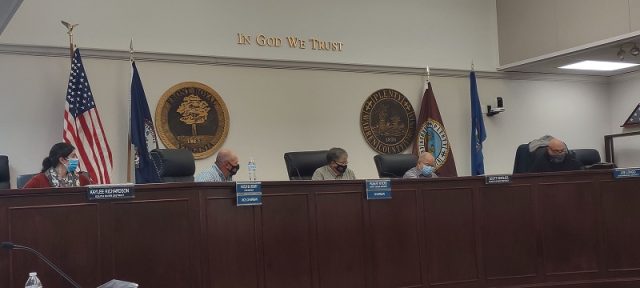
County Planning commissioners wrestle with the challenge of when to enforce the zoning ordinance and when to “grandfather”. Increasing numbers of Conditional Use Permits will require decisions about whether to recommend waiving County regulations for individual applicants.
An example case will likely be considered at next months meeting, when the commissioners will be looking at a request from Alvand Khoshgavar for a CUP for a short-term tourist rental for his residentially zoned property at 668 Old Dam Road in the Shenandoah District. His property doesn’t meet the 100-foot setback requirement, so that requirement would have to be waived for a permit to be issued. The request was approved for advertising the public hearing, but the commissioners agreed that the topic of these properties will need to have a better solution. The County can waive provisions of an ordinance, but every waiver creates a precedent.

Meanwhile, this month, John LaVoie is requesting a CUP for his residentially zoned property at 1196 Old Oak Lane in the Shenandoah District. Deputy Planning Director Matt Wendling briefed the commission on the details of the application. The proposal meets the County short-term rental supplementary regulations, and comments were received from the County Building Official and the Department of Health. There were no citizen comments during the public hearing, and no comments or objections were received from neighboring property owners by the County Planning Department.
With no other comments by commission members, the vote to recommend approval was unanimous. The permit request will now go to the County Board of Supervisors for final approval.
The consent agenda for the meeting consisted of authorization to advertise public hearings for seven Conditional Use Permit requests and one zoning ordinance change. Those items will be on the agenda for next month’s meeting on February 9th.
Chairman Myers adjourned the meeting at 7:45 p.m.





Dance and Arts VA Finds New Home, New Opportunities on Water Street

Ann L. Shuman (1933 – 2026)

Wendy Lee Whitacre-Stout (1966 – 2026)

Spanberger’s Energy Plan Keys in on Clean Energy to Meet Growing Demand and VCEA Goals

Jean Elizabeth Grubbs Fogle (1939 – 2026)

Feds Provide Guidance on New Federal K-12 Scholarship Tax Credit Program

Why Wait Till November? Mid-Term Election Early Voting Processes in Place Now

US Senate Leaves Nation’s Capital in Advance of Midterms With Much Still Undone

Business Growth Series: If You Don’t Control Your Day, It Controls Your Business

The End of a 20-Year Monopoly on the Credit Score

Voltron and Immigration

States OK Solar Panels for Balconies. Safety Guidelines Haven’t Caught Up

Trump TV Ads Paid for with $20M in Homeland Security Funds, Dems Find

Blue Ridge Wildlife Center Patient of the Week: Gray Treefrog

Birthday Twins: See Which Famous Face Shares Your Big Day

Meet-and-Greet Set Sunday for Republican-Endorsed Front Royal Candidates

Barbara Ann Mathews Smelser (1943 – 2026)

Kathleen Frances Elar (1956 – 2026)

Happy Creek Crossing to Hold Vendor Interest Meeting Oct. 8 in Front Royal

If the Car Name Fits, Drive It

Front Royal Begins Smoke Testing Sewer System; Residents May See Smoke Around Homes

Trump Orders Federal Agencies to Replace ‘Artificial Intelligence’ With ‘Super Intelligence’

Town-Wide Weed Spraying Underway in Front Royal Through Oct. 6

Southbound I-81 Lane Closure Near Strasburg Expected to Cause Significant Weekend Delays
