
National News
In Ukraine conflict, Syrians and Syrian-Americans witness familiar Russian brutality
As Ukraine defends itself against Russian forces, it is getting unexpected help from Syrian and Syrian-American doctors, lawyers, and activists who have seen first-hand the brutality inflicted by Russian ground and air forces supporting Bashar al Assad’s regime for the last 11 years.
“We are seeing the same tactics in Ukraine now as we saw in Syria,” said Amjad Rass, a former Aleppo physician who heads the Syrian American Medical Society, which is placing doctors in Ukrainian facilities. “We can help our colleagues in Ukraine with war-related injuries, we can help them with how to deal with besiegement, massive displacement, attacks on healthcare, and how to document that.”
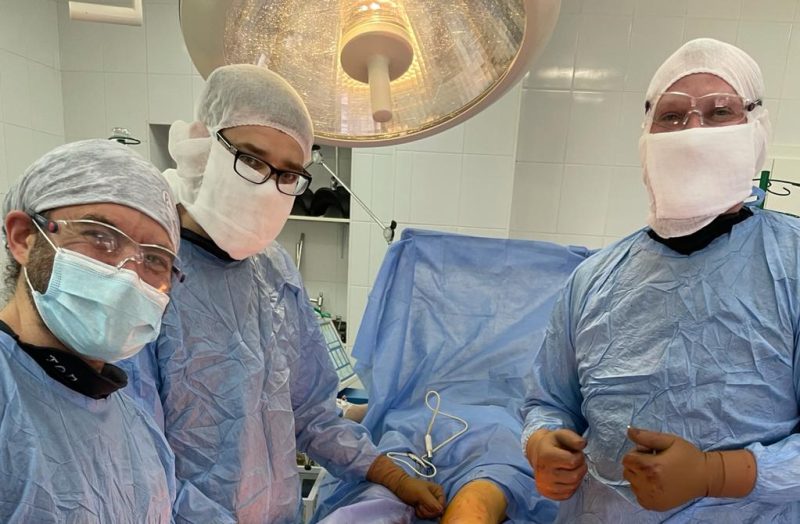
UKRAINE – Chicago physician Samer Attar, left, traveled to Ukraine to volunteer in a Brovary-area hospital treating war-related injuries. (Photo courtesy of Samer Attar)
The Syrian Ukrainian Network was formed recently to match Syrians and Syrian-Americans with relevant skills to the humanitarian effort on the ground. Coordinator Olga Lautman, a senior fellow at the Center for European Policy Analysis in Washington, is using her Ukrainian connections to arrange volunteer placements and to help obtain visas as well as translators, transportation, and housing inside the country.

The network has connected Syrian lawyers experienced in investigating and documenting war crimes to lawyers in Ukraine, she said. They are also linking outside advocacy groups fighting pervasive Russian disinformation inside Ukraine and elsewhere.
“There are things that Syrians can pick up easily, especially if it involves cluster bombs or mass graves,” Lautman said, “things that Syrians have already experienced – and that Ukrainians have not yet.”
Another of those is the use of chemical weapons on the battlefield.
Dr. Mohamed Tennari, a Syrian doctor who previously treated chemical-attack-related injuries, used Lautman’s network to go to Ukraine recently to help prepare physicians for the worst. When asked if he thought Russia would use chemical weapons, Tennari’s response was grim.

“If the Russians feel themselves in a bad situation, they can do anything. There is a big chance they can use it,” Tennari said.
Lautman closely followed Russian media during the height of the Syrian conflict and saw clear indicators of the coming chemical attacks. We are now seeing those indicators in Ukraine, she said.
“They’ve been laying the groundwork,” she said, by equipping Russian troops with chemical agent antidotes and by spreading false claims that Ukraine has biological weapons.
The most obvious similarity between the two wars is the bombardment of civilian infrastructure, including schools, apartment buildings, and hospitals, say humanitarian and military experts steeped in the Syrian war. Purposefully targeting civilians is considered a war crime under international law.

Samer Attar, a Chicago orthopedic surgeon who volunteered in Syria after learning hospitals there were being bombed during the war, entered Ukraine last week on a similar mission.
Speaking over an encrypted app from Ukraine, he described a man with a mine-blast injury. The injury reminded him of a child he was treated in Syria where such high-velocity injuries were common. The child had someone else’s bone fragments lodged in his skin from an airstrike on his school.
The injury “looks exactly like the ones that you would find anywhere in Syria,” he said from a hospital in the Brovary region outside of Kiev.
Ukraine says 158 children have been killed in the war, while the United Nations says 59 have died. The World Health Organization has reported 105 Russian attacks impacting healthcare facilities in Ukraine.

“On a humanitarian level, because of what we’ve seen in Syria, we know what the Russians will do and how brutal they’re going to be,” said Shadi Martini, executive director of Multifaith Alliance for Syrian Refugees and formerly a hospital manager in Aleppo who escaped in 2012. “Mariupol was expected for us. We know what the Russians are capable of.”
As a tactic, the bombardment is meant to bring about starvation, he said.
Based on Russian actions in Syria, Russian troops are then likely to show up with food to save the population it just bombed, said U.S. Army Col. Myles B. Caggins III, the former spokesman for the Global Coalition to Defeat ISIS in Iraq and Syria and a fellow at the Council on Foreign Relations.
“In a few weeks, we’re likely to see Russian infantrymen carrying bags of grain and baby formula and handing it to the civilians in these eastern cities as a way to show that they are the good guys,” he said. “They want to paint the picture that the Ukrainian government has abandoned its citizens.”

As in Syria, even the agreed-to ceasefires and humanitarian corridors are part of Russia’s propaganda campaign to portray themselves as saviors, said Carsten Wieland, a German diplomat, and senior United Nations consultant.
“This whole process of corridors and so on is part of that because suddenly the core of the war is 100,000 civilians being trapped in Mariupol,” he said. “And Russia is trying to use it for their own propaganda.”
Wieland said this could include Russians “distributing their Russian-marked packages of humanitarian aid in Mariupol to starving civilians who have no other choice but to accept it or opening corridors towards the east – towards Russia – where Russian cameras are standing saying ‘look, the Ukrainians are fleeing from their own Ukrainian government.”
Portraying Russians as humanitarian liberators is a disinformation tactic the Kremlin also used in Syria, where Russian officials justified bombing cities like Homs and Aleppo by claiming to fight Islamic extremism.
“Russia would claim that there were terrorist groups throughout those urban areas,” said Caggins. “While there was a presence of some terrorists, that in no way can explain the tens of thousands of civilians killed and maimed by Russians.”
In Ukraine, Russian authorities claim to be fighting Nazis, a label that is likely to appeal to the Russian population, said Caggins.
“Now, they’ve employed social media trolls, paid agitators, fake media personalities, fake experts, and fake anti-imperialist influencers … It’s basically rinse and repeat,’ said Caggins. “They did it in Syria. They got away with it. They’re doing it in Ukraine.”
Still, there are differences.
Retired Army Brig. Gen. Peter Zwack, the senior defense attaché at the U.S. Russian Embassy from 2012to 2014, says the Russians have mistakenly convinced themselves their success in Syria will translate to Ukraine.
In Syria, the Russian-backed Assad regime and the Russian military maintained nearly uncontested control of the skies. Ukrainian forces, however, have had considerable success downing Russian warplanes at low and medium altitudes, Zwack said.
At the root of Russia’s overconfidence, said Zwack, are incorrect, deeply-held biases.
“Russian authorities hold these core beliefs: Ukraine isn’t a real nation and they aren’t real people – they are part of us,” Zwack said. “That dismissive aspect has manifested in military planning. They thought winning a war in Ukraine would be a cakewalk.”
For recent volunteers with time in war-torn Syria, revisiting a war zone has not been easy. For Attar, who is consulting with Ukrainian physicians on the best ways to manage war casualties, the trip to Ukraine also meant revisiting the personal stress of war-torn Syria.
“I had to revisit that fear: of airstrikes, of another siege. But…there’s a strength and power of community that helped me overcome that fear. Especially when you’re in a hospital where everyone – no matter what their role – had one job: helping and saving others.”
By EVE SAMPSON
Capital News Service
Editor’s note: Eve Sampson is a former U.S. Army captain who was deployed to Syria in 2018.




Mayor Lori Athey Cockrell Looks to Water, Economic Development and Rail Trail in Another Term

WCHS vs. Brentsville HS – Girls Volleyball – October 6, 2026

BMI Is Only One Piece of the Health Picture

The Eye Surgery Factory That Could Not Expand

Ancient Ownership of Israel

VDOT: Warren County Traffic Alert for October 5 – 9, 2026

Reaching Out Now Expands Programs and Opportunities for Warren County Youth

Dance and Arts VA Finds New Home, New Opportunities on Water Street

Ann L. Shuman (1933 – 2026)

Wendy Lee Whitacre-Stout (1966 – 2026)

Spanberger’s Energy Plan Keys in on Clean Energy to Meet Growing Demand and VCEA Goals

Jean Elizabeth Grubbs Fogle (1939 – 2026)

Feds Provide Guidance on New Federal K-12 Scholarship Tax Credit Program

Why Wait Till November? Mid-Term Election Early Voting Processes in Place Now

US Senate Leaves Nation’s Capital in Advance of Midterms With Much Still Undone

Business Growth Series: If You Don’t Control Your Day, It Controls Your Business

The End of a 20-Year Monopoly on the Credit Score
Voltron and Immigration

States OK Solar Panels for Balconies. Safety Guidelines Haven’t Caught Up

Trump TV Ads Paid for with $20M in Homeland Security Funds, Dems Find

Blue Ridge Wildlife Center Patient of the Week: Gray Treefrog

Birthday Twins: See Which Famous Face Shares Your Big Day

Meet-and-Greet Set Sunday for Republican-Endorsed Front Royal Candidates

Barbara Ann Mathews Smelser (1943 – 2026)
