
Local News
Lost by fire: more than a business and a building
According to County Fire Marshal Gerry Maiatico’s press release on the April 29 fire investigation, the old warehouse at 1868 North Royal Avenue destroyed that day was built in the late 1800s. It was “constructed using limestone/rock walls approximately 12 inches thick and heavy timber wood framing for the floor and ceiling supports. An attached barn type structure housed an estimated 35,000-40,000 board-feet of reclaimed lumber destroyed in the fire.”
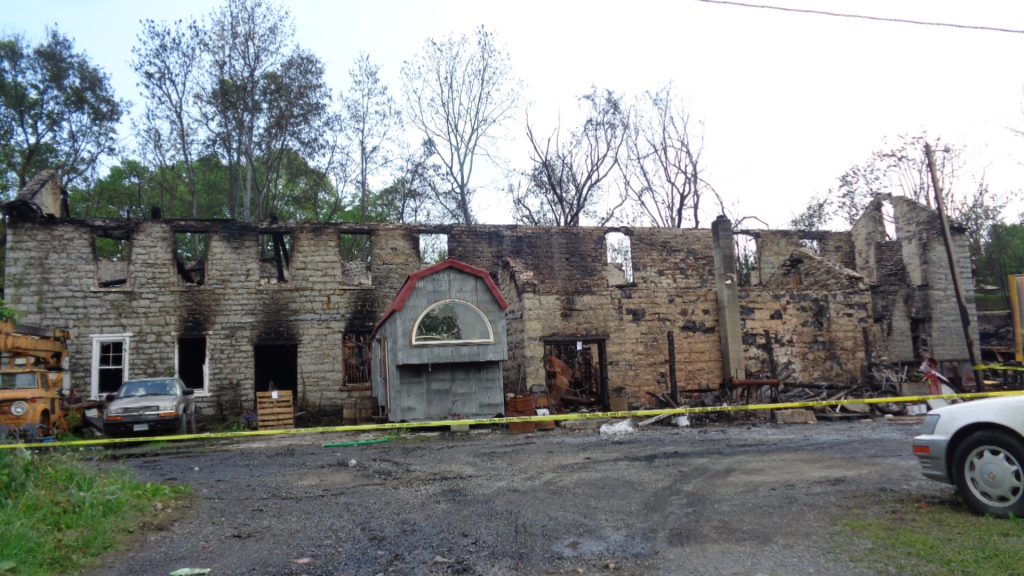
A long shot of the destruction wrought by the April 29 fire that destroyed more than a building. Photos/Roger Bianchini
Even more detail on the building’s history was found online in a 2016 article on the business it housed, the Strong Oaks Woodshop. The article appeared in “The Arlington Catholic Herald”. The Herald reported that the old warehouse “was a one-time poorhouse and railway depot, and during World War II the building was a warehouse for airplane parts. Foreshadowing the current work between its walls, it first served as a furniture manufacturing facility after the Civil War.”
While we have been unsuccessful in contacting Strong Oaks Woodshop owner Michael Schmiedicke since the fire, The Arlington Catholic Herald article offers great insight into the business, its owner and exactly how much was lost in that fire of April 29. According to The Herald, Schmiedicke is “a web-developer-turned-woodworker and parishioner of St. John the Baptist, Catholic Church in Front Royal.”
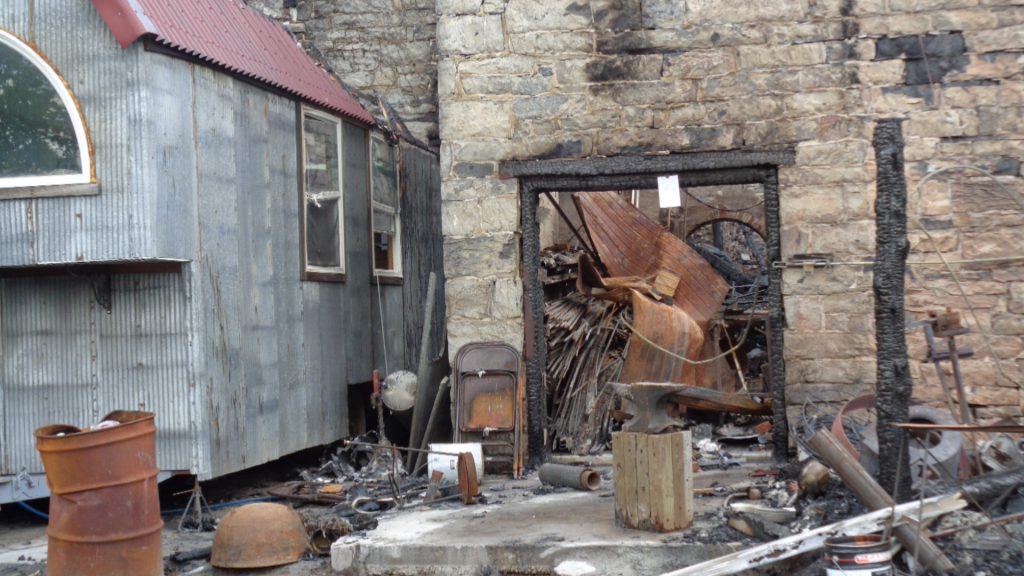
A closer look inside …
At the time, Schmiedicke told The Herald that his shop employed about 10 people. Since The Herald article was published that number had risen to 18 full-time, with various other seasonal employees. One important aspect of his business, Schmiedicke told The Herald was his and his staff’s use of reclaimed lumber.
“We live in a relatively materialistic society, where national trends say new is better,” Schmiedicke told The Herald, which reported that Schmiedicke and his staff “create by hand everything from bed frames and chairs to bar stools and kitchen tables from reclaimed wood. The company dismantles wood from old houses, barns, warehouses and other abandoned structures slated for demolition. Primarily salvaging lumber from the Shenandoah Valley, Schmiedicke has traveled as far as New York and Michigan to rescue buildings that otherwise would be bulldozed or burned.”
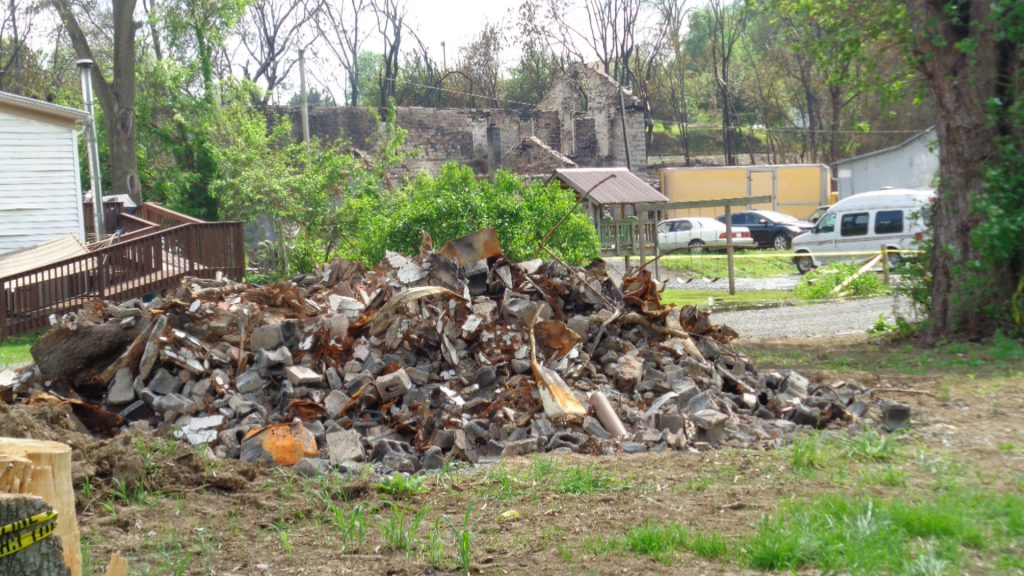
A pile of debris remains on lot where rental house was previously destroyed by fire, the Strong Oaks Woodshop warehouse site is in background.
While Schmiedicke told The Herald that “the barstools pay the bills” he observed that a much smaller part of the business was what he considered a personal “side ministry”, casket making. Schmiedicke described the advent of that work beginning six years earlier when he and two younger brothers made a casket for their grandmother.
“My understanding of death up to that point was tied to a certain sense of passivity and helplessness; I was a spectator to it … It was a turning point in my relationship with faith, with death and what comes after … Making that first casket took away a lot of that feeling of helplessness and gave me a new perspective,” Schmiedicke told The Arlington Catholic Herald.

Torch the Bridges – the nearby Civil War marker noting Col. John R. Kenly’s burning of two bridges across the Shenandoah River to cover his retreat.
click here to read related story
And now tragically, that mission and the furniture building and wood restoration business that supported it lie in ruins near the edge of the Shenandoah River, where over 150 years earlier two bridges were burned to cover the northward retreat of Yankee forces under the command of Colonel John R. Kenly.

How Farming Is Changing and Evolving

Robert H. Goddard: The Visionary Who Helped Launch the Space Age

40 Winners Named in Front Royal’s 6th Annual Pot o’ Gold Hunt

French Earl Tolliver, Jr. (1960 – 2026)

5 Tips to Prevent Sports Injuries

Standardbred Owners Ainspan, McDonald Each Score Thoroughbred Wins at Colonial Downs’ Virginia Derby Meet

Most Dangerous Cycling Scenarios Involving Cars

VDOT: Warren County Traffic Alert for March 23 – 27, 2026

Virginia State Police Seize $22.4 Million in Drugs, Recover Firearms in Weeklong Operation

Virginia Home Sales Rise in February as Inventory Grows, Spring Outlook Uncertain

Bing Crosby Stadium Hosts Warren County–Skyline Baseball Battle Tonight

Warren Supervisors Address Audit Contract, Permits, and Property Sale at March 17 Meeting

Here’s How Virginia Lawmakers Suggest the Next State Budget Handle Federal Health Care Funding Fallout

Spring Essentials Checklist: Prepare Your Home for Summer

Virginia Joins National Push for Refunds After US Supreme Court Voids Trump Tariffs

Four Reasons to Consider Hiring a Professional Cleaning Company

Ask the Expert : We Are Applying for a Mortgage Soon. What Kind of Documents Will We Need?

Charles Michael “Rusty” “Chuck” Fischbein (1944 – 2026)

Jerrold E. “Jerry” Groves (1931 – 2026)

Town Planning Commission Moves Forward with Industrial Zoning, Holds Preliminary Discussion of Urban Agriculture

Schools Push for Budget Flexibility, Consistent Funding as Needs Grow

Skyline High Teams, Athletes Successful Seasons and Performances Acknowledged – Oh, and Those Roosters

School Board Seeks to Restore Meals Tax Funding for School Facilities

Wasting Drinking Water: 3 Habits to Eliminate From Your Daily Routine
