
Local Government
School Board Seeks to Restore Meals Tax Funding for School Facilities
The Warren County School Board is renewing its effort to ensure meals tax revenue is used as originally intended, calling for the funds to be directed toward school capital improvement projects in accordance with a 2003 voter-approved referendum.
During a recent meeting, board members revisited a resolution first introduced in October 2025, emphasizing that the meals tax was approved “solely for public school capital improvement projects.”
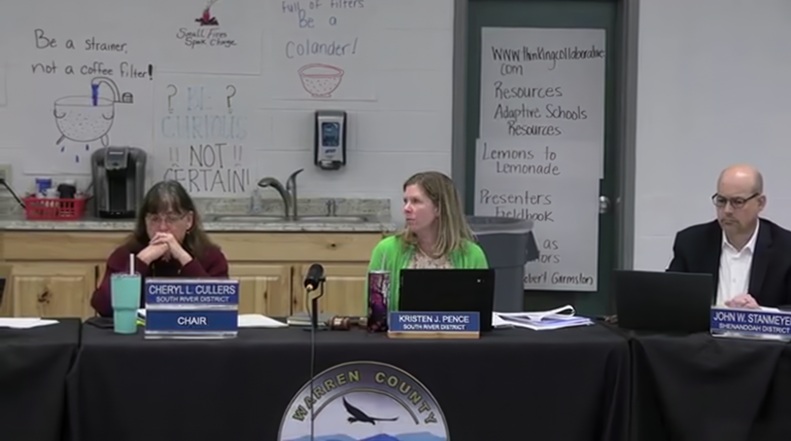
Warren County School Board members discuss meals tax funding and a proposed agreement to direct revenue toward school capital improvements during a recent meeting.
School officials expressed concern that the current handling of the revenue, now placed in the county’s general fund and used in part for debt service, does not align with that original purpose.
“This is about honoring what the voters approved,” School Board chair Kristen Pence said, noting that residents agreed to the tax with the expectation it would directly support school facilities.
The School Board’s resolution also acknowledges the Warren County Board of Supervisors’ ongoing commitment to funding school construction debt, while stressing the need for a more reliable and transparent funding structure for maintenance and capital needs.
As part of that effort, the board is proposing a Memorandum of Understanding (MOU) with the county to establish clearer protections for meals tax revenue and ensure it is consistently directed toward school-related capital projects.
The proposed MOU outlines a shared intent that meals tax revenues be used for construction, renovations, infrastructure improvements, and long-term maintenance of school facilities. It also calls for those funds to be transferred into a designated Capital Improvement Plan (CIP) fund for the school system.
Board members said such a structure would provide a predictable funding stream and reduce uncertainty around annual budget decisions.
The discussion also revisited a 2018 joint settlement agreement between the county and the Town of Front Royal, which allocates funding equivalent to 30 percent of meals tax revenue to the town.
School officials noted they were not involved in those negotiations and raised concerns about how that agreement has been implemented over time.
According to the original agreement, the county was to provide the town with an equivalent amount from its general fund, while schools continued to receive the full meals tax revenue. Board members said that practice appears to have changed.
“It sounds like it was originally done the correct way… it’s just fallen by the wayside,” Pence said.
Another major concern raised was the lack of clarity surrounding who is paying the meals tax and how it is being collected across the county.
Supervisor Rich Jameison said he has struggled to obtain a complete list of businesses subject to the tax, making it difficult to verify compliance.
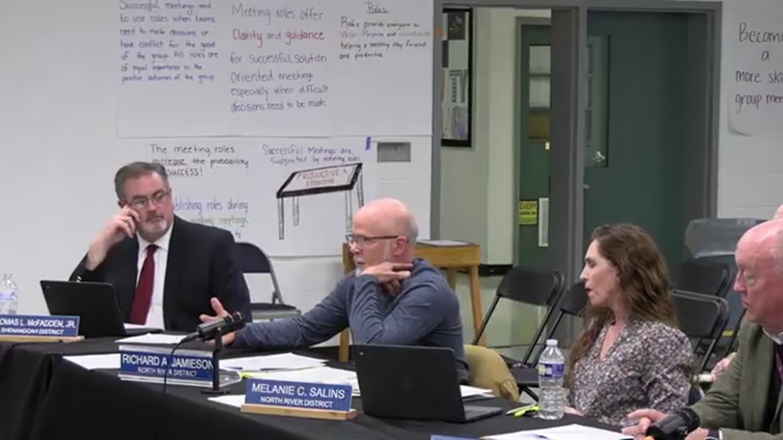
Supervisor Rich Jameson raises concerns about meal tax transparency, citing difficulties identifying all businesses subject to the tax and verifying compliance.
“I’ve been trying to obtain a list of all entities that pay the meals tax… and it’s been extremely difficult,” Jameison said, describing the process as “like pulling teeth.”
The meals tax is intended to apply broadly to prepared food sales, including restaurants, grocery stores, and convenience stores. However, officials questioned whether collections are concentrated primarily in the Route 340 corridor, with limited visibility into other areas.
While the total amount collected is known, board members said that figure alone does not provide enough insight into whether the tax is being applied consistently.
The board also emphasized the importance of establishing a clear schedule for transferring funds, noting that delays can impact the school system’s ability to address urgent facility needs.
“There needs to be a set date,” School board member Melanie Salins said, pointing to existing agreements that require payments to the town twice a year as a possible model.
Underlying the discussion is a growing list of capital needs, including aging roofs and infrastructure concerns, that board members say require stable, dedicated funding.
The resolution further states that any agreement should not allow future arrangements, such as the 2018 settlement, to reduce the amount of meals tax revenue directed to schools, particularly if debt service obligations decrease.
School officials said ensuring transparency and consistency now is critical, especially before considering any future tax referendums.
“The taxpayers of this community need to know that when they vote… that that tax money is going to go where it is supposed to be going,” Salins said.
The School Board is expected to move forward with updated language in both the resolution and the proposed MOU and formally request that the Board of Supervisors take up the issue in an upcoming meeting.
County officials indicated support for placing the matter on a future agenda, though no timeline has been set.

Uptick in Continued Virginia General Assembly Legislation Reflects Varied Motivations

Mini Quiches with Ham and Swiss Cheese

Tips to Help Employers Sort Job Applications More Efficiently

Town Council Finishes Retreat, Considers Memorandum of Understanding with Smithsonian for Water Conservation

Spanberger Amends, Signs Sweeping Gun Legislation Reshaping Virginia’s Firearm Laws

Governor Pitches Amendments to Prescription Drug Affordability Board Bill That Some Say ‘Nullify’ It

Debate Continues Over Tax Rate as Supervisor Offers New Option

Blue Ridge Wildlife Center Patient of the Week: Eastern Fence Lizard

Joyce Henderson Banks (1941 – 2026)
Accountability Before Adjustment

Supreme Court Ruling Revives Debate Over Conversion Therapy Bans, Including in Virginia

Growing Pains: Rising Diesel, Fertilizer Costs Spurred by Iran War Impact Virginia Farmers

Virginia, Other States Make It Easier for Physician Assistants to Practice

Working Part-Time After Retirement: For the Paycheck — and the Fun

Compressed Air Safety: Why 30 PSI Is the Limit for Cleaning

ORDER OF PUBLICATION: In the Circuit Court for Warren County, Virginia

Local NAACP Recalls Segregated Criser High/Elementary School During ‘Learn From the Past for a Better Future’ Event

Virginia Revenues Top Forecast, But Economic Concerns Remain

Governor Clarifies: Proposed Tax Changes Never Became Law

Driver Runs After Crash, Caught by Police Moments Later

Debate Continues Over Tax Rate as Supervisor Offers New Option

POLICE: 7 Day FRPD Arrest Report 4/13/2026

Spanberger Joins Other Governors in Push for PJM to Prioritize Ratepayer Protections

Cannabis Testing Challenges Persist as Virginia Retail Market Nears
