
Interesting Things to Know
The Coin That Traveled Through Time and Space
Over the past 1,000 years, one small object has traveled thousands of miles across oceans and continents, passing through many hands before quietly resting in the soil of Maine.
It’s not a piece of science fiction. It’s a coin, a tiny silver coin now known as the Maine Penny.
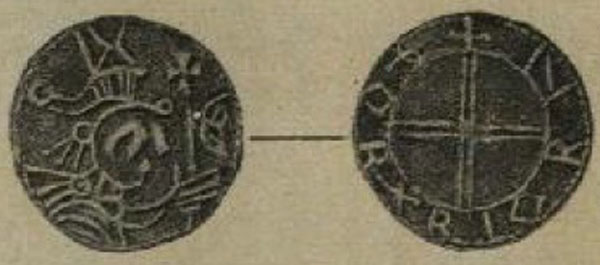
Here is an example of what the Maine penny looks like. The actual Maine penny is now in a museum and is quite chipped.
The coin was minted around 1065 AD in Norway during the reign of King Olaf III, also known as Olaf Kyrre. At some point in the following centuries, it began a journey that would eventually carry it across the Atlantic Ocean.
By the 12th century, historians believe the coin may have been aboard a Viking ship traveling to the North American coast. Norse explorers had already established a settlement at L’Anse aux Meadows in Newfoundland, proving Vikings reached the continent centuries before Columbus.
How the coin traveled from Norway to North America remains uncertain, but its next known stop was likely the northern tip of Newfoundland, about 2,600 miles from its place of origin.
There, the coin was either lost or traded. To the local people, its value probably had little to do with money. Instead, it may have been a curiosity, a small silver disc bearing a cross on one side and the image of a man on the other.
At some point, someone punched a small hole through the coin, suggesting it may have been worn as a pendant or decorative item.
The journey didn’t end there.
Roughly 200 years later, the coin appears to have traveled again, this time more than 1,000 miles south to what is now Brooklin, Maine, where it eventually ended up at a Native American trading site.
Exactly how it made that trip is still debated. Some researchers believe Viking traders carried it along the coast, while others think it likely moved through Native American trade networks, passing from community to community over generations.
Whatever the route, the coin eventually slipped into the dirt and remained there for centuries.
In 1957, an amateur archaeologist discovered the small silver coin during excavations at the site. The find puzzled researchers because it appeared in a location far from any confirmed Viking settlement.
Since then, the Maine Penny has sparked decades of debate among historians and archaeologists. Some have questioned whether the coin might have been planted as a hoax. Others believe its presence fits with the extensive trade networks that existed among Native American communities long before Europeans arrived.
According to researchers cited by Live Science, the most widely accepted explanation today is that the coin likely traveled through indigenous trade routes after originally arriving in North America with Norse explorers.
Still, no one knows for certain.
The small silver coin remains a mystery, a curious object found in a curious place, carrying the silent story of a journey that crossed oceans, cultures, and centuries.

Business Growth Series: Why Good Businesses Still Struggle to Grow

Brownies with Mini Chocolate Easter Eggs

Shenandoah Downs Opens 11th Season April 11 with Tribute to Roger Hammer

We Don’t Know Everything About DNA

How PAAS Came to Dominate the Easter Egg Dye Tradition

Spanberger Signs Bipartisan School-Safety, Student Support Bills Into Law

Melanie J. Pomeroy (1958 – 2026)

David Benjamin Heller (1990 – 2026)

1776 Wasn’t Just About Independence

Three-Tiered System for Urban Agriculture Based on Lot Size Takes Shape at Town Planning Commission Work Session

Child Abuse Awareness Month Brings Focus to Reporting, Prevention in Warren County

National Dental Hygienists Week: Is Your Oral Care Routine Optimal?

The Coin That Traveled Through Time and Space

One “What If?” Question Is Changing the Future of Farming

AA Speaker to Explain Recovery Program at United Methodist Men’s Dinner
Jeannette M. Hyland (1944 – 2026)

Allen William Derflinger II (1959 – 2026)

Warehouse Clerk: A High-Demand Job—Even With Robots

FDA Cracking Down on Compounded GLP-1 Drugs

“Christmas in April” or Overspending? Budget Draws Criticism

Court Ruling Voids Prince William Data Center Rezoning, Raising Stakes for Local Debate

Spanberger Signs First Bills Targeting Healthcare, Housing and Energy Costs

Blue Ridge Singers Spring Concerts to Showcase Powerful Blend of Voices and Brass
What Counts as “Good Policy” Depends on Who’s in Power
