
State News
The Fight for Fairness: Democrats Push for Collective Bargaining Rights
Jeanne Robinson will never forget the chilling words of a former coworker who once warned her that their job might cost them their life — words that became tragically prophetic when that same coworker died at her desk.
Now a home care worker with decades of experience in public service across two states, Robinson is on a mission.
Fired up about workplace protections and collective bargaining, she threw her support behind two bills before Virginia’s General Assembly on Friday that would grant public service workers statewide the right to collectively bargain.
During her time working in Pennsylvania, where collective bargaining was allowed, Robinson said she “saw firsthand how it helped with retention” of employees. She explained that having a union contract “made me feel like I had a voice in my job.”
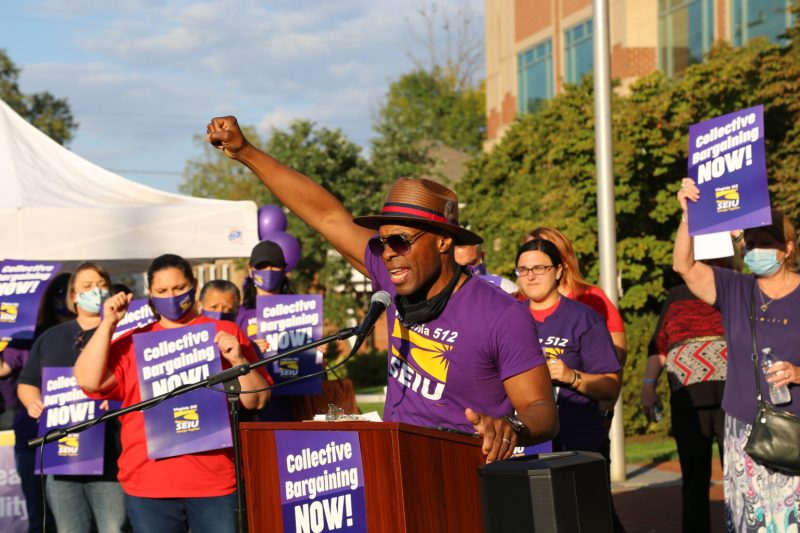
Public sector workers organize in Loudoun. (Photo courtesy of Service Employees International Union)
The proposed bills aim to expand on a 2020 law that permits local government employees in Virginia to opt into collective bargaining if their localities allow it. While some jurisdictions — like Alexandria, Loudoun County and the city of Richmond — have adopted bargaining rights, public employees in areas without such ordinances remain without a seat at the table.
The push for broader bargaining rights is led by Senate Majority Leader Scott Surovell, D-Fairfax, and Del. Kathy Tran, D-Fairfax, who were joined by Robinson and other advocates during Friday’s announcement.
Tran warned that Virginia’s failure to expand collective bargaining protections perpetuates what she called a “legacy of Jim Crow.” She referenced the 1940s, when Black nurses at the University of Virginia organized for better pay but were fired for their efforts. It wasn’t until 2020 that Virginia finally began to loosen restrictions on public employee bargaining.
The new legislation could extend bargaining rights to state employees, including correctional officers, state-contracted employees and instructors at public universities.
Harry Szabo, an assistant professor at Virginia Commonwealth University, didn’t mince words when describing the plight of graduate student workers and adjunct faculty at higher education institutions — calling it “a hidden crisis.”
Szabo explained how adjunct faculty often face uncertainty about the length of their employment while being denied the benefits of full-time positions. Meanwhile graduate students have shared troubling accounts of being paid late, leaving some unable to pay rent or afford groceries.
Sharon Gilbert, an administrative office associate at William Fox Elementary School, shared a more hopeful story. She and her colleagues successfully advocated for higher salaries, flexible hours and additional staff, including Spanish-language professionals, to prevent burnout. Gilbert “thoroughly loved” the experience of speaking directly with Richmond’s school board, city council and state lawmakers.
“We had to advocate for those who were afraid or uncomfortable about what was fair and what was equitable,” Gilbert said.
Since the 2020 law allowed some local government employees to collectively bargain, Tran has championed additional bills to include state-level public employees, higher-education workers and state-paid contractors.
While the efforts have yet to succeed, Tran and Surrovell remain hopeful that this year could be different. Both lawmakers and the public speakers who joined them expressed a shared goal: getting the legislation to Gov. Glenn Youngkin’s desk.
When asked about the possibility of a veto, Tran struck a cautious but optimistic tone. “Let us get this through the General Assembly first and we’ll have our conversations with the governor,” she said.
Earlier in the week, a Senate committee had rejected a Youngkin-supported constitutional amendment to enshrine Virginia’s “right-to-work” law in the state constitution. While the law already exists, the proposal would have reinforced protections to not join or pay dues to unions as a condition of employment.
Lt. Gov. Winsome Earle-Sears, who is running for governor this year, also backed the measure. She repeatedly emphasized that it was “not anti-union.”
A concern Republicans have expressed about collective bargaining for public employees is that it could cost taxpayers more money should salaries be raised or benefits expanded.
When asked about Youngkin’s stance on Surovell and Tran’s bill, spokesman Christian Martinez said that the governor “will not support a bill which threatens the funding and delivery of critical local services and will collectively cost taxpayers hundreds of millions of dollars a year.”
by Charlotte Rene Woods, Virginia Mercury
Virginia Mercury is part of States Newsroom, a nonprofit news network supported by grants and a coalition of donors as a 501c(3) public charity. Virginia Mercury maintains editorial independence. Contact Editor Samantha Willis for questions: info@virginiamercury.com.

Did You Know Smiling Has Many Benefits?

AI Tools Could Give Phishing Scammers a New Advantage

Cline Targets Virginia Policies in New Immigration Enforcement Bill

Seconds That Saved a Life: Chester Gap First Responders Show Value of Rural Coverage

Spanberger Creates New Cabinet Position, Appoints SELC’s Josephus Allmond Chief Energy Officer

Debra M. Wolford (1958 – 2026)

Vacant Lots on Grand Avenue Keep Their R-1 Designation at Town Council Meeting

Redistricting, Legislative Issues Discussed at GOP Gathering

Front Royal Welcomes New Wellness Studio Focused on Mind, Body, and Community

On 16th Anniversary of Affordable Care Act, Virginia’s Federal Lawmakers and Health Leaders Weigh Risks

Your Age Shouldn’t Stop You From Changing Careers

World Cheese Day Celebrates One of the World’s Favorite Foods

Blue Ridge Wildlife Center Patient of the Week: Mourning Dove

POLICE: 7 Day FRPD Arrest Report 3/23/2026

Documentary Screening at Laurel Ridge Highlights Hidden Struggle of Student Hunger

US Senate Confirms Mullin as Next Homeland Security Boss

Dominion Produces First Power From Coastal Virginia Offshore Wind Project

Rebecca Joy Knight Pucher (1953 – 2026)
Clarence Patrick “Stinker” “Wooley” Deavers (1957 – 2026)

Four Weeks Before April 21 Referendum, Early Voting Shows Stronger Turnout in GOP-Leaning Areas

After Bills Passed, NoVa Lawmakers Urge SCC to Consider Burying Transmission Lines

Next Generation of Conservation Leaders Selected for Shenandoah Valley Fellowship

Using an Exfoliant to Care for Your Skin: Beneficial at Any Age

Airport Chaos: TSA Agents Skip Work, Security Lines Expand, Trump Sends in ICE to Assist
