
Community Events
The Great American Smokeout: Plan Day 1 to a Tobacco-Free Future

44th annual event encourages those who smoke to make a plan to kick addiction:
Thursday, November 21, 2019, marks the 44th annual Great American Smokeout®, which has a new theme: “Day 1.” “This theme expresses the GASO’s recognition that that successfully quitting smoking is difficult and takes time and planning. We encourage people who smoke or who use any type of tobacco to use the day to create a plan for a tobacco-free life, and the American Cancer Society is available to help,” says Aimee Nuwer, American Cancer Society senior community development manager for Front Royal and Warren County.
The Great American Smokeout (GASO), a public awareness event created in 1976 to encourage people to quit smoking, is celebrated annually on the third Thursday of November. Across the country, GASO encourages people who smoke or use tobacco to take action to quit.
Nearly one in three cancer deaths in the U.S. is connected to smoking, which increases the risk of these 12 cancers: lung, mouth, larynx (voice box), pharynx (throat), esophagus (swallowing tube), kidney, cervix, liver, bladder, pancreas, stomach, and colon/rectum, as well as for myeloid leukemia.
Smoking also damages nearly every organ in the body, including the lungs, heart, blood vessels, reproductive organs, mouth, skin, eyes, and bones, causing other fatal diseases. About 1 out of 5 deaths in the U.S. is due to smoking.
 While the smoking rate has dropped significantly, from 42% in 1965 to 14% in 2017, smoking rates vary greatly depending on geographic location. For example, according to the American Cancer Society in 2016, in Virginia, 15% of adults age 18 and older smoked, and in West Virginia, 25% of adults age 18 and older smoked.
Quitting smoking can be very difficult. Experts say the best approach is to start with a plan and seek support. “Quitting often takes multiple attempts,” explains Nuwer, “and the American Cancer Society offers resources to support people and help them quit. We have information and tips at www.cancer.org/smokeout.” Smokers are strongly advised to use proven cessation methods, such as nicotine replacement therapies (NRTs, such as patches, gum, lozenges, etc.) or prescription medications and counseling, or a combination of all, to quit smoking. Newer encourages, “It’s a good idea to talk to your doctor or pharmacist to get their advice. Support is also important. Stop-smoking programs, telephone quit lines, the American Cancer Society’s Freshstart program, self-help materials, and smoking counselors or coaches can be a great help.”
Nuwer adds, “Smoking is the number one cause of lung cancer, and November is Lung Cancer Awareness Month.” Lung cancer is the leading cause of cancer death among both men and women, with more people dying of lung cancer than of colon, breast and prostate cancers Most lung cancers do not have symptoms until they spread, but some people with early lung cancer do have symptoms. When cancer is diagnosed at an earlier stage, treatment is more likely to be effective.
Common Symptoms of Lung Cancer:
- A cough that does not go away or gets worse
- Coughing up blood or rust-colored sputum (spit or phlegm)
- Chest pain that is often worse with deep breathing, coughing, or laughing
- Hoarseness
- Weight loss and loss of appetite
- Shortness of breath
- Feeling tired or weak
- Infections such as bronchitis and pneumonia that do not go away or keep coming back
- New onset of wheezing
The American Cancer Society estimates that in 2019, there will be about 228,150 new cases of lung cancer will be diagnosed in the U.S. and there will be 142,670 deaths from lung cancer.
To raise funds to attack all cancers from every angle, local American Cancer Society Relay For Life of Front Royal Warren County volunteers host a Bingo Fundraiser every Wednesday at 6:30 p.m. at the . “Funds raised go to help cancer patients and their families gain access to resources and support through American Cancer Society programs as well as to fund lifesaving cancer research,” says Nuwer.
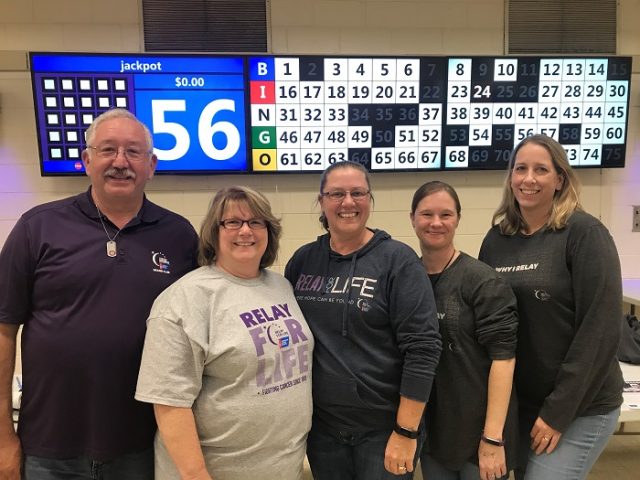
Photo, left to right – American Cancer Society volunteers Brad Fletcher, Jill Johns, with Aimee Nuwer (centered – American Cancer Society senior community development manager), and volunteers Kari Little and Susie Wickham.
For more information about tobacco and cancer risk, as well as detection, treatment, resources and support, visit www.cancer.org or call 1-800-227-2345.

Sales Set to Bloom Like Daffodils This Spring

America 250: The Bookseller Who Helped Save the Revolution

Business Growth Series: Why Good Businesses Still Struggle to Grow

Brownies with Mini Chocolate Easter Eggs

Shenandoah Downs Opens 11th Season April 11 with Tribute to Roger Hammer

We Don’t Know Everything About DNA

How PAAS Came to Dominate the Easter Egg Dye Tradition

Spanberger Signs Bipartisan School-Safety, Student Support Bills Into Law

Melanie J. Pomeroy (1958 – 2026)

David Benjamin Heller (1990 – 2026)

1776 Wasn’t Just About Independence

Three-Tiered System for Urban Agriculture Based on Lot Size Takes Shape at Town Planning Commission Work Session

Child Abuse Awareness Month Brings Focus to Reporting, Prevention in Warren County

National Dental Hygienists Week: Is Your Oral Care Routine Optimal?

The Coin That Traveled Through Time and Space

One “What If?” Question Is Changing the Future of Farming

AA Speaker to Explain Recovery Program at United Methodist Men’s Dinner
Jeannette M. Hyland (1944 – 2026)

Allen William Derflinger II (1959 – 2026)

Warehouse Clerk: A High-Demand Job—Even With Robots

FDA Cracking Down on Compounded GLP-1 Drugs

“Christmas in April” or Overspending? Budget Draws Criticism

Court Ruling Voids Prince William Data Center Rezoning, Raising Stakes for Local Debate

Spanberger Signs First Bills Targeting Healthcare, Housing and Energy Costs
