
Local Government
Three-Tiered System for Urban Agriculture Based on Lot Size Takes Shape at Town Planning Commission Work Session
“You can lose control of rabbits very fast.”
Planning Director Lauren Kopishke pinpointed one concern among many during a discussion of urban agriculture at the Town Planning Commission’s April 1 work session. This discussion came amid staff’s efforts to gather expert opinion on various aspects of the ordinance rewrite so that definitions and performance standards go before the Town Council with the greatest maturity possible. The commissioners are going slowly. They see the importance of this development and want to avoid another “ping-pong” exchange with the council, like the one they recently had over auxiliary dwelling units, in which the item returned to the commission several times. Game-changing conversations between staff and the Virginia Cooperative Extension Office that very day altered how staff and commission, in concert, approached the issue.

The Town Planning Commission meets for a work session on April 1. Royal Examiner Photo Credits: Brenden McHugh
Above all, Kopishke hopes for a formidable citizen turnout on April 15 at the Government Center for the commission’s public hearing on the urban agriculture ordinance. She and her team freely admit that they are not experts on urban agriculture and would benefit greatly from the public’s input. And the item does not have to go straight from that meeting to the council. Rather, that meeting and the input received could be foundational for another commission work session, sculpting the ordinance to greater perfection before sending it to the council. The discussion on April 1 laid the foundation for classifying allowances by lot size, approached compliance with rabbit breeding realistically, briefly touched on the importance of keeping any kind of slaughter within town limits under prohibition, and imagined a scenario in which a rooster, currently disallowed, could be feasible.

Deputy Zoning Administrator John Ware presents an application for short-term rental and makes prefatory remarks to a discussion of the urban agriculture ordinance in progress.
The commission emerged from the meeting with a three-tiered classification system based on lot size, permitting only bees, rabbits, and chickens for urban agriculture. On a lot less than one acre, Tier One, single-family residences are permitted six hives, six rabbits, and six chickens. On a lot of at least one acre but less than five, Tier Two, single-family residences are permitted six hives, twelve rabbits, and twelve chickens. On a lot of at least five acres but less than ten, Tier Three, single-family residences are allowed twelve hives, eighteen rabbits, and eighteen chickens, and at the time of the meeting, Tier Three was the only category that would permit a rooster. Of course, these numbers and categories are subject to change upon review. The ordinance is in a fluid state, under review by the town attorney, and the commission anticipates public input on April 15.
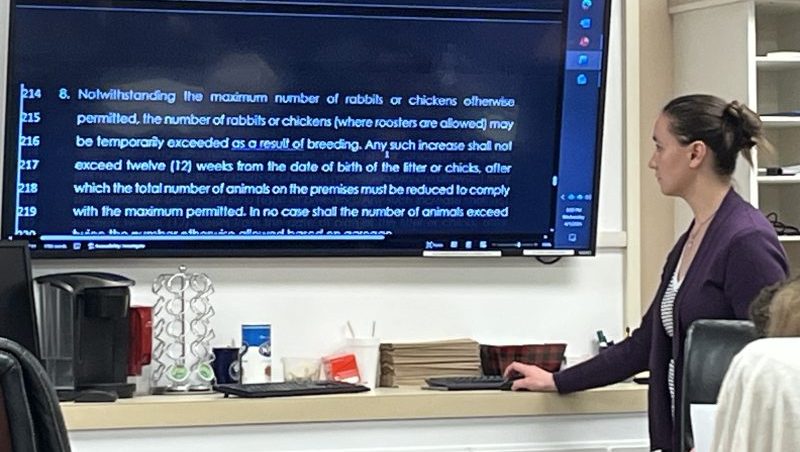
Vice-Chairman Megan Marrazzo interfaces with the other commissioners while making edits to the document for the urban agriculture ordinance.
Based on information received from the extension office, staff concluded that slaughtering would never be appropriate within town limits. The commissioners lamented that it is likely to occur whether permitted or not, but they saw the wisdom of maintaining the disallowance to comply with the state code. How quickly rabbits can proliferate was also a focus of discussion, creating a potentially ongoing compliance nightmare for the urban agriculture practitioner. Coop and run space were discussed in tandem with setback requirements, again generating provisional numbers and categories that do not reflect a final product. In the past, Kopishke has lamented that the code is “convoluted”, ultimately failing to provide guidance. The rewrite will hopefully provide that guidance, combining institutional knowledge with the experience of engaged citizens.
Having also reviewed an application for short-term rental and a zoning text amendment related to the definitions for “firearms retail establishment” and “firearms manufacturing” and their potential places in the C-1 designation, because of the lateness of the hour, the commission postponed the review of the I-2 zone and adjourned.

4 Stimulating Activities for a Healthy Brain After 50

The First Amendment: America’s Unique Foundation of Freedom

How to Tackle Credit Card Debt

Summer Enrichment Camp Gives Teens Hands-On Learning Opportunities

VDOT: Warren County Traffic Alert for April 6 – 10, 2026

David Silek to Remain in Chairman’s Seat of WC Republican Committee Pending 6th District Appeal Decision

Sales Set to Bloom Like Daffodils This Spring

America 250: The Bookseller Who Helped Save the Revolution

Business Growth Series: Why Good Businesses Still Struggle to Grow

Brownies with Mini Chocolate Easter Eggs

Shenandoah Downs Opens 11th Season April 11 with Tribute to Roger Hammer

We Don’t Know Everything About DNA

How PAAS Came to Dominate the Easter Egg Dye Tradition

Spanberger Signs Bipartisan School-Safety, Student Support Bills Into Law

Melanie J. Pomeroy (1958 – 2026)

David Benjamin Heller (1990 – 2026)
1776 Wasn’t Just About Independence

Three-Tiered System for Urban Agriculture Based on Lot Size Takes Shape at Town Planning Commission Work Session

Child Abuse Awareness Month Brings Focus to Reporting, Prevention in Warren County

National Dental Hygienists Week: Is Your Oral Care Routine Optimal?

The Coin That Traveled Through Time and Space

One “What If?” Question Is Changing the Future of Farming

AA Speaker to Explain Recovery Program at United Methodist Men’s Dinner
Jeannette M. Hyland (1944 – 2026)
