
State News
Virginia Cannabis Budget Language Triggers Legal Confusion, Political Fallout
Virginia’s decision to revive legal cannabis sales through the state budget instead of standalone legislation has triggered several days of confusion over the commonwealth’s marijuana laws, with lawmakers, local prosecutors, Virginia State Police, and legislative officials offering differing interpretations of when key provisions take effect.

Virginia officials this week sought to reassure the public that existing marijuana laws remain in effect after budget language prompted confusion among prosecutors, lawmakers, and law enforcement.
Much of the confusion focused on two issues: whether Virginia’s long-delayed retail cannabis market had accidentally been moved up by a year and whether existing criminal penalties for marijuana possession and distribution involving people younger than 21 were still enforceable.
For much of the week, the lawmakers who wrote the budget language, along with state officials, sought to settle the matter. They said licensed retail sales will not begin until July 1, 2027, and that Virginia’s current criminal laws remain in effect until then.
Virginia State Police Superintendent Col. Jeff Katz also publicly reaffirmed the agency’s enforcement position after questions arose from an internal email circulated earlier this week.
“VSP acknowledges that there have been rumors and questions pertaining to the agency’s posture on cannabis enforcement,” Katz said in a statement on X, formerly Twitter. “I would like to make it clear that the Virginia State Police will continue to enforce existing laws, in line with the Code of Virginia.”
The back-and-forth exposed how difficult budget language can be to interpret when it rewrites criminal statutes instead of changing them through standalone legislation.
By the time officials responded Thursday, the unclear language in the spending plan had been revised.
Budget language draws different readings
Questions about the budget language first surfaced among Virginia prosecutors after the General Assembly revived adult-use cannabis retail through the state budget rather than a standalone bill.
Gov. Abigail Spanberger had vetoed legislation creating a retail market earlier this year, and lawmakers instead folded a revised proposal into the budget passed last month instead of reintroducing the measure next year.

Williamsburg-James City Commonwealth’s Attorney Nate Green, a former president of the Virginia Association of Commonwealth’s Attorneys, told The Virginian-Pilot earlier this week that prosecutors spotted the unclear language while preparing guidance for colleagues after the state’s biennial budget became law July 1.
Green said the budget repeals existing statutes governing marijuana possession and distribution involving people younger than 21 but does not explicitly apply the same delayed effective date that lawmakers attached to Virginia’s new retail cannabis market.
He told the paper that it leaves room for competing interpretations over whether the existing criminal provisions remained in effect after July 1 or were immediately repealed.
When asked for clarification on Thursday, Meg Lamb, deputy director of the Virginia Division of Legislative Services — the non-partisan agency that provides legal and legislative support to lawmakers in the legislative process — declined to comment on the budget language, referring instead to the Virginia Code Commission and its executive committee.
Del. Marcus Simon, D-Fairfax, chair of the Code Commission, said the budget language has since been revised in the online Code of Virginia to reflect lawmakers’ intent, describing the change as part of the commission’s routine work to reconcile legislation, usually before it’s formally codified.
“This is sort of a routine process, but things like this do not happen infrequently,” Simon said in a phone interview Thursday afternoon. “We have to sort out internal cross-references in legislation.”
Simon said the commission’s executive committee determined it was obvious lawmakers intended the existing criminal statutes to remain in effect until the new retail marketplace is launched in 2027.
Because the new fiscal year began less than 48 hours after the General Assembly approved the budget, he said the commission had less time than usual to complete its review and sped up the process after questions surfaced publicly.
“We did accelerate things a little bit as sort of a way to quell the controversy,” Simon said, calling the issue “an unmistakable error” the commission is authorized to correct.
Green said in an email Thursday afternoon that the change eliminated the legal uncertainty that had concerned prosecutors.

“I have confidence that the action taken by the Code Commission has addressed and eliminated the argument that the General Assembly intended to repeal the prohibitions against the underage possession or distribution of marijuana before the new laws become effective next July,” Green said.

Del. Marcus Simon, D-Fairfax, chair of the Virginia Code Commission, said revisions to the online Code of Virginia clarified lawmakers’ intent that existing marijuana laws remain in effect until the state’s retail cannabis market launches in 2027. (Photo by Markus Schmidt/Virginia Mercury)
State Police reaffirm enforcement
The different interpretations of the budget language quickly reached law enforcement agencies.
Virginia Scope reported Wednesday that an internal email from a Virginia State Police lieutenant advised that, as of July 1, there were “no Code of Virginia violations related to marijuana” and instructed personnel to report any enforcement action while the agency developed additional guidance.
The email also said cases involving seizures of more than five pounds of marijuana could be referred to the federal Drug Enforcement Administration before any state enforcement action was taken. According to Virginia Scope, the message quickly circulated among prosecutors through the Virginia Association of Commonwealth’s Attorneys.
The internal guidance prompted speculation that marijuana enforcement had effectively been put on hold.
Del. Wren Williams, R-Patrick, an attorney and member of the House Courts of Justice Committee, said the unclear budget language illustrates the risks of making significant changes to criminal statutes through the state’s spending plan instead of the regular legislative process.
“The issue basically is that you’ve got this discrepancy in the budget language, and the argument is that particular language repealed the marijuana related enforcement actions in the budget, starting July 1, 2026,” Williams said in a phone interview Thursday.
“But then, they didn’t take the new laws into effect until July 1 of 2027. So the idea is that there’s a one-year enforcement gap, and that’s going to be problematic, because the ambiguity and the confusion is going to impact our law enforcement and prosecution.”
Simon acknowledged that the budget process was compressed this year and said that the confusion might have been avoided had lawmakers completed their work at the end of the regular legislative session in March.

“I don’t think anybody would argue that the process we went through this year was ideal,” Simon said. “Things did have to happen and come together quickly. It would have been a smoother process if we had gotten everything done on time.”
Democratic lawmakers clarify retail cannabis laws
After questions about the budget language spread through legal circles and onto social media this week, the Democratic lawmakers who sponsored Virginia’s cannabis retail legislation pushed back against claims that the budget had accidentally legalized marijuana distribution or possession by people younger than 21.
Del. Paul Krizek, D-Fairfax, and Sen. Lashrecse Aird, D-Henrico, said in a joint statement Thursday that interpretations suggesting the state’s criminal penalties had disappeared until next summer were wrong.
“Let me be absolutely clear: the budget language passed by the General Assembly did not legalize cannabis possession by minors, did not legalize the distribution of cannabis to minors, and did not eliminate Virginia’s criminal penalties protecting young people,” Krizek said.
“Virginia law continues to prohibit underage possession and unlawful distribution of cannabis. The enactment clauses included in the budget did not change those protections.”

Del. Paul Krizek, D-Fairfax, speaks in support of his bill creating a legal adult-use marketplace for cannabis on the House floor on Saturday, March 14, 2026. (Photo by Markus Schmidt/Virginia Mercury)
Aird said the disagreement stemmed from differing interpretations of a complicated piece of legislation.
“Unfortunately, misinformation spreads quickly, particularly when it involves complex legislation,” she said. “Virginians deserve an honest conversation about cannabis policy based on the facts and what the law actually says — not on inaccurate interpretation based on political opinion.”
Krizek and Aird also pointed to the Code of Virginia, which continues to include the state’s existing prohibitions of unlawful marijuana distribution and possession by people younger than 21.
They said the retail system approved by lawmakers retains age-verification requirements, product testing, child-resistant packaging and other safeguards that will take effect when sales begin next year.

Republicans criticize process
Republicans argued the dispute illustrates why major revisions to criminal law and related legislation should move through the regular legislative process instead of the budget.
Former Virginia Attorney General Jason Miyares wrote on X that lawmakers “jammed their marijuana retail scheme into the state budget instead of allowing it to go through the normal legislative process.”
Williams said the episode reinforced why legislative panels closely scrutinize criminal-law language before bills advance.
“Most people hate coming through our committee because of the nitpicking that we do on the language,” he said. “But this is the exact reason that we do that nitpicking, and it’s because you don’t want to have sloppy language that turns into a wedge argument inside of a jury trial.”
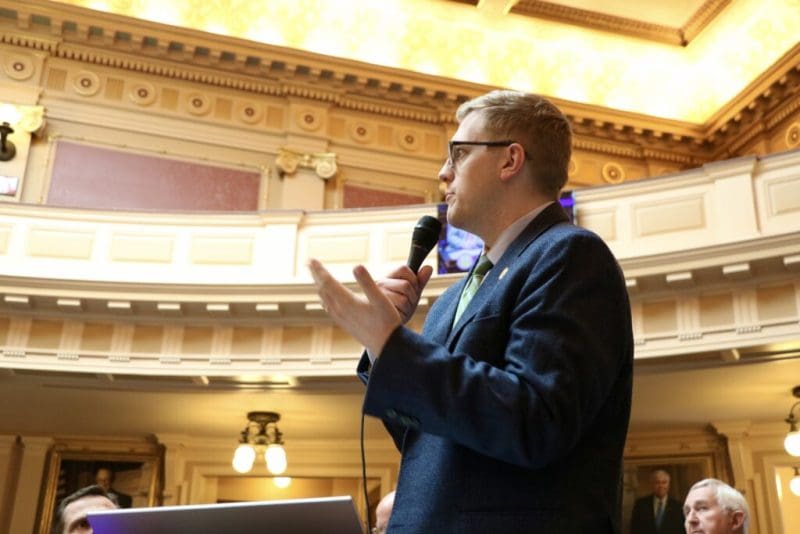
Del. Wren Williams, R-Patrick, said the confusion over Virginia’s cannabis budget language illustrates the risks of making changes to criminal law through the state budget rather than the traditional legislative process. (Photo by Charlotte Rene Woods/ Virginia Mercury)
Politically-fueled fallout
Simon said he believes the controversy has been amplified by politics rather than substantive disagreement over what the law ultimately requires.
“I think people are trying to make some political advantage of it, and people are trying to argue that this was a rushed process, that this was done in a sloppy way,” he said. “But I don’t think there’s a genuine argument about this.”
Simon emphasized that the Code Commission routinely reconciles legislation before it’s incorporated into law, regardless of which party controls the government, and that similar technical corrections have been made for years under both Democratic and Republican leadership.
“It’s a routine thing, this happens countless times on all kinds of legislation,” he said. “This one’s just highlighted because of the timing, because it happened sort of late in the game. But I think it’s been politicized, and I think unfairly so.”
by Markus Schmidt, Virginia Mercury

Virginia Mercury is part of States Newsroom, a nonprofit news network supported by grants and a coalition of donors as a 501c(3) public charity. Virginia Mercury maintains editorial independence. Contact Editor Samantha Willis for questions: info@virginiamercury.com.




Achieve Your Goals by Taking More Positive Action in Your Life

February 1st, 2027, Set for Circuit Court Trial & Further Scheduling in Stroud vs. Treece Criminal Cases

VIEWPOINT: Getting Down to Brass Tacks

Caring For Yourself While You Grieve

Anime USA Brings Three Days of Cosplay, Gaming and Japanese Pop Culture to Chantilly

Your Mammogram Report Now Includes Something New: Breast Density

Halloween Hazards Can Put Senior Pets at Risk, Virginia Animal Welfare Advocates Warn

Spanberger Orders Statewide Cybersecurity Plan to Address Growing Threats From Artificial Intelligence

Another Veteran’s Perspective

Warren County High School Students Help Bring Fall Fest Fun to E. Wilson Morrison Families

Rising Mortgage Rates Slow Virginia Home Sales as Housing Inventory Climbs 20 Percent

10 Tips for a Safe Halloween

Virginia Joins Governors Public Health Alliance to Strengthen Disease Prevention and Emergency Response

When Your Phone Stops Recognizing Your Fingerprint

Joan Chapman Named 2026 Valley Treasure for Bringing Women and Girls Closer to the Shenandoah River

Loss of 130,000 Trout at Virginia Hatchery Will Reduce Stocking in Warren County and 10 Other Counties

VDOT: Warren County Traffic Alert for Oct. 26 – 30, 2026

Stone Branch Offers Sugar Skull Art Workshop to Celebrate Day of the Dead

Ink & Drink Returns to Front Royal With Halloween-Inspired Printmaking Workshop

38 Years Without Answers: Family and Investigators Still Seek Justice for Tammy Thorpe

Warren County Wildcats Host Meridian Under Friday Night Lights – October 23

Community First: Jubilee Event Sees High Turnout with Public Servants in Attendance

St. John’s Drama Brings Tom Sawyer to Life in Musical Celebrating America’s 250th Birthday

Remembering the Legacy of Ditka and Da Bears
