
Local Government
Worthy Possibility or Strategic Failure: Data Centers in Focus at Town Council Work Session
“It communicates we’re open for business.”
Vice-Mayor Amber Veitenthal, at a Town Council work session of May 11, identified the Achilles’ heel of an effort, developing in 2025 and spearheaded by the Town Planning Commission, to articulate standards by which a data center’s arrival in Front Royal might be welcomed. Her statement was embedded in the context of a high-voltage exchange with Town Attorney George Sonnett, which ended with her request that legal’s advisement be captured in writing and facilitated by outside counsel. Their exchange reflected upon a closed meeting of May 4 in which Veitenthal heard things and developed impressions that conflicted with what she was hearing and perceiving at this meeting. Hence, the need for ambiguity to be murdered, murdered as openly as possible.
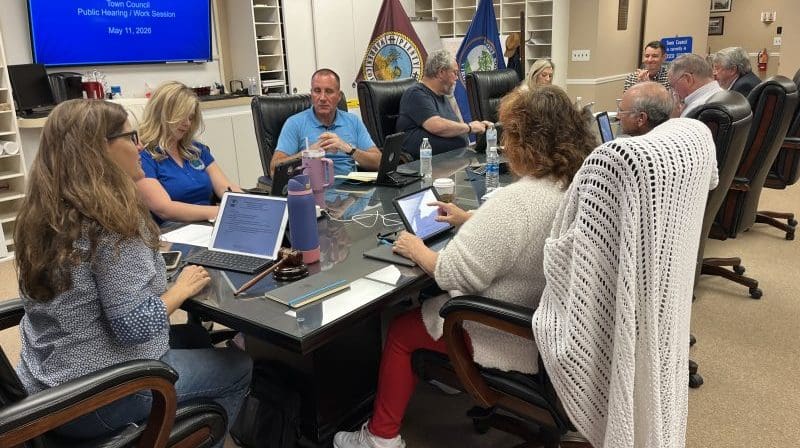
The Town Council met for a work session on May 11. Royal Examiner Photo Credits: Brenden McHugh
Today’s data centers might have inspired Alan Turing with conflicting emotions, had he lived to see how the device he crafted to break the Nazi code would get hijacked by the computing industry. Northern Virginia is now the global capital of a use that has been known to take more than it gives, running roughshod over communities as it places a high demand for resources like water and electricity, while being unsightly, noisy, and commandeering precious space that could be used for more worthwhile operations the communities need. The developers have come with a Luciferian promise of power, not limited to tax revenue, but also the storage space in the “cloud” that will facilitate the transfer of information. What is left out is how quickly these complexes will become obsolete and the relative lack of privacy in having one’s information uploaded to that cloud.
According to Sonnett, any ban on the data center use in Front Royal, a ban being what Veitenthal favors, must arise from the commission; according to Veitenthal and her understanding of Robert’s Rules of Order, the ban could be established at the same moment that the proposed ordinance that articulates the standards for data centers is rejected. What specifically Sonnett said during the exchange that may constitute a change from what he said in the closed meeting remains in shadow, for now. But another point addressed is Virginia’s character as a Dillon Rule state, in which uses allowed by the General Assembly are likely to prevail in court if a municipality disallows them. Data centers being a use allowed by the assembly, it is therefore arguable that a data center developer could bring success from on high. In this connection, Veitenthal stated what she has stated before: that the state code may say something that the municipality is justified in rejecting.
Other council members held varying positions. While there was consensus to expedite the item, not send it back to the commission to check for alignment with a recent development in state code, and possibly strengthen the standards further, Councilman Bruce Rappaport allowed that the standards could indeed be strengthened. Councilman Glenn Wood asked legal whether a “temporary moratorium” is a possibility, and received the same evasive response that characterized the response to Veitenthal. Given water as a limited resource, Councilman Wayne Sealock said he sees no potential for a data center in Front Royal. While noting that standards may not be completely out of the question, Councilwoman Melissa DeDomenico-Payne joined others in urging that the process be expedited and that the proposed ordinance come to a vote. Councilman Joshua Ingram, with experience in data centers and a clear understanding of how they work, joined Veitenthal in the view that they should be banned.
Thus, the mayor was directed to mark the item as an action item for the June 22 meeting. The council also reviewed housekeeping items with Purchasing Manager Michelle Campbell, listened to a presentation from a CHA consultant on a potential water resource, and gave the public an opportunity to provide input on the budget to be adopted on May 26, though no one did. With no other business to conduct in an open meeting, the council went into a closed meeting.




American Songs Concert Coming to First Baptist Church in Front Royal on October 25

When Grief Doesn’t Ease With Time

Sudden Cardiac Arrest May Not Be As Sudden As Its Name Suggests

100 Years of Hundred Acre Wood

A Moment of Honor: Veterans Receive a Powerful Tribute at the Tomb of the Unknown Soldier

Samuels Public Library Invites Young Writers and Artists to Enter 48th Annual Holiday Contest

New Exhibitions Bring World-Class Contemporary Art to Downtown Front Royal

VDOT: Warren County Traffic Alert for October 19 – 23, 2026

Discover The Many Benefits Of Organized Sports

The Family Bond That Doesn’t Necessarily End When Contact Does

Virginia State Police Urge Drivers to Stop for School Buses and Students

Economic Development Director Patrick Barker Details Maturing Plan at Town-County Liaison Meeting

Virginia Breeders’ Championships Begin This Weekend at Shenandoah Downs

Local Author Invited to Share Children’s Book at Irish Castle That Inspired It

Virginia State Police Seize More Than $334,000 in Drugs, Recover Five Firearms in Weeklong Operations

Business Growth Series: Big Projects Don’t Get Done — Small Tasks Do

Data Center Moratorium Bills Stack Up Ahead of Virginia Legislative Session in January

Transgender Care for Young Patients Remains On Hold at Virginia Hospitals

Commentary: Spanberger’s Energy Plan Dazzles – and Disappoints

The Workplace Accommodation That Costs Nothing

Nothing In Dolly Parton’s Library Is Ever Returned

Trump: Execution of Fort Hood Shooter Will Not Be Livestreamed

Harmony Hollow Holler Music Festival Brings Appalachian Music to Front Royal October 17

Winsome Earle-Sears Warns of Consequences of Virginia’s Proposed Constitutional Amendments
