
State News
Little Tracking, Wide Variability Permeate the Teams Tasked With Stopping School Shootings
Max Schachter wanted to be close to his son Alex on his birthday, July 9, so he watched old videos of him.
“It put a smile on my face to see him so happy,” Schachter said.
Alex would have turned 21 that day, six years after he and 16 other children and staff at Marjory Stoneman Douglas High School in Parkland, Florida, were shot and killed by a former student in 2018. In the years before the shooting, that former student had displayed concerning behavior that elicited dozens of calls to 911 and at least two tips to the FBI.
“Alex should still be here today. It’s not fair,” Schachter said.

After two weeks of grieving Alex’s death, Schachter, propelled by anger and pain, began advocating for school safety. In part, he wanted to ensure his three other children would never be harmed in the same way. He joined the newly formed Marjory Stoneman Douglas High School Public Safety Commission to improve the safety and security of Florida’s students. And he launched a nonprofit bearing Alex’s name, which advocates for school safety.
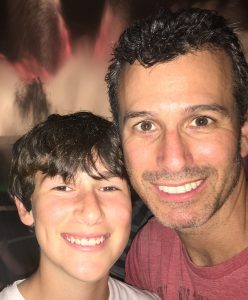
Max Schachter with his son Alex. (Max Schachter)
Doing that work, he learned about threat assessment teams, groups of law enforcement and school officials who try to identify potentially dangerous or distressed kids, intervene, and prevent the next school shooting. Florida is one of about 18 states that require schools to have threat assessment and intervention teams; a national survey estimates 85% of public schools have a team assigned to the task.
The teams, whose mission and operational strategies often are based on research from the FBI and the Secret Service’s National Threat Assessment Center, or NTAC, have become more common as the number of school shootings has increased. Despite their prevalence for almost 25 years, some of the teams have developed systemic problems that put them at risk of unfairly labeling and vilifying children.

States vary widely in their requirements of threat assessment teams and there isn’t a nationwide archetype. Few school districts and states collect data about the teams, little is known about their operations, and research on their effectiveness at thwarting mass shootings and other threats is limited. But a 2021 analysis by the NTAC of 67 plots against K-12 schools found that people “contemplating violence often exhibit observable behaviors, and when community members report these behaviors, the next tragedy can be averted.”
“School shooters have a long thought process. They don’t just snap. They have concerning behavior over time. If we can identify them early, we can intervene,” said Karie Gibson, chief of the FBI’s Behavioral Analysis Unit.
Yet, Dewey Cornell, a forensic clinical psychologist who in 2001 developed one of the first sets of guidelines for school threat assessment teams, said there have been problems. In many cases, he said, threats have been deemed not serious “but parents and teachers are so alarmed that it is difficult to assuage their fears. The school community gets in an uproar and the school administrators feel pressured to expel the student.”
Virginia was the first state to require threat assessment teams in all its public schools. The Virginia General Assembly first passed legislation in 2008 requiring all public institutions of higher education to establish threat assessment teams. The law followed a mass shooting on the Virginia Tech campus in 2007.

Then, in 2013, lawmakers enacted legislation requiring all public schools to establish and operate threat assessment teams in support of their schools.
And in other cases, a school doesn’t do a threat assessment and assumes a student is dangerous when somebody else reports them as a threat, and they may take a zero tolerance approach and remove them from the school, said Cornell, the Virgil S. Ward professor of education at the University of Virginia.
A task force convened by the American Psychological Association found little evidence that zero tolerance policies have improved school climate or school safety and said they may create negative mental health outcomes for students. The task force cited examples of students who were expelled for incidents or school rule violations as minor as having a knife in their lunch box for cutting an apple.
Marisa Randazzo, a research psychologist and the director of threat assessment for Georgetown University, said she has also seen “hyperreactions,” especially among school communities that have experienced a mass killing.

“It’s understandable. People who have been close to an event like this are on higher alert than other people,” said Randazzo, who previously worked for the Secret Service and co-founded Sigma Threat Management Associates.
Threat assessments are supposed to be a graduated process calibrated to the seriousness of a problem, since the majority of student threats are not credible and can be resolved through supportive interventions, according to research from the Secret Service.
Stephanie Crawford-Goetz, a school psychologist and the director of mental health for student support services in the Douglas County School District in Colorado, where a shooting occurred at a charter school in 2019, said her district’s threat assessment process emphasizes a proactive, rehabilitative approach to managing potential threats, as the NTAC suggests.
Crawford-Goetz said her district interviews students before convening the team to assess whether a threat is a misguided expression of anger or frustration and if the student has a plan and means to carry out violence.

Students whose threats are deemed transient receive support, such as help with coping skills, and they may meet with a mental health provider.
If the threat is credible, a student may be temporarily removed from the classroom or school.
Randazzo said the vast majority of kids who make threats are suicidal or despondent: “The process is designed primarily to figure out if someone is in crisis and how we can help. It is not designed to be punitive.”
Crawford-Goetz tells parents about her district’s threat assessment team at the beginning of the school year. Some districts report keeping their teams a secret from parents, which is not how they were designed to operate, said Lina Alathari, chief of the NTAC. Her team encourages schools to educate the whole community about the threat assessment process.
Some advocacy groups contend that threat assessment teams have perpetuated inequities. There has also been widespread concern that children with disabilities can easily get swept into a threat assessment.
In a 2022 report, the National Disability Rights Network, a nonprofit based in Washington, D.C., said some threat assessment teams have become “judge, jury, and executioner,” going beyond assessing risk of serious, imminent harm to determining guilt and punishment.
Expanding their scope allows threat assessment teams to get around civil rights protections, the report says.
Cornell disputed the disability rights group’s conclusion. “This has not been corroborated by scientific studies and is speculative,” he said.
Some states, such as Florida, mandate that threat assessment teams determine whether a student’s disability played a role in their behavior and recommend they include special education teachers and other professionals in their evaluation.
In Texas, which has mandated threat assessment teams, a third of students subjected to threat assessments in the Dallas Independent School District receive special education services.
Yet, the district doesn’t have a special education staff representative on its threat assessment team, according to a March 2023 report by Texas Appleseed, a nonprofit public interest justice center.
Many school districts are developing their own models in the absence of national standards for threat assessments.
Florida revamped its threat assessment system in January 2024 to improve response times, provide consistent data collection, and build in more checks and balances and oversight, said Pinellas County Sheriff Bob Gualtieri, who is also chair of the Marjory Stoneman Douglas High School Public Safety Commission.
The new model requires the teams to work quickly and file uniform, electronic summary reports of threat assessment findings. Those results follow students throughout their school years.
The adjustments are intended to eliminate the risk of not knowing about a student’s past troubling behavior if they change schools, as occurred with the Parkland shooter and a student who shot and killed classmates at a high school near Winder, Georgia, in September, said Gualtieri.
“As parents, you never stop worrying about your kids,” Schachter said.
Virginia mandates that all public schools and higher education institutions, including colleges, have threat assessment teams. In Florida, where one of Schachter’s daughters attends college, threat assessment teams are mandated in all public schools, including charter schools.
“There’s more work to be done,” Schachter said.
KFF Health News is a national newsroom that produces in-depth journalism about health issues and is one of the core operating programs at KFF — the independent source for health policy research, polling, and journalism.
by Cheryl Platzman Weinstock, Virginia Mercury
Virginia Mercury is part of States Newsroom, a nonprofit news network supported by grants and a coalition of donors as a 501c(3) public charity. Virginia Mercury maintains editorial independence. Contact Editor Samantha Willis for questions: info@virginiamercury.com.




Mayor Lori Athey Cockrell Looks to Water, Economic Development and Rail Trail in Another Term

WCHS vs. Brentsville HS – Girls Volleyball – October 6, 2026

BMI Is Only One Piece of the Health Picture

The Eye Surgery Factory That Could Not Expand

Ancient Ownership of Israel

VDOT: Warren County Traffic Alert for October 5 – 9, 2026

Reaching Out Now Expands Programs and Opportunities for Warren County Youth

Dance and Arts VA Finds New Home, New Opportunities on Water Street

Ann L. Shuman (1933 – 2026)

Wendy Lee Whitacre-Stout (1966 – 2026)

Spanberger’s Energy Plan Keys in on Clean Energy to Meet Growing Demand and VCEA Goals

Jean Elizabeth Grubbs Fogle (1939 – 2026)

Feds Provide Guidance on New Federal K-12 Scholarship Tax Credit Program

Why Wait Till November? Mid-Term Election Early Voting Processes in Place Now

US Senate Leaves Nation’s Capital in Advance of Midterms With Much Still Undone

Business Growth Series: If You Don’t Control Your Day, It Controls Your Business

The End of a 20-Year Monopoly on the Credit Score
Voltron and Immigration

States OK Solar Panels for Balconies. Safety Guidelines Haven’t Caught Up

Trump TV Ads Paid for with $20M in Homeland Security Funds, Dems Find

Blue Ridge Wildlife Center Patient of the Week: Gray Treefrog

Birthday Twins: See Which Famous Face Shares Your Big Day

Meet-and-Greet Set Sunday for Republican-Endorsed Front Royal Candidates

Barbara Ann Mathews Smelser (1943 – 2026)
