
Interesting Things to Know
How George Washington Used His First Thanksgiving as President to Unite a New Country
On Thursday, Nov. 26, 1789, George Washington woke early. Assisted by his enslaved valets – William “Billy” Lee and the young Christopher Sheels – he powdered his hair, put on his favorite black velvet suit, tied his white neckwear, and donned his yellow gloves.
Finally ready, he set out to travel the short distance from the President’s House, at what used to be 3 Cherry St., New York, and St. Paul’s Chapel, which still stands at 209 Broadway.
He had an important aim that day: to celebrate Thanksgiving. Washington had thought carefully about this Thanksgiving, the first of his presidency. On Oct. 3, 1789, following the recommendation of a joint committee of the Senate and House of Representatives, Washington had issued a proclamation. He urged the people of the United States to celebrate “a day of public thanksgiving and prayer.”
But Washington believed that particular Thanksgiving in 1789 was a crucial occasion. He would use it to call on the people he now led to hold their new country together in the face of forces that he knew could pull it apart.

Devotion in the service of unity
It was not the first Thanksgiving Americans celebrated. The firsttook place at Plymouth colony in the autumn of 1621 – Pilgrims held a feast to thank God for their first harvest and invited members of the neighboring Wampanoag tribe.
It was not even the first national Thanksgiving – which was held on Dec. 18, 1777, at then-General Washington’s behest. Nor was Thanksgiving yet a federal holiday to be observed every last Thursday of November – it became so with the 1863 proclamation of President Abraham Lincoln.

George Washington’s Oct. 3, 1789, Thanksgiving Day Proclamation. (Photo courtesy National Archives)
Nov. 26, 1789, was a Thursday, and the weather was miserable. Few New Yorkers showed up at St. Paul’s Chapel to see the president: “I went to St. Pauls Chapel,” Washington wrote in his diary, “though it was most inclement and stormy.” There were “but few people at Church.”

The president had prepared for the occasion. He also contributed a sizable sum of his own money to buy beer and food for prisoners confined for debt in the New York City jail. The donation was deemed to be a magnanimous and moving gesture, suitable to the spirit of the holiday. A week later, in an advertisement in the Dec. 3 issue of the New York Journal, those very prisoners returned their “grateful thanks” to their president “for his very acceptable donation on Thursday last.”
Washington’s first Thanksgiving as a president may have not been tremendously successful, given the scarce attendance at the church service.
Yet, as a scholar writing a biography about Washington, I believe it was an important step in his much larger political plan to bring the executive branch to the people’s doorstep.
What Washington wanted was a virtuous kind of populism in the new country he led. Washington’s populism wasn’t about inciting an angry mob; it was about sharing in their rituals, worshiping their God, speaking their own language. And he did so in the sole interest of the American people.

Thanksgiving 1789, for Washington, was at once religious and more than religious. Washington’s proclamation invoked devotional language, literally. The upcoming festivity, in his words, could “be devoted by the People of these States to the service of that great and glorious Being, who is the beneficent Author of all the good that was, that is, or that will be.”
But Washington’s main concern was political. The nation was recently formed, and he feared that it could easily collapse. Its many internal divisions and separate interests could be lethal. Consequently, the president wanted this holiday to be a civic celebration in which “we may then all unite.”
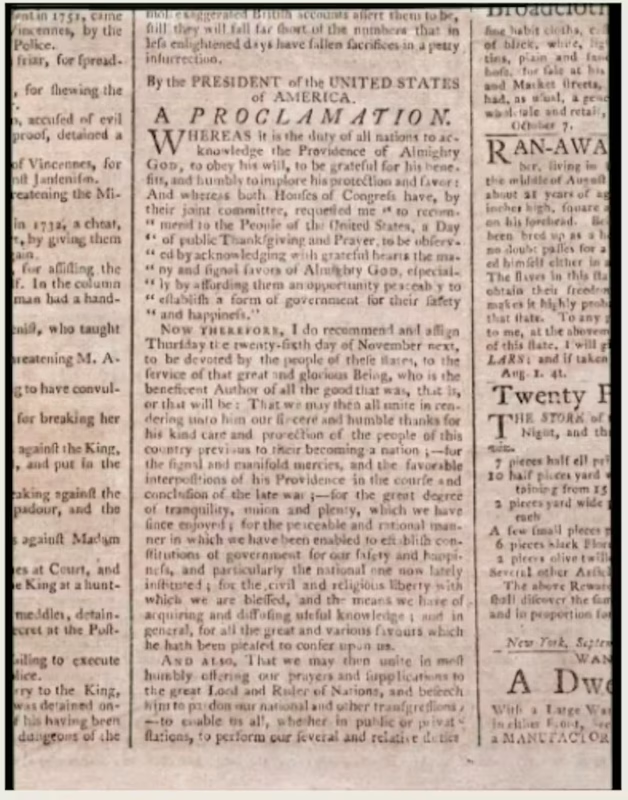
Washington’s proclamation was printed in newspapers throughout the country. George Washington’s Mt. Vernon
‘Pardon our national…transgressions’
As its first president, Washington recognized that the United States was born out of slavery, conquest and violence as much as of sacred principle. Civic unification required acknowledgment of these flaws. Thus, in the proclamation, Washington asked God “to pardon our national and other transgressions.”

A tremendously self-aware man, Washington knew that he was a deeply flawed person himself.
He was a slave owner, a relentless pursuer of African American fugitives and a destroyer of Native American villages. He was also a warrior who deployed brutality against enemies. He was a commander who resorted to corporal punishment with his own soldiers. Washington believed that he was not a saint to be mindlessly imitated. This made him humble in his duties.
More importantly, Washington also grasped the power of his symbolic position as president. He sought to leverage that for the good of the nation.
As president, Washington could not advertise his actions effectively via Twitter and social media. He had to show himself around constantly, no matter the weather. He had to painstakingly attend balls, plays, dinners, public receptions and of course the church. Every occasion, every Thanksgiving counted.

Through his outings, Washington met with a diversity of people, including those who were second-class citizens or were not citizens at all. Women, for example, greeted Washington at nearly every stop of the extended presidential trips he took between 1789 and 1791. Textile workers in New England, Jewish leaders in Newport, many enslaved persons in the South and churchgoers everywhere did the same.
These women and men, in bondage or free, believers or skeptics, played a part in the invention of a new political theater. Maybe, it was just a theatrical illusion. But these individuals – just like the prisoners in the New York City jail – thanked President Washington because they felt they were voices in a larger political culture.
Washington made sure his Thanksgiving message – not simply a message, but a “proclamation” – sounded clear and strong: May God “render our national government a blessing to all the people, by constantly being a Government of wise, just, and constitutional laws, discreetly and faithfully executed and obeyed.”
This story originally appeared in The Conversation.
by Maurizio Valsania, Virginia Mercury
Virginia Mercury is part of States Newsroom, a nonprofit news network supported by grants and a coalition of donors as a 501c(3) public charity. Virginia Mercury maintains editorial independence. Contact Editor Samantha Willis for questions: info@virginiamercury.com.




Hike Kidz Foundation Partners with Love in Action to Deliver Fresh Food to Families

After 12 Years of Service, Seniors First Executive Director Jimmy Roberts to Retire

Warren County Residents Speak Against Data Centers at County Planning Commission Meeting

Pirate Adventure Vacation Bible School Sets Sail July 19 at First Baptist Church

The Human Access Layer

Two Juveniles Charged After 17 Vehicle Break-Ins in Bentonville Area

Prince William Supervisors Reject Dulles Cloud South Data Center Proposal

Trump Faces Looming Deadline to Sign Popular Bipartisan Housing Package

How the Declaration and the Constitution Are Inseparable

How to Say “I Don’t Know” Gracefully

Meet the Brown Marmorated Stink Bug

Fireman’s Parade Draws Crowds Despite Summer Heat as Carnival Continues Through Saturday

Warren Memorial Hospital Achieves Another National Recognition

Warren County Tourism Debate Expands Into Broader Conversation About Governance, Accountability, and the Future of Regional Marketing

Game Postponed to July 17 – Cardinals Host New Market Rebels Thursday, July 9 at Bing Crosby Stadium

Court Battles Leave Virginia’s New Assault Weapons Ban in Legal Limbo

Virginia Ranks Among Top States for Highway Safety and Mobility Benefits, but Challenges Remain

The Supreme Court Should Be Above Politics

Commentary: Virginia’s Atlantic Coast Should Be Protected, Not Turned Into a Sacrifice Zone

Dropped Your ACA Insurance Due to Spiking Premiums? You Could Qualify for a State Subsidy This Fall

CDC Monitors Rise in Cyclosporiasis Cases as Summer Produce Season Begins

Kathryn E. “Kathy” Warren (1958 – 2026)

Virginia Expands RetirePath Retirement Program to More Small Businesses

Everyone Is Going to the Moon. Will We Fight Over It?
