
Automotive
A history of roads in Virginia: A new study, a new network
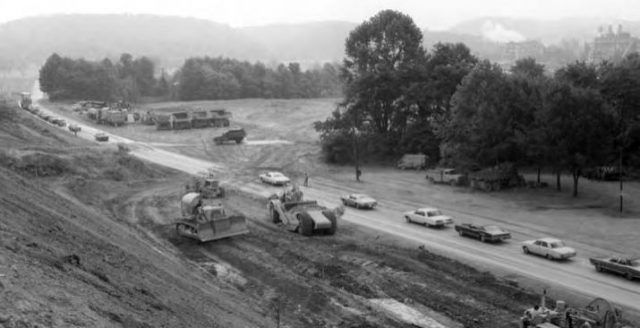
Two additional lanes are constructed parallel with the lanes of Route 460 in Giles County in 1969 to create a divided arterial highway.
It soon became evident, however, that the interstate routes alone would not adequately serve the burgeoning population and the increasing desire for mobility by Virginians in the second half of the 20th century. The spreading suburban growth that marked Virginia and other states in the years after World War II was induced in large part by the flexible mobility permitted by the family auto. Suburban housing development was followed by suburban shopping centers and office buildings. It all placed new demands on the state’s roads and streets. The 20-year improvement plan that had been implemented by the commission in the immediate post-war years had to be revised and updated frequently to keep pace with changing needs and growth patterns.
In 1962, the General Assembly established a new study commission to examine and evaluate highway needs, revenue, fund distribution procedures, and the organization of the Department of Highways. It consisted of one member from each of the eight construction districts and two citizens at large. The study commission members were appointed by Gov. Albertis S. Harrison Jr., in May 1962, with Sen. William F. Stone of Martinsville, an experienced legislator who had been a chief patron of the act calling for the study, chosen as chairman.
For more than a year, the study commission went about its assignment, reviewing nearly every aspect of the highway program. The commission itself probably was the most important highway study group since the 1916 committee that recommended the establishment of the first state highway system.

The Stone commission submitted its report to the governor and the General Assembly in December 1963, in time for its recommendations to be considered at the legislative session beginning the following month. Among its points: “One of the prime factors in inducing business management to select a state for expansion or a new location is a good highway system, which not only is needed for transportation of goods and raw materials but enables employees to be drawn from a wide radius. Some other states have moved ahead of Virginia in expanding their highway systems. We cannot afford to be left behind.”
The study commission also described the motor vehicle as “an essential and integral part of our everyday life. Its impact upon our economy and way of life has reached dimensions which have exceeded all forecasts.”
In an effort to keep up, the commission said, a new arterial network should be developed to supplement the interstate system.
Douglas B. Fugate, who joined the department shortly after graduating from VMI with a degree in civil engineering in 1927, was serving as assistant chief engineer at the time and in 1964, was appointed commissioner by Gov. Harrison. Fugate proposed the arterial network concept to the study commission and thus became chief architect of the network.

“The arterial road program, when completed, will in conjunction with the interstate system connect every city within the commonwealth of 5,000 or more and nearly every town having a population of 3,500 to 5,000. When completed, there will be an arterial route or interstate route within a 40-mile radius of every town in Virginia,” the study commission said.
Development of the network was authorized by the 1964 General Assembly, which also provided additional revenue through increases in the state’s motor vehicle registration and operator’s license fees. As approved, it totaled more than 1,700 miles and was to be developed chiefly by building new two-lane roadways parallel to existing two-lane primary routes to create four-lane, divided facilities. More than 70 bypasses of cities and towns were to be constructed, to free local streets for local traffic, and many of the bypasses would be constructed virtually to interstate standards.
The arterial network was half-finished within seven years after it was begun. In some quarters, the network was described as a “model for the nation because of the orderly way in which it ensured up-grading of older primary roads while the interstate system development was still under way.”
In the mid-1950s, when the interstate program was beginning, Virginia had about 300 miles of multi-lane divided highways. With interstate and arterial completion, it later would have slightly more than 3,000 miles of such roads.

Produced by the
Virginia Department of Transportation
Office of Public Affairs
1401 E. Broad Street
Richmond, VA 23219
VirginiaDOT.org




Virginia State Police Seize More Than $2.6 Million in Drugs During Weeklong Operations

Give Downtown Front Royal a Place to Sit

Warren County High School Welcomes E. Wilson Morrison Students After Emergency Closure

Warren Heritage Society Opens New Main Street Pocket Museum and Tour Headquarters

Carla Schwarck Slater (1947 – 2026)

PickleStock Returns to Warren County Fairgrounds September 12

William “Bill” John Mathers (1935 – 2026)

Trump Orders Commission to Explore Creation of U.S. Space Academy

First Warren County GOP Meeting Under Scott Lloyd Stalls in Procedural Disputes, Ends Without Officer Vote

Virginia Officials Announce Disbursement of $122 Million in Rural Health Transformation Fund Awards

If Virginia’s Reproductive Rights Amendment Passes, Challengers Say They’ll Fight to Overturn It in Court

Agritourism Summit Brings Farmers, Tourism Leaders and State Officials Together in Frederick County

Terry Wayne Foster (1962 – 2026)

Cottonwood Ranch Hosts Saturday Social With Live Music, Wine and Local Food

Business Growth Series: Why Simple Businesses Grow Faster

As Student Well-Being Concerns Grow, Virginia Advocates Push for Stricter School Tech Guidelines

With Six West Nile Cases Reported Statewide, Infected Mosquitos Are on the Rise in Virginia Beach

Commentary: A Pesticide-Free Farm Can Have Worse Soil Than One Sprayed With Roundup

Warren County Sheriff’s Office Foundation Expands Community Programs, Plans Fall Events

New Proposal from Grid Operator PJM Would Require Data Centers to Gring Their Own Power

Apple Wallet Adds Driver’s Licenses and IDs for Virginia Residents

Samuels Library Sets September Lineup With SamiCon, Community Programs and Family Activities

Virginia to Receive $353 Million in Landmark Meta Child-Safety Settlement

Trump’s Second-Term Immigration Agenda Extends Beyond Border Enforcement
