
Automotive
A history of roads in Virginia: The interstate system
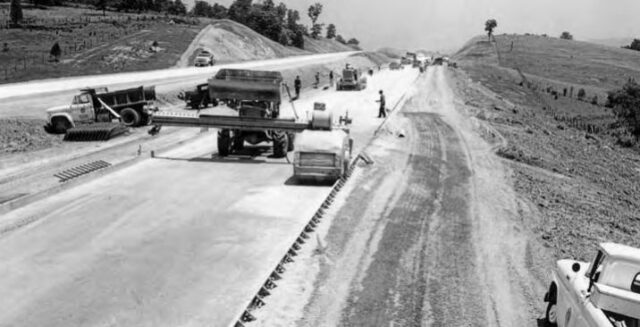
Interstate construction in 1964 progresses along the I-81 corridor.
In 1923, a Delaware business executive named T. Coleman DuPont had built a three mile stretch of divided highway with his personal funds and had given it to the state of Delaware. Road historians generally regard that segment of road as representing the origin of the concept of the superhighway. But Depression, war and catching up on other basic needs had slowed the spread of the concept.
Before his death in 1941, Henry Shirley had seen the need for such a facility in the rapidly urbanizing Northern Virginia suburbs of the District of Columbia. Active planning got under way in the mid-1940s, and the road was built in the late ‘40s and early ’50s. It was Virginia’s first superhighway, and the commission named it for Shirley.
Development of a nationwide system of such highways was first seriously considered in 1938, when Congress asked the federal highway agency, by then called the Bureau of Public Roads, to study the feasibility of a toll-financed system of three east-west and three north-south superhighways. The study report encouraged the concept of a superhighway system, but said that it would be far from self-supporting if built on a toll-road basis. It proposed, instead, a network of toll-free roads for which the federal government would pay more than the normal 50 percent federal-aid rate.

The idea was studied further, and in the Federal Aid Highway Act of 1944, Congress called for the designation of a national system of interstate highways that was “so located as to connect by routes, as direct as practicable, the principal metropolitan areas, cities, and industrial centers, to serve the national defense, and to connect at suitable border points with routes of continental importance.”
It was not until the passage of the Federal-Aid Highway Act of 1956 that sufficient funding was provided for development of the system to begin in earnest. This act created the National System of Interstate and Defense Highways. Eventually, the system was to total 42,700 miles. It would represent little more than 1 percent of the nation’s total road and street mileage, but it would carry 23 percent of the traffic. It was to be financed with 90 percent federal and 10 percent state funds.
Virginia’s share was more than 1,070 miles (eventually 1,118 miles), and the Highway Commission assessed what development of the interstate system would mean to Virginia:
“Construction of this modern road network… involves many problems and radical changes in thought. Under the new program, interstate highways will be insulated from marginal traffic generated by motels, service stations, other types of businesses, and dwellings. Traffic entering and leaving these highways will do so at designated points. Cross movements of traffic, with which we are so familiar, will be eliminated.”

“The benefits of controlled-access construction are numerous. A modern controlled access road transforms, in many ways, the area through which it passes. Land values increase. This type of road promotes safety, saves travel time, reduces the strain on drivers, and aids the economic development of the area. Controlled-access standards also protect the state’s investment in its highways,” the commission observed, even before the first mile of the interstate system had been built.
The commission members recognized, as well, the size of the job before them. “We are now embarked on the most accelerated road program in the state’s history. Unprecedented sums of money will be spent… to provide Virginia with modern adequate highways. Present traffic patterns will be changed, new areas will be opened for business, and residential and recreational development. The future will present a challenge greater than any we have faced in our highway development. What we accomplish will depend largely on public understanding, acceptance, and support.” An extensive series of public hearings was held around the state to discuss plans for interstate system projects with citizens and local governing officials.
The first interstate system hearing in Virginia was held by the Department of Highways on Feb. 20, 1957. It concerned a 10-mile segment of Interstate 95 south of Petersburg. Within the next four months, 10 more hearings were conducted on interstate projects, and construction began on the state’s first project on the new system — the six-mile Interstate 95 bypass of Emporia. Early emphasis was on the 1-95 facility because it was to parallel U.S. Route 1, which by the mid-1950s had become the most heavily traveled through road in Virginia and one of the nation’s busiest highways.
The Emporia bypass also was the first interstate project to be completed in the commonwealth. It was opened to traffic Sept. 8, 1959. The first major interstate route to be completed fully was Interstate 495, the Virginia portion of a beltway circling the District of Columbia, with its final section being opened on April 2, 1964.

By the early 1970s, the interstate system was about 75 percent finished, and it was fulfilling to a large degree the expectations expressed by the commission at the outset of the program. Accident rates on the new superhighways were only about onehalf the rates on the older conventional roads; travel time was reduced an hour or more on cross-state auto trips; the new roads stimulated extensive commercial, industrial, and residential growth; and this, in turn, provided broader tax bases for local governments.
A new generation of Virginians, growing up with the interstate system, could hardly remember what travel was like without it.
Produced by the
Virginia Department of Transportation
Office of Public Affairs
1401 E. Broad Street
Richmond, VA 23219
VirginiaDOT.org




CSM Aesthetics Celebrates Growth With Front Royal Ribbon Cutting

VDOT: Warren County Traffic Alert for September 21 – 25, 2026

Spanberger Presents Slate of Data Center Regulation Proposals, Puts First Directives in Motion

Early Voting Begins in Virginia, as Trump Mail-Ballot Restrictions Remain Blocked

Virginia Confronts $1.7 Billion Shortfall in Highway Maintenance Funding

Trump Admin Aims to Shift Homelessness Grants Toward Addiction Treatment, Enforcement

James I. “Jim” “Bubba” Benjamin Jr. (1942 – 2026)

Business Growth Series: Distractions Are Costing You Customers

GPS Dog Collars Can Give Hunters Added Peace of Mind in the Field

Encouraging Peonies

E. Wilson Morrison Physical Plant Engineering Update Leaves Questions on Path Forward in Most Cost-Effective Manner

In Cannabis Ordinance Review, Commissioners Identify Direction from Town Council as Critical

Fed Raises Interest Rates for First Time in 3 Years, Battling Persistent Inflation

Barbara Tilden Neitzey (1940 – 2026)

Ronald Wayne Montgomery (1957 – 2026)

If You Have a Story, Tell It: Pentagon Responder Reflects on 9/11

Nancy Grant Boger (1936 – 2026)

Community Leadership: The Visibility That Shapes Tomorrow

Spanberger Declares State of Emergency as Drought Strains Virginia Farmers

Cars Changing Lives Plans Murder Mystery Fundraiser as Nonprofit Nears 100 Vehicle Milestone

Childhood Cancer Awareness Month Focuses on Education, Support and Action

The Window Topper We Tore Out Is Back

County Elected Officials Seek Path Forward Economically with the Town’s Decision Makers – NOT Behind Citizens Backs

For the Cats’ Sake Fall Market Returns to Front Royal Oct. 3
