
Automotive
A history of roads in Virginia: 20 year plan – upgrade all roads; replace most ferries

In 1948, the department took over operation of the ferryboat service in Hampton Roads. The service ended in 1957 when the Hampton Roads Bridge-Tunnel opened.
Just after the war, Commissioner Anderson set a new objective for the state’s regrouping highway forces: Not a school day lost because of mud. Muddy roads remained a problem in many areas, particularly in winter thaws, and Anderson’s idea was to solve that dilemma while providing a solid goal toward which maintenance forces could work.
Moving in other new directions, the commission began implementing a 20-year plan for upgrading all road systems and embarked on a new program intended to replace most of the state’s remaining ferries.
As authorized by a revenue bond act passed earlier by the General Assembly, the commission decided during the 1946-47 fiscal year to construct toll bridges to replace ferry crossings on the York River at Yorktown and the Rappahannock River at Grey’s Point and to acquire from private owners the ferries that carried vehicles across Hampton Roads between the Norfolk and Lower Peninsula areas. Later, the commission was to construct a modern bridge-tunnel to replace the Hampton Roads ferries. Through separate legislation, the General Assembly would establish a special authority to replace the Chesapeake Bay ferries between the mainland and Eastern Shore with a 17.6-mile toll bridge-tunnel facility and would authorize toll financing for a few other facilities that were considered essential but for which other funds were not available. Unlike the turnpike era a century and a half earlier, this was not to be another period of widespread toll financing for roads. Relatively few were constructed in the 20th century.
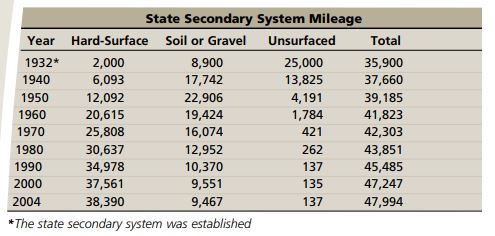 By mid-1948, the state’s road program generally had recovered from the wartime slowdown. A few deferred construction projects had been completed, and many others had been started. The commission said the secondary roads were in better condition than ever before and proudly announced that “for the second consecutive winter, not one school bus day was lost because of mud on the roads.”
With that objective producing dividends, another goal was set: A reasonably passable year-round road to every reasonably located farm and rural dwelling in Virginia. It reflected the commission’s belief that “there is no comfortable living in rural Virginia without a motor vehicle and a passable year-round road.”
Progress truly was remarkable in those immediate post-war years. From 1945 to 1947 alone, the unsurfaced secondary system mileage was reduced by more than half — from 11,151 miles to 5,184 miles. As the state entered the second half of the century, its road development program was about to enter its busiest time.
Virginia in 1950 had a population of 3.3 million. Motor vehicle registration was approaching a million. The U.S. census that year would be the last showing a majority of the state’s citizens living in rural areas. Urban dwellers had grown from 35.3 percent to 47 percent of the total between 1940 and 1950. By the time of the 1960 census, 56 percent of all Virginians would be in urban areas.
Traffic volumes were exceeding estimates, and in August 1950, the commission said that many “roads designed 10, 15, and 20 years ago were incapable of handling the growing mass of heavy, fast-moving traffic. Throughout the commonwealth, the demand for road improvement was intensified… In most instances, no immediate relief is in sight… Funds simply are not available for the overnight modernization of the entire highway system… In the municipalities, the problem of providing free movement for traffic became increasingly acute. Huge sums will be required to alleviate traffic congestion in Virginia towns and cities.”
Five years later, the commission said again that it felt “a growing concern regarding Virginia’s highway needs. People who use our highways are continuing to pay a big price in lives and money because of inadequacies on our roads. Statistics prove that the better road is the safer road. Highways with controlled intersections, with entrances and exits only at designated points, have fewer fatalities in relation to traffic volumes than do highways that lack such controls.”
It was almost as if the commission knew what was around the next corner.
Produced by the
Virginia Department of Transportation
Office of Public Affairs
1401 E. Broad Street
Richmond, VA 23219
VirginiaDOT.org

4 Stimulating Activities for a Healthy Brain After 50

The First Amendment: America’s Unique Foundation of Freedom

How to Tackle Credit Card Debt

Summer Enrichment Camp Gives Teens Hands-On Learning Opportunities

VDOT: Warren County Traffic Alert for April 6 – 10, 2026

David Silek to Remain in Chairman’s Seat of WC Republican Committee Pending 6th District Appeal Decision

Sales Set to Bloom Like Daffodils This Spring

America 250: The Bookseller Who Helped Save the Revolution

Business Growth Series: Why Good Businesses Still Struggle to Grow

Brownies with Mini Chocolate Easter Eggs

Shenandoah Downs Opens 11th Season April 11 with Tribute to Roger Hammer

We Don’t Know Everything About DNA

How PAAS Came to Dominate the Easter Egg Dye Tradition

Spanberger Signs Bipartisan School-Safety, Student Support Bills Into Law

Melanie J. Pomeroy (1958 – 2026)

David Benjamin Heller (1990 – 2026)
1776 Wasn’t Just About Independence

Three-Tiered System for Urban Agriculture Based on Lot Size Takes Shape at Town Planning Commission Work Session

Child Abuse Awareness Month Brings Focus to Reporting, Prevention in Warren County

National Dental Hygienists Week: Is Your Oral Care Routine Optimal?

The Coin That Traveled Through Time and Space

One “What If?” Question Is Changing the Future of Farming

AA Speaker to Explain Recovery Program at United Methodist Men’s Dinner
Jeannette M. Hyland (1944 – 2026)
