
Automotive
A history of roads in Virginia: Acting on future mobility needs
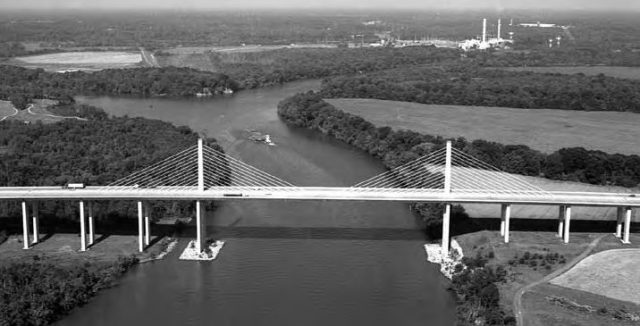
The award-winning Varina-Enon Bridge over the James River south of Richmond employed a dramatic
cable-stayed design.
Major highway construction projects were completed during the 1990s, among them the last stretch of Virginia’s interstate network, a section of I-295 around Richmond finished in June 1992. The completion of I-295 brought the number of miles of interstate highway in the commonwealth to 1,105. Where I-295 crosses the James River, the Varina-Enon Bridge was constructed with a cable-stayed design used on only a few other bridges in the nation. Cables fan out from two 300-foot-high towers on the bridge structure, making for a dramatic and beautiful feat of engineering.
Completion of I-295 was preceded by a few weeks by the opening of the Monitor Merrimac Memorial Bridge-Tunnel (MMMBT). This massive project carries traffic over 3.5 miles of the waters of Hampton Roads and under almost one mile of those waters through a tunnel of twin tubes. The tunnel required joining 15 300-foot sections of the steel tubes, each wide enough to carry four lanes of traffic. When encased in concrete, each section weighed 28,000 tons, and each had to be joined to others under the water with a tolerance of one inch. The MMMBT enabled I-664 to link Newport News and Suffolk and put the last piece in place in a 55-mile interstate beltway in the region. It became the second water crossing from the Peninsula to Southeast Virginia after the Hampton Roads Bridge-Tunnel, which opened its first two lanes in 1957 and its second two lanes in 1976.
A choke point of congestion at the George P. Coleman Bridge across the York River between Yorktown and Gloucester Point was remedied with the conversion of the bridge from two lanes to four. It was a marvel of engineering that provided for construction of the new, larger spans in Norfolk and the delivery of them, by barge, to the reinforced piers. The new spans were set in place while closing the bridge to traffic for only nine days. The innovative project won several awards.
Meanwhile, renewing the aging interstates without disrupting travelers on them was a continuing challenge, one that was met with intense planning and innovative engineering. Chief among these projects was the intersection of I-395 and I-495 with I-95 in the Springfield Interchange in Northern Virginia. This facility carries almost 400,000 vehicles daily on traffic lifelines for the entire East Coast. In the same period, VDOT began to convert the four-lane I-81 corridor to six lanes, as north-south traffic along it burgeoned. Meanwhile, bridges on I-95 through Richmond, one of the
earliest pieces of interstate built in Virginia, were being rehabilitated.
Despite the increase in highway construction activity, highway congestion continued to be a major concern for citizens, especially in Northern Virginia and Hampton Roads. That concern often became a demand for more roads, built more quickly. In 1996, the General Assembly created the Commission on the Future of Transportation in Virginia to address ways of meeting the projected highway needs through the year 2015. Those needs involved projects some citizens considered vital and others considered optional, but together they totaled $34.7 billion, far more than the state had projected in revenues over that time period.
Shortly after taking office in 1998, Gov. Jim Gilmore appointed a Governor’s Commission on Transportation Policy to study Virginia’s present and future transportation needs. Subsequently, in August 1999, Gov. Gilmore unveiled a transportation plan called “Innovative Progress.” Then, in the spring of 2000, the General Assembly passed much of the governor’s plan into law, as well as its own transportation measures, in the Virginia Transportation Act of 2000. The act provided a new record-setting transportation budget of $3.2 billion for fiscal year 2001—an increase of 22 percent over the previous year’s budget.
Legislators also stipulated in the act of 2000 that there would be three tiers of priorities for upcoming highway construction projects. Projects of first priority would be partially funded from what became known as the Priority Transportation Fund, a fund created under the act. It would draw funding from increased efficiencies in motor fuel tax collections, dedication of a portion of taxes paid on insurance premiums, and specified savings within VDOT.
Among the priority projects listed were improvements to Route 58, construction of the Coalfields Expressway in Southwest Virginia, a third crossing for Hampton Roads waterways, and widening of I-81 through Virginia. Second in priority would be projects in the Six-Year Improvement Program to be financed in part with money from the state’s General Fund. Third in priority would be other projects in the Six-Year Improvement Program, or those that would be added to it in the future.

Schools Push for Budget Flexibility, Consistent Funding as Needs Grow

Skyline High Teams, Athletes Successful Seasons and Performances Acknowledged – Oh, and Those Roosters

School Board Seeks to Restore Meals Tax Funding for School Facilities

Wasting Drinking Water: 3 Habits to Eliminate From Your Daily Routine

Medicare Launches TEAM Program to Improve Recovery After Surgery

Izaak Walton League Promotes Conservation and Outdoor Programs at Community Forum

POLICE: 7 Day FRPD Arrest Report 3/16/2026

Blue Ridge Wildlife Center Patient of the Week: Great Horned Owl

Airline CEOs Warn of Travel Strain Amid DHS Funding Uncertainty

Robert B. Walters (1931 – 2026)

Lemmon & Hale Highlight Importance of Estate Planning for Families and Businesses

Hike Kidz Foundation Highlights Programs for Families in Need

Phoenix Project Offers Support and Resources for Victims of Abuse

Virginia Moves to Launch Legal Cannabis Marketplace After Years of Delay

As Spanberger Reviews State-Level ‘Momnibus’ Bills, Kaine and Booker Try Again on a Federal Package

Detox Diets: Don’t Overlook the Risks

How to Answer the Interview Question: “Where Do You See Yourself in Five Years?”

HARTS, DSS & House of Hope Highlight Services at Community Forum

Joyce Henry Sutherland (1942 – 2026)

Commentary: Building on What We Have – A Proposed Economic Development Agenda for Warren County

Jamie Christopher Tewalt (1971 – 2026)

George Jules Pouzenc III (1958 – 2026)

Samuels Public Library Prepares for Annual “Taste for Books” Fundraiser

Assistant Chief and Fire Marshal Gerry Maiatico Highlights Staffing Needs and Volunteer Opportunities
