
State News
Are Virginia Toll Roads Costly and Confusing? A State Study Shows Many Drivers Think So.
Researchers found that some complex toll roads in Northern Virginia are “less understandable” for people who drive high occupancy vehicles and that inconsistent toll signage in Virginia may also cause driver confusion. The findings come after a months-long study into easing vehicle traffic congestion, specifically on popular Interstates 81 and 95, and possible ways to stop rising toll costs.
Cost concerns
According to the Joint Legislative Audit and Review Commission, which conducts analysis and provides oversight of state agencies on behalf of the General Assembly, 7% of EZ-Pass users from Northern Virginia surveyed said they don’t use the toll routes because of their design and layout.
However, 72% of respondents said they refrained due to costs ranging from $2 to more than $20, depending on the travel length and congestion.
“72% of the people polled said the high cost of the tolls was preventing them from using the toll lanes, and to us, this confirms a major flaw in the private toll lane concept,” said Stewart Schwartz, executive director of the Coalition for Smarter Growth, which advocates for walking, cycling and using public transportation as sustainable, equitable alternatives to driving.
On June 5, researchers presented their results to state lawmakers. The findings also included a review of the state’s public-private transportation partnerships, which are agreements between the state and private entities to develop and operate toll roads.
NoVa tolls and highway congestion
According to the report, five toll operators manage over 100 miles of road in Northern Virginia alone.
Sen. Jeremy McPike, D-Prince William, whose district encompasses toll lanes, said on June 5 that the state’s review of contracts with toll operators is key to addressing the costs for drivers. Researchers said the contracts allow operators to determine access and are rated based on several factors including a vehicle’s weight, type and number of axles.
McPike hopes the Department of Transportation will focus on standardizing the contract provisions with toll operators to ensure they’re applied “fairly and equitably across all around the system.”
Research staff also found that some drivers had trouble navigating express lanes because of the “complex nature of facilities and tolling,” such as limited entry and exit ramps and dynamic toll pricing, which can vary based on the traffic conditions to maintain a free-flowing level.
Just 44% of drivers in Northern Virginia understood the requirements to use high occupancy vehicle or HOV lanes, the report revealed.

Researchers said most Northern Virginia drivers correctly identified the toll price when shown a static image of a toll sign, compared to others who were less likely to understand toll price when shown a video approaching a toll sign.
Researchers recommended that the Virginia Department of Transportation require toll operators to use signage consistent with existing signage, especially for state roads.
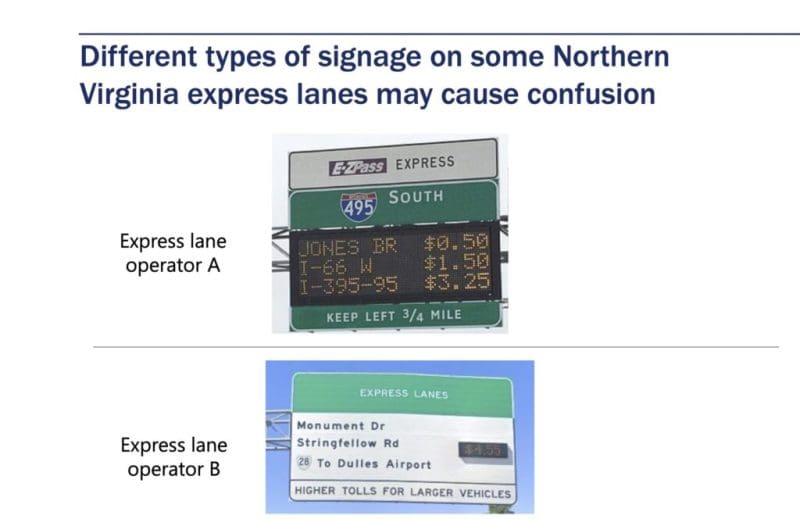
According to researchers from the Joint Legislative Review and Audit Commission, inconsistent signage about access and rates may create further confusion for larger vehicle drivers. (Courtesy of JLARC)
While researchers found some benefits to the toll operator partnerships, they also found contractual restrictions complicate attempts to alleviate congestion around Northern Virginia’s Occoquan, one of the most congested traffic areas in the Commonwealth.
Adding more lanes on I-95 may not be a cost-effective long-term solution to congestion, according to VDOT, which researchers cited in their report.
McPike said there are other plans to help address congestion in the region, such as expanding rail services, “but the long-lasting growth projections still have failing infrastructure that needs to be addressed by Virginia. It’s gotta start soon, or else we’re going to continue to be decades behind.”
Researchers said a 2012 toll operator contract requires the state to pay penalties if a project in the region diverts traffic away from I-95 and the express lanes, decreasing revenue.
According to the contract, Virginia would be required to pay the toll operator if it adds general lanes on I-95, on the Occoquan Bridge on Route 1 or if it expands Route 1 from Lorton Road in Fairfax County to Garrisonville Road in Stafford.
What the study said about I-81
State officials have considered using a public-private partnership toll system to improve the 325-mile Interstate 81, which runs north to south through the western part of the commonwealth. However, researchers told lawmakers the concept would not be suitable given the “substantial” state contribution required. The measure would have cost up to $13 billion for a car-only tolled lane.
I-81 does not have enough congestion to warrant creating a toll system on the corridor, researchers said, despite its daily use by freight truck drivers and other travelers who use it to connect to dozens of communities, colleges, and businesses. The area’s traveling terrain and the trucks make delays less predictable compared to other interstates in Virginia, and they are likely due to random incidents.

Kim Sandum, an Alliance for the Shenandoah Valley coordinator and transportation lead, said she hoped researchers would have focused more on addressing the safety issues instead of congestion on I-81.
In December 2018, the Commonwealth Transportation Board adopted findings from an I-81 Corridor Improvement Plan, which she said focused on addressing the corridor’s safety issues, which stem from its constrained configuration, and lack of capacity and reliable detour routes.
“That whole process had to do with fixing the safety issues so that you wouldn’t have the six-mile traffic back up when a truck crashes,” Sandum said. “Secondarily [it] addressed congestion, but the focus of the fixes was safety,”
She added “congestion isn’t the issue on 81 like it is on 95. Safety is the issue on 81 that leads to congestion when an incident happens.”
Virginia is expediting plans to widen I-81 in the Salem area. Last month, lawmakers agreed on a budget that appropriates $70 million in fiscal year 2025 for the project and up to $175 million from year-end revenue surpluses for the next three fiscal years.
The commonwealth is also expected to receive $42 million from the federal government for I-81 corridor improvements, but additional funding would be needed to complete them. Staff said increasing the regional fuel tax by one cent per gallon is the most feasible path to raising the money, with a potential annual revenue of $10 million.
Other funding options could include adding a regional surcharge to the state’s highway use fee or considering a user fee and other taxes for electric and fuel-efficient vehicles, including heavy EV vehicles.
by Nathaniel Cline, Virginia Mercury
Virginia Mercury is part of States Newsroom, a nonprofit news network supported by grants and a coalition of donors as a 501c(3) public charity. Virginia Mercury maintains editorial independence. Contact Editor Samantha Willis for questions: info@virginiamercury.com. Follow Virginia Mercury on Facebook and X.


Front Royal Man Charged with Two Counts of Forcible Sodomy Following RSW Regional Jail Investigation

James Edward “Jimmy” Mahoney (1953 – 2026)

Ask Stewart: Are There Any Scary Trees?

Janet Denny Casarotti (1933 – 2026)

Virginia Breeders Championship Series Opens at Shenandoah Downs with Impressive Performances

Clark Preston “Lucky” Cameron (1961 – 2026)

Commentary: Data Centers and AI – A Rare and Raw Issue in Virginia for This Midterm Election

Douglas MacArthur “Dougie” Green (1964 – 2026)

Dominion’s Energy Roadmap Keeps Fossil Fuels in the Mix, Expands Solar

Richmond No Kings Protest Turns Out Hundreds Ahead of Midterm Election

Dr. William Kent Renas (Bill) (1948 – 2026)

Careful With Money, Invisible to Lenders

3 Car Problems You May Avoid By Paying Attention

American Songs Concert Coming to First Baptist Church in Front Royal on October 25

When Grief Doesn’t Ease With Time

Sudden Cardiac Arrest May Not Be As Sudden As Its Name Suggests

100 Years of Hundred Acre Wood

A Moment of Honor: Veterans Receive a Powerful Tribute at the Tomb of the Unknown Soldier

Samuels Public Library Invites Young Writers and Artists to Enter 48th Annual Holiday Contest

New Exhibitions Bring World-Class Contemporary Art to Downtown Front Royal

VDOT: Warren County Traffic Alert for October 19 – 23, 2026

Discover The Many Benefits Of Organized Sports

The Family Bond That Doesn’t Necessarily End When Contact Does

Virginia State Police Urge Drivers to Stop for School Buses and Students
