
Local News
Blue Ridge Wildlife Center Patient of the Week: Barred Owl
What if an owl loses an eye?
This barred owl was found on the side of the road by a trucker who just happened to be passing through and worked quickly to get this patient to us! As with most roadside patients, this owl was presumably the victim of vehicular trauma.

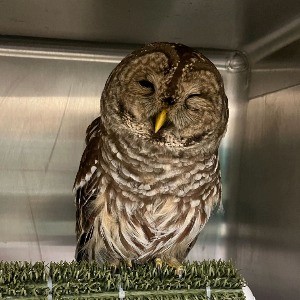
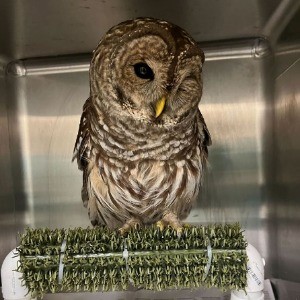
On presentation, the owl was obtunded—able to perch and weakly react to us when handled, but otherwise extremely depressed with their eyes closed and head hanging. In addition to some classic signs of head trauma, there was evidence of direct damage to the left eye.
Here’s a close-up look at the left eye the owl was keeping tightly shut. The pupil is maximally dilated, so much so that you can BARELY see a thin ring of the brown iris (colored portion of the eye) along the right edge. There is a “cloudy” or blueish appearance throughout most of what’s visible. This is from corneal edema (swelling of the eye surface) as well as anterior uveitis (inflammation that causes the fluid in the front of the eye to become clouded with proteins). There are little reddish wisps in the lower left region indicating hyphema (blood inside the globe).
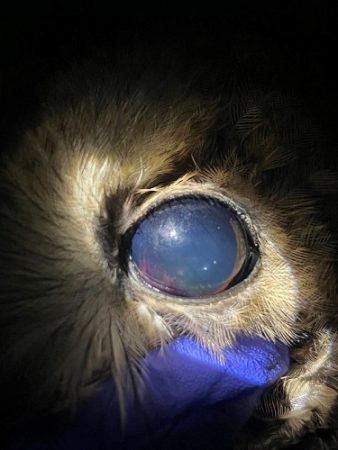
Additional injuries not shown in this image are bruising of both eyelids and complete detachment of the retina (the lining in the very back of an eye that is responsible for generating vision). All of these findings indicate severe blunt force trauma to the eye. These injuries are not only extremely painful, but make it so that this owl’s left eye will never be visual again.

Diurnal raptors (hunt during the day) rely on their ability to spot tiny mice from miles above, dive down at high speeds, or swiftly maneuver in flight to catch prey. Sudden reduction of depth perception and field-of-view would have a major impact on their survival.
Owls, however, are an exception! Because they are nocturnal (active at night) they primarily rely on their incredible hearing to locate and catch prey, losing an eye doesn’t have such a negative impact and we routinely release owls with one non-functional eye, as long as the other one is perfect and as long as hearing has not been affected.

This incredible hearing is thanks to owls having asymmetric ears (their two ears are not identical in size or position on their heads).
This asymmetry helps owls to better pinpoint the location of sounds. When a sound hits one ear before the other, the owl’s brain can calculate the difference in time between the two signals to determine the direction of the sound. This is similar to how humans use two eyes to perceive depth. Asymmetric ears are a common adaptation among owls and gives them a significant advantage in hunting. By being able to pinpoint the location of a sound, owls can more easily track down and capture their prey, even in total darkness.

Looking for an easy way to help native wildlife? Become a monthly BRWC donor! For as little as $5/month, you can provide year-round, sustainable support that helps us fulfill our mission.




Mayor Lori Athey Cockrell Looks to Water, Economic Development and Rail Trail in Another Term

WCHS vs. Brentsville HS – Girls Volleyball – October 6, 2026

BMI Is Only One Piece of the Health Picture

The Eye Surgery Factory That Could Not Expand

Ancient Ownership of Israel

VDOT: Warren County Traffic Alert for October 5 – 9, 2026

Reaching Out Now Expands Programs and Opportunities for Warren County Youth

Dance and Arts VA Finds New Home, New Opportunities on Water Street

Ann L. Shuman (1933 – 2026)

Wendy Lee Whitacre-Stout (1966 – 2026)

Spanberger’s Energy Plan Keys in on Clean Energy to Meet Growing Demand and VCEA Goals

Jean Elizabeth Grubbs Fogle (1939 – 2026)

Feds Provide Guidance on New Federal K-12 Scholarship Tax Credit Program

Why Wait Till November? Mid-Term Election Early Voting Processes in Place Now

US Senate Leaves Nation’s Capital in Advance of Midterms With Much Still Undone

Business Growth Series: If You Don’t Control Your Day, It Controls Your Business

The End of a 20-Year Monopoly on the Credit Score
Voltron and Immigration

States OK Solar Panels for Balconies. Safety Guidelines Haven’t Caught Up

Trump TV Ads Paid for with $20M in Homeland Security Funds, Dems Find

Blue Ridge Wildlife Center Patient of the Week: Gray Treefrog

Birthday Twins: See Which Famous Face Shares Your Big Day

Meet-and-Greet Set Sunday for Republican-Endorsed Front Royal Candidates

Barbara Ann Mathews Smelser (1943 – 2026)
