
Local News
Blue Ridge Wildlife Center Patient of the Week: Belted Kingfisher
Don’t leave your fishing line behind!
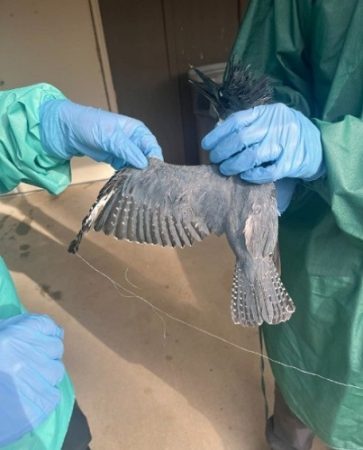
Patient 24-424 during intake exam. @BRWC 2024
This Kingfisher was brought to us on the 4th after he was rescued by a park ranger from Shenandoah National Park who spotted the bird tangled in fishing line, dangling from a tree above the river.
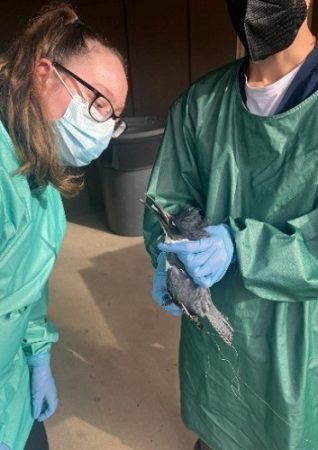
Patient 24-424 shows the fishing line tightly wrapped around the primary feathers of the left wing. @BRWC 2024
This bird is now recovering with us as we monitor for capture myopathy as well as treat a minor injury on the left wrist.
Capture myopathy is a condition observed in wildlife, particularly in animals subjected to high stress or physical exertion during capture or handling procedures. It manifests as muscle damage or dysfunction due to the release of stress hormones, such as cortisol, which can lead to severe muscle weakness, pain, and even death. Capture myopathy is a significant concern in wildlife rehabilitation, management, and conservation efforts, especially during activities like trapping, relocation, or research studies.
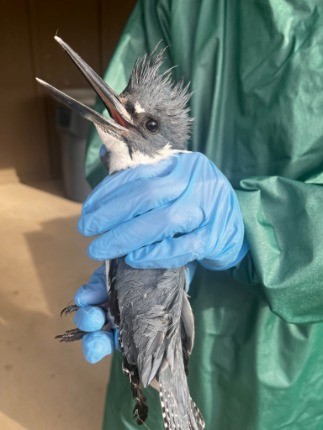
Patient 24-424 during intake exam in BRWC’s outdoor triage area. @BRWC 2024
Did you notice that this patient is being examined outside? BRWC has an outdoor triage area to is used when there’s a concern about highly pathogenic avian influenza (HPAI) or other contagious diseases. Although this particular patient wasn’t showing any symptoms, it is at high risk of contracting and spreading HPAI. If the patient is deemed a candidate for treatment or further examination, they are then moved into an isolation room.
This isolation room serves as a controlled environment where the risk of disease transmission to other patients is minimized. Patients are cared for in isolation until they receive a negative HPAI test result (typically 3-4 days). This abundance of caution ensures the safety of both the individual patient and the other animals within the facility.
Belted Kingfishers are an interesting species as they’re the opposite of most birds in terms of sexual dimorphism (sexual dimorphism refers to the physical differences between males and females of the same species). In their case, the females are actually the more colorful of the pair, with her sporting a striking chestnut belt that the male lacks. So in this case, this bird is a male! We’re hoping that he will only need a short time to recover before he can go home!
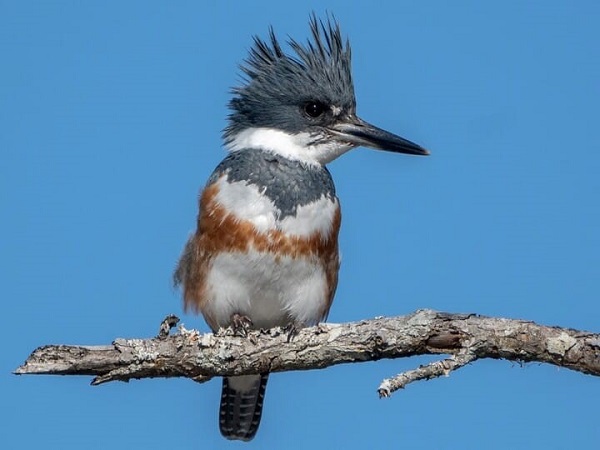
Female Belted Kingfisher @Charlie Bruggemann, Cornell Lab All About Birds
Looking for an easy way to help native wildlife? Become a monthly BRWC donor! For as little as $5/month, you can provide year-round, sustainable support that helps us fulfill our mission.

The Coin That Traveled Through Time and Space

One “What If?” Question Is Changing the Future of Farming

AA Speaker to Explain Recovery Program at United Methodist Men’s Dinner

Jeannette M. Hyland (1944 – 2026)

Allen William Derflinger II (1959 – 2026)

Warehouse Clerk: A High-Demand Job—Even With Robots

FDA Cracking Down on Compounded GLP-1 Drugs

“Christmas in April” or Overspending? Budget Draws Criticism

Court Ruling Voids Prince William Data Center Rezoning, Raising Stakes for Local Debate

Spanberger Signs First Bills Targeting Healthcare, Housing and Energy Costs

Blue Ridge Singers Spring Concerts to Showcase Powerful Blend of Voices and Brass
What Counts as “Good Policy” Depends on Who’s in Power

Planned Parenthood Presses Virginia to Restore State Funding for Contraception Program

Weapon Offenses Rise on Virginia University Campuses

Trump Steps In to Pay TSA Workers as Congress Remains Stalled

Escaping the ‘Captivity of Activity’ by Making Time to Rest

Why Wearing a Bike Helmet Matters

Wilma J. Martin (1927 – 2026)
Michael Fanning (1957 – 2026)

Spanberger Order, RNC Lawsuit Highlight Divide Over Virginia Voter Roll Maintenance

DNC Kicks Off Voter Registration Blitz, Unveils New Campaign Playbook Ahead of Midterms

Republican State Lawmakers Propose Three-Month Gas Tax Holiday in Virginia

April Star Birthdays: Famous Faces Celebrating This Month

Time to Strengthen Those Hips Again
