
Local Government
Council examines planned northside pedestrian-activated light project
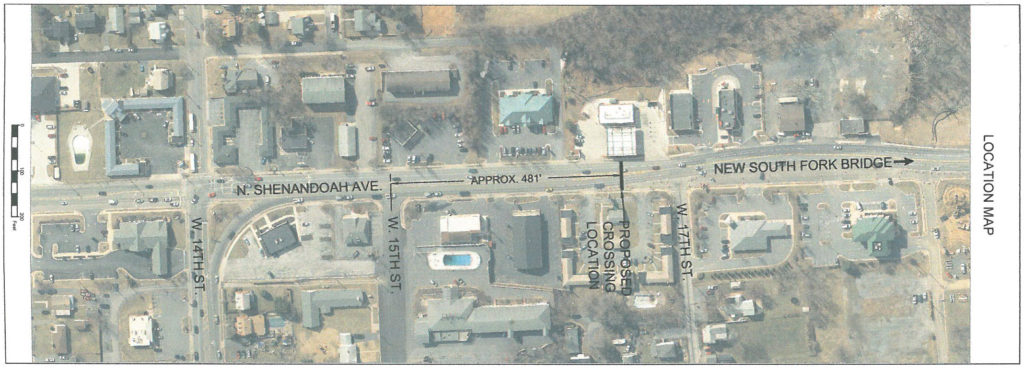
Money – whether to save it; raise it; and how to spend it – continues to be a primary topic of conversation for the Front Royal Town Council. At a Monday, September 17 work session those topics included first, who will pay for a 500-foot stretch of 42-inch stormwater drain pipe across the ITFederal property where the first building on the planned 147-acre business park at the former Avtex Superfund site is under construction; and second, how to fund a planned pedestrian-activated traffic stoplight on North Shenandoah Avenue about two blocks from the South Fork Bridge.
At issue, on one hand, is public safety, and how to best attain it related to vehicular-pedestrian accidents in high-volume traffic areas; on the other, the first commercial client at the planned Royal Phoenix Business Park site is trying to get one over on the Town regarding stormwater management across its property.
Let’s flip a coin and see which one to go to first – loser gets a companion story.
Public Safety
As previously reported, as part of a council-sponsored pedestrian safety program – STOPS, Smart Towns Observe Pedestrian Safety – spearheaded by Councilman William Sealock, the Town has repainted some old crosswalks and added some new ones; as well as adopted a local anti-jaywalking ordinance promoted largely as a pedestrian-safety educational tool for citizens.
But despite newly-painted crosswalks at some distant points on North Shenandoah Avenue, many pedestrians choose not to walk the several extra blocks in each direction to use them.
So, as a next step in the STOPS program, a council majority favors installation of a pedestrian-activated stoplight across North Shenandoah Avenue between the Speedway convenience store-gas station and several nearby motels on the other side of the five-lane northside entranceway into town. The downside of the plan, as Town Manager Joe Waltz observed, is the random disruption of traffic on one of the town’s highest-volume thoroughfares.
The location is one of two high-traffic volume entranceways at which a number of vehicle-pedestrian accidents, including three fatal ones, have occurred in the last two to three years. The other is the Route 55 East corridor into town from Linden where John Marshall Highway becomes South Street at the South Commerce Avenue intersection through one of the town’s most commercially-developed strips between Royal Lane and South Royal Avenue. Two of the pedestrian fatalities have occurred along this stretch.
At Monday’s work session only Councilman Jacob Meza expressed concern about the proposed solution for North Shenandoah Avenue. While saying he agreed it was time to move forward on enhanced pedestrian safety solutions, Meza worried at the traffic backup implications of a pedestrian-activated stoplight about a block and a half to two blocks into town off the South Fork Bridge.
He noted a traffic count of 20,000 vehicles a day on North Shenandoah Avenue, much of that during the two rush hours. Meza wondered at the advisability of a non-coordinated stoplight as a solution and asked his colleagues if this light would begin a trend of randomly-activated traffic stoppage throughout town.
“Where else,” Meza asked his colleagues, perhaps on 14th Street at the Melting Pot he wondered, noting the traffic volume and pedestrian traffic crossings in that area.

The cost estimate for the pedestrian-activated light is $65,000. Some project costs will be kept down by keeping as much work as possible in-house. At the outset of the work session discussion Mayor Hollis Tharpe noted that even moving forward now, delivery of equipment wasn’t likely before March 2019, with an installation that spring.
Sealock called the solution a hybrid to higher-dollar ones he and Town Manager Joe Waltz encountered at a recent transportation-safety conference. The price tag on those full-blown, more traditional traffic signal solutions were in the neighborhood of $200,000 Sealock observed. Waltz added that the cost analysis for a more traditional light system between 14th Street and the South Fork Bridge just past 18th Street was a quarter million dollars ($250,000).
After a polling of council, the mayor noted a consensus “of most everybody” for the pedestrian-activated stoplight for the town’s northside entranceway.
“I think it’s a good idea – we should push forward,” John Connolly said speaking for the “most everybody” consensus. Connolly then repeated a question the mayor had asked to open the discussion – “Where will the money come from?”
And if Waltz had been hesitant to answer the mayor’s initial query, indicating a staff preference for direction from the mayor and council on how to fund the project, this time he more seriously replied, “The only place is the General Fund, whatever’s left there (of mandated reserves).”
As Royal Examiner has previously reported during a discussion of funding a new digital police radio system, an unexpected two-pronged hit from required retirement program funding is anticipated to reduce the General Fund reserve of about $1.4 million by more than $1.2 million. The total General Fund balance for non-self supporting projects was estimated at $7,632,807, prior to the estimated coming loss of $1.2 million or more to the retirement accounts funding.
That unexpected $1.2-million hit to reserves also forced the council to rethink its preferred $545,000 interest-free internal loan paid back over 10 years to fund the police radio system. A final decision on that FRPD radio funding has yet to be made, though council moved the project forward with a temporary internal loan to be paid back upon a final decision on a permanent funding plan.

40 Winners Named in Front Royal’s 6th Annual Pot o’ Gold Hunt

French Earl Tolliver, Jr. (1960 – 2026)

5 Tips to Prevent Sports Injuries

Standardbred Owners Ainspan, McDonald Each Score Thoroughbred Wins at Colonial Downs’ Virginia Derby Meet

Most Dangerous Cycling Scenarios Involving Cars

VDOT: Warren County Traffic Alert for March 23 – 27, 2026

Virginia State Police Seize $22.4 Million in Drugs, Recover Firearms in Weeklong Operation

Virginia Home Sales Rise in February as Inventory Grows, Spring Outlook Uncertain

Bing Crosby Stadium Hosts Warren County–Skyline Baseball Battle Tonight

Warren Supervisors Address Audit Contract, Permits, and Property Sale at March 17 Meeting

Here’s How Virginia Lawmakers Suggest the Next State Budget Handle Federal Health Care Funding Fallout

Spring Essentials Checklist: Prepare Your Home for Summer

Virginia Joins National Push for Refunds After US Supreme Court Voids Trump Tariffs

Four Reasons to Consider Hiring a Professional Cleaning Company

Ask the Expert : We Are Applying for a Mortgage Soon. What Kind of Documents Will We Need?

Charles Michael “Rusty” “Chuck” Fischbein (1944 – 2026)

Jerrold E. “Jerry” Groves (1931 – 2026)

Town Planning Commission Moves Forward with Industrial Zoning, Holds Preliminary Discussion of Urban Agriculture

Schools Push for Budget Flexibility, Consistent Funding as Needs Grow

Skyline High Teams, Athletes Successful Seasons and Performances Acknowledged – Oh, and Those Roosters

School Board Seeks to Restore Meals Tax Funding for School Facilities

Wasting Drinking Water: 3 Habits to Eliminate From Your Daily Routine

Medicare Launches TEAM Program to Improve Recovery After Surgery

Izaak Walton League Promotes Conservation and Outdoor Programs at Community Forum
