
Local News
First Warren County GOP Meeting Under Scott Lloyd Stalls in Procedural Disputes, Ends Without Officer Vote
The Warren County Republican Committee’s first meeting under newly elected Chairman Scott Lloyd became bogged down Wednesday night in questions over notice requirements, membership status, precinct limits and parliamentary procedure, ultimately ending without the committee electing its officers or completing much of its planned business.
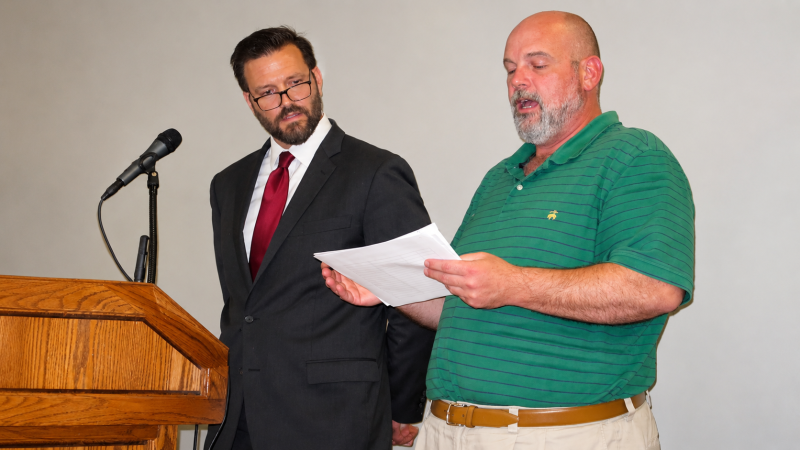
Newly elected Warren County Republican Committee Chairman Scott Lloyd, left, and Parliamentarian Thomas Rainieri during a WCRC meeting in Warren County. Royal Examiner Photos Roger Bianchini.
What was expected to be an organizational meeting instead stretched into a lengthy debate over whether the meeting itself had been properly called and whether the committee could legally proceed with votes.
Lloyd opened the meeting by thanking members for attending and said he wanted to begin his term as chairman with “humility,” promising to listen to concerns and work toward a fair process.

“This is your party,” Lloyd said. “I am serving you as chairman for the benefit of the party.”
Before Lloyd’s remarks, 6th Congressional District Republican Committee Chairman John Massoud offered a welcome urging members to set aside internal disagreements and focus on November’s elections.
Massoud congratulated Lloyd and also recognized Lloyd’s opponent in the chairman’s race, saying both sides needed to leave the meeting as united as possible.
“Our enemy is not here tonight,” Massoud said before directing his criticism toward Democrats and liberal policies.
That call for unity was soon followed by repeated procedural disputes.

Lloyd acknowledged early in the meeting that there were questions surrounding the official meeting call. He said he wanted to address those concerns before conducting business so that decisions made during the meeting would not later be challenged or overturned.
Among the issues raised were whether members received the required seven days’ notice, whether a proxy form had been included with the meeting call and whether ex officio members had received notice.
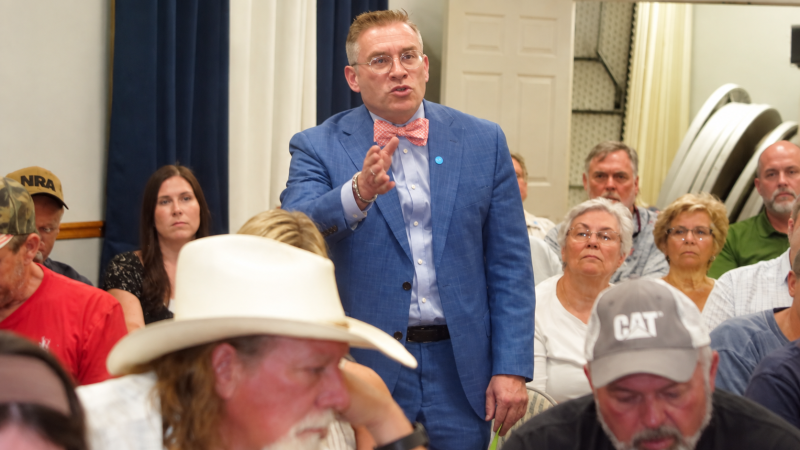
Former chairman candidate David Silek challenged the call of the meeting on three procedural points during the Warren County Republican Committee meeting.

Former chairman candidate David Silek challenged the call on all three points.
Lloyd ruled that the seven-day notice requirement had been satisfied. He acknowledged, however, that ex officio members had not initially been included in the distribution.
“That was simply a mistake of mine,” Lloyd said.
On the proxy issue, Lloyd acknowledged that the form had not been included in the first communication but said an effort had been made to correct the problem afterward.
The discussion quickly became complicated by questions over who had the authority to decide whether the meeting could continue.
Parliamentarian Thomas Rainieri told the committee that his role was advisory and that rulings ultimately rested with the chairman and, when challenged, the membership.

At one point, Massoud placed Republican Party of Virginia Interim Executive Director Nicholas Proffitt on speakerphone. Proffitt told the room that, under party rules, failure to include the proxy and minutes did not invalidate the meeting call.
The committee eventually voted to sustain Lloyd’s ruling and continue.
The next major dispute involved committee membership and payments.
Lloyd explained that questions remained over people whose membership payments had been submitted by others and later canceled or refunded. Massoud said those applicants remained members once their forms and payments had been properly submitted.
The meeting then shifted toward organizing the committee by magisterial district, but that process exposed another problem: leaders did not have complete information showing which members belonged to which district and precinct.

Under party rules, representation is capped by district and precinct population and Republican vote totals.
Committee members began trying to reconstruct the information from sign-in sheets.
Some attendees had entered their precinct in the wrong column. Others did not know their precinct or magisterial district. Organizers began calling names one by one and asking where each person normally voted.
Members were told they could use the Virginia Department of Elections website to look up their polling location.
The committee took a recess while people checked their information and corrected the sign-in sheets.
When the meeting resumed, organizers continued calling names and identifying precincts.
Lloyd then raised another complication: even if organizers determined the districts of everyone in the room, they still did not know the districts of committee members who were absent.
That mattered because, if total membership exceeded the allowable number in a particular district, votes taken that evening could later be challenged.
“I do not think that it’s advisable for us to have a vote in light of the precinct issues,” Lloyd said.
By that point, members had been meeting for well over an hour and had yet to reach the planned election of officers.
Several attendees expressed concern about losing time before the November election and questioned whether the committee could at least move forward with candidate support and other campaign work.
Lloyd said any vote taken without first resolving the membership issue could potentially be invalid.
The committee then entered another round of motions over whether to recess, adjourn, reconvene in two weeks, or set a later date.
A proposed recess created another procedural issue when Rainieri advised that, under Robert’s Rules of Order, a recess could not simply carry the meeting into another day.
The motion was withdrawn.
Members ultimately voted to adjourn without setting a date for the next meeting.
The result was an organizational meeting that ended before the committee could organize.
No officer elections were completed, the membership questions remained unresolved, and much of the planned agenda was left untouched. The evening instead became a prolonged effort to determine whether the committee was properly constituted and whether its votes would be valid.
Lloyd repeatedly said he wanted to avoid making decisions that could later be overturned and indicated the committee would have to resolve the district and precinct membership questions before moving forward.
The meeting closed with those questions still outstanding, and the committee is expected to reconvene after leadership determines its membership numbers and issues a new call.
The meeting was dominated by procedural interruptions, conflicting interpretations of party rules, and repeated efforts to correct incomplete information rather than the organizational business members had expected to conduct.




The Platypus: A Truly Amazing Animal!

A Thing of the Heart: Two-Fold Outreach to Children and Award Presentation Brings Hike Kidz to Stone Branch Arts Center

Virginia State Police Seize Drugs Valued at More Than $830,000, Recover 13 Firearms

Commentary: We Hate Technology. Please Like and Share

One Medicare Open Enrollment Decision That Can Be Hard to Undo

Constitution 101: The Postal Clause

VDOT: Warren County Traffic Alert for October 12 – 16, 2026

UVA Poison Expert Warns of Emerging Synthetic Opioids That Fentanyl Tests May Miss

Pumpkins Will Take to the Skies at Front Royal Warren County Airport Oct. 24

Front Royal Remains Under Mandatory Water Conservation As Shenandoah River Flow Drops

Front Royal Women’s Resource Center Opens 2027 Dare to Dream Grant Applications

Warner, Mizusawa Outline Competing Approaches to Disability Policy

Fable Greenhouse and Gardens Breathes New Life into Former Horton’s Nursery

Louise Virginia “Mom” Messer (1936 – 2026)

Business Growth Series: Doing Everything Yourself Is Slowing You Down

The Mystery of the Purple Seal

Front Royal Outdoors Founder Don Roberts Named 2026 Protector of the Shenandoah

Front Royal Man Held Without Bond Following Child Sexual Abuse Material Investigation

Performing Arts Center Pointing to 2027 Opening as Local Entertainment, Business, and Educational Partner

Town Planning Commission Continues to Prepare for the Arrival of Cannabis on the Local Market

Warren County Schools Improve, But Federal Rules Lower Seven Ratings

Spanberger Announces $1.3 Million in Scholarships and Incentives for Nursing Students

The First Long-Distance Phone Call Came With Receipts
Middletown Man Killed In I-81 Crash In Frederick County
