
National News
Geologists Uncover New Evidence From Ancient Asteroid That Hit the Chesapeake Bay
About 35 million years ago, Hampton Roads was underwater, with the coastline dozens of miles west toward Richmond.
Dinosaurs were long gone, but the ocean teemed with marine creatures such as ancient whales, sharks and sea stars.
That is until one unfortunate day, when life across what’s now southeastern Virginia was obliterated within seconds.
A bolide – an extraterrestrial object such as an asteroid or comet – hurtled out of space and landed in the lower part of the Chesapeake Bay.
“There was a kill zone that would have been several hundred miles out in every direction,” said Rich Whittecar, a geologist and emeritus professor at Old Dominion University.
The volcanic-like lateral blast from the impact ripped through faster than the speed of sound, with exponentially more explosive power than atomic bombs detonated by humans, Whittecar said.
Plants and animals would be “totally shredded” by all the material – and simultaneously incinerated by the intense heat.
“Not a good day,” Whittecar said.
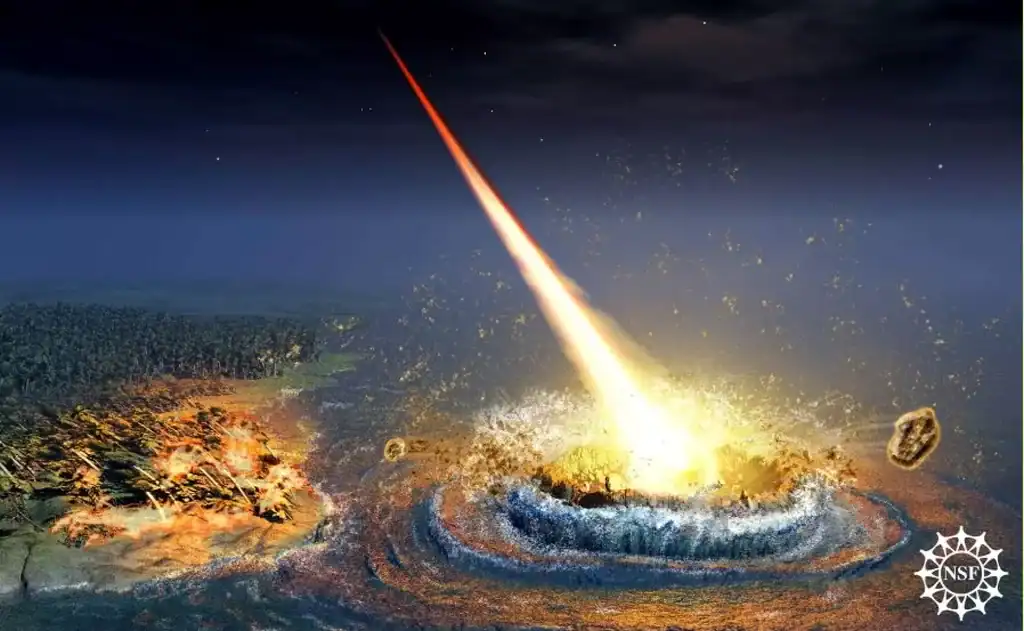
An illustration of the bolide impact in the Chesapeake Bay 35 million years ago. (Illustration by Nicolle Rager-Fuller /U.S. National Science Foundation)
Geologists first pieced together the story of the Chesapeake Bay impact crater in the 1990s. It’s the largest known bolide strike in the U.S. and among the largest in the world.

But new research is the first to document the far-reaching impacts of the collision. Scientists say they uncovered a site 240 miles away in the Sandhills of North Carolina showing traces of a massive tsunami caused by the Virginia asteroid.
And the discovery all started by chance.
A mystery buried underground
Almost a decade ago, retired consulting geologist Bob Ganis was investigating some fossils in Moore County, N.C. when he got a call from a local property owner nearby.

Geologist Bob Ganis stands at the research site in Moore County, N.C., observing rocks containing shark teeth fossils. (Photo courtesy Of Bob Ganis)
A pipeline was set to be constructed through the edge of her property called Paint Hill Farm, and she wondered if Ganis might like to come investigate the temporary trench as part of his research.
Ganis accepted the offer and it became “one of the most strange days of my life,” he said.
He took a look at the rock layers exposed about 10 feet deep and was “totally baffled.” What he saw didn’t align with his geological understanding of the region.
“I had no idea what it was, and no reports of this kind of geology were available to understand what it was,” he said.
Thus began a yearslong quest to get to the bottom of the mystery trapped in sediment. The first piece of the puzzle was determining the age of the rock layers in question.
Ganis said he found fossilized shark teeth nearby and worked with peers who helped date them to the late Eocene era, which lasted from about 56 to 34 million years ago.

Next Ganis connected with Ralph Willoughby with the South Carolina Geological Survey, and described the mysterious sediment layers. They methodically went through the rock beds to try and explain each within the geological context of the region.
“When we get to the top, this explanation of all this rubble at the top, we’re still scratching our heads,” Ganis said. “‘What is this stuff?’”
One day, looking at photos from the trench site, “a light bulb goes off,” he said. “It struck us (that) this is a tsunami deposit.”
There was no geological history to explain why such a deposit would be there, except for one: the meteoroid strike up in Virginia on that fateful day 35 million years ago.
Solving the mystery

A Map Shows The Outline Of The Chesapeake Bay Impact Crater (Photo courtesy U.S. Geological Survey)
The asteroid, moving at about 44,000 miles per hour, was about 2 to 3 miles wide and blasted an enormous crater into the continental shelf of modern day Virginia, according to the U.S. Geological Survey.
Much of the crater is still underwater in the bay, which is why it took until recent decades for scientists to discover. The circular outline of the impact in Hampton Roads includes the bottom half of the Eastern Shore, northern edge of Norfolk and eastern outskirts of the Peninsula and Middle Peninsula.
Like any object that lands in water, the asteroid caused a big splash – a giant tsunami likely thousands of feet high, “the kind of tsunami that the world rarely sees,” Ganis said.
It likely washed over the Blue Ridge Mountains and swept across the Southeast – maybe even over the Atlantic Ocean to lap at the shores of Africa and Europe, he said.
Scientists described such a wide-reaching tsunami when they first investigated the Chesapeake Bay impact crater but no one had found actual remains of it.

Ganis’ team homed in on the tsunami as a likely explanation for the Paint Hill rock formation, but needed more evidence to prove it.
The bottom layer featured charcoal, natural glass and other rock fragments; materials you would expect to fly out of the impact, Ganis said. It also had the hallmarks of a “tremendously hot blast.” Another layer contained ash from the explosion.

The rock formation at the North Carolina site showing impacts from the ancient tsunami, with lines superimposed to distinguish layers. The reddish layer includes plinthite, followed below by ash and crushed rock material. (Photo courtesy Of Rich Whittecar)
Whittecar, the ODU geologist, came in to help figure out the top layer, a sandy conglomeration including petrified wood and what looked like a substance called plinthite. The team needed an expert to confirm.
“I went down (to) look at this stuff and basically said, ‘Yep, that’s plinthite,’” Whittecar said.
The material is an iron-rich, clumpy reddish clay common in tropical regions. Researchers believe the Virginia tsunami swept up this material from the seabed and ended up at Paint Hill.
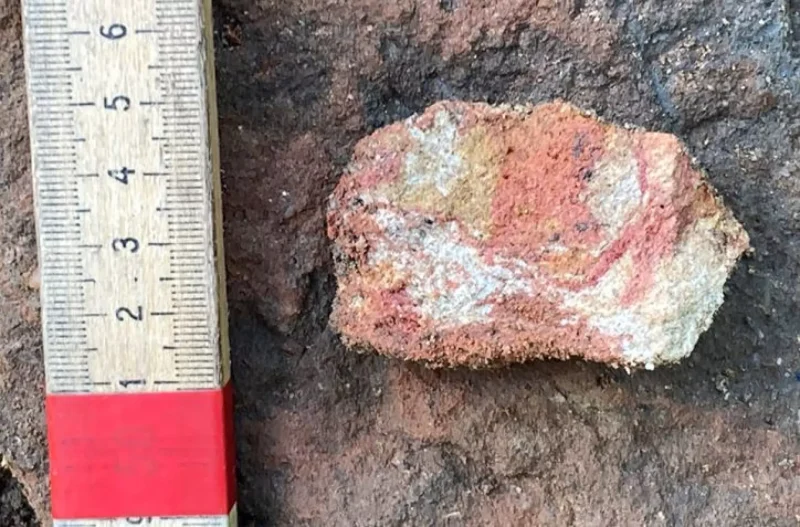
A plinthite sample from the Moore County site. (Photo courtesy Of Rich Whittecar)
The presence of iridium in the sediment helped nail down the team’s tsunami theory. It is an extremely rare metal on Earth but common in asteroids.
The researchers published their collaborative findings in the peer-reviewed journal Southeastern Geology last month.
Paint Hill’s owner recently sold the 300-acre property to the nonprofit Nature Conservancy, which plans to turn it over to the state park system to expand the Weymouth Woods Sandhills Nature Preserve.

The tsunami deposits will be preserved and may become a “highlight of the park” through related exhibits and educational activities, Ganis said.
Whittecar said geologists are interested in this type of work largely out of curiosity and advancing knowledge for future generations.
“From the practical hazard prevention side of things,” he said, “of course it does give a little weight to the notion that if we can stop one of these (asteroids) from hitting, it is worth getting out there and nudging that thing out of the way.”
This story was originally published by the Mercury’s media partner WHRO Public Media, the Hampton Roads region’s largest media company.
by WHRO, Virginia Mercury
July 4, 2025
By Katherine Hafner/WHRO
Virginia Mercury is part of States Newsroom, a nonprofit news network supported by grants and a coalition of donors as a 501c(3) public charity. Virginia Mercury maintains editorial independence. Contact Editor Samantha Willis for questions: info@virginiamercury.com.




Virginia State Police Launch Two-Day Interstate 81 Safety Enforcement Campaign October 21–22

Everybody Is a Leader Somewhere

Warren County Wildcats Host Meridian in Girls Volleyball Match Tuesday Night – October 20

Closing Virginia’s Childcare Affordability Gap Could Cost Up To $4.5B a Year

New Coalition Aims to Keep Virginians Covered as Medicaid Rules Tighten

General Assembly Calls Off Oct. 26 Special Session to Elect Judges

Trump Order Sets Up New Women’s Health Research Initiative at NIH, White House Task Force

What Is Puberty?

First New Class of Pain Medicine in Decades Comes with A 14-Day Limit

Front Royal Man Charged with Two Counts of Forcible Sodomy Following RSW Regional Jail Investigation

James Edward “Jimmy” Mahoney (1953 – 2026)

Ask Stewart: Are There Any Scary Trees?

Janet Denny Casarotti (1933 – 2026)

Virginia Breeders Championship Series Opens at Shenandoah Downs with Impressive Performances

Clark Preston “Lucky” Cameron (1961 – 2026)

Commentary: Data Centers and AI – A Rare and Raw Issue in Virginia for This Midterm Election

Douglas MacArthur “Dougie” Green (1964 – 2026)

Dominion’s Energy Roadmap Keeps Fossil Fuels in the Mix, Expands Solar

Richmond No Kings Protest Turns Out Hundreds Ahead of Midterm Election

Dr. William Kent Renas (Bill) (1948 – 2026)

Careful With Money, Invisible to Lenders

3 Car Problems You May Avoid By Paying Attention

American Songs Concert Coming to First Baptist Church in Front Royal on October 25

When Grief Doesn’t Ease With Time
