
National News
USAID Shutdown Would Halt Research Grants to State Universities
If the Trump administration succeeds in shutting down the federal United States Agency for International Development, known globally as USAID, state colleges and universities stand to lose hundreds of millions of dollars in annual research funding.
For decades, USAID has turned to experts at state colleges and universities to help it improve agriculture, education and public health in foreign countries — and in the process build goodwill toward the United States.
Dozens of U.S. colleges and universities, for example, are involved in USAID’s efforts to develop more climate-resilient, pest-resistant crop varieties in underdeveloped countries. In recent years, state universities also have received USAID contracts to help train K-12 teachers in Egypt and Georgia, and to strengthen the capacity of African and Asian countries to combat tuberculosis and malaria.
“We’re set up to be able to draw from throughout U.S. society the best of the best,” said Neil Levine, who helped oversee USAID’s democracy and human rights work from 2014 to 2017. “That’s why Tier 1 research universities are also aid partners, and that’s why the impact of this [shutdown] goes so broadly.”
Some critics, however, say that too much foreign aid from USAID is soaked up by universities and other contractors, instead of reaching the people in other countries who are supposed to benefit from it.
“The area that I worked in for almost 20 years is tuberculosis, and I’ve seen that the toughest grants to get through are the ones that actually do work in the recipient country to provide care or screening for tuberculosis,” said Tom Nicholson, executive director of Advance Access & Delivery, a global health nonprofit based in Durham, North Carolina.
Nicholson, who recently published an op-ed in The Wall Street Journal that was critical of USAID, said his group has not applied for any USAID grants, but that in his work he’s met several times with agency subcontractors to urge them to provide more direct TB care.
“I am just looking to advocate for better bilateral assistance with some transparency, so we can differentiate between helping out friends in academia and really delivering services,” Nicholson said.
Red states create their own DOGE efforts to cut state government
In 2021, USAID set a target of sending at least a quarter of its funds directly to local partners in other countries by the end of fiscal 2025. But the percentage was 9.6% in 2023, down from 10.2% in 2022, according to a January report by the nonpartisan Congressional Research Service.
Last month, President Donald Trump ordered a 90-day freeze on all foreign aid so the administration could review which programs will continue. Over the past couple of weeks, the administration has effectively dismantled USAID, placing its employees on leave, ordering a halt to its work, and closing its Washington, D.C., headquarters.

On Friday, Trump called for the permanent closure of USAID on his social media platform, Truth Social, accusing the agency of corruption and fraud without providing evidence. Later that day, a federal judge paused the administration’s plan to put 2,200 agency employees on administrative leave and withdraw nearly all of its overseas workers within 30 days.
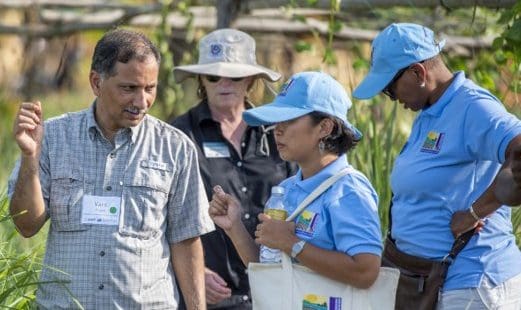
Vara Prasad, left, an agronomy professor at Kansas State University, visits an agricultural technology park in Cambodia. Many state universities rely on research grants from USAID, an agency the Trump administration is trying to dismantle. (Courtesy of the Climate Resilient Sustainable Intensification Innovation Lab)
That move was in response to a lawsuit filed by unions representing USAID employees. On Tuesday, a group of nongovernmental organizations, contractors and small businesses that receive USAID money filed a similar lawsuit.
The United States is the world’s largest provider of humanitarian assistance, though only about 1% of the federal budget is spent on foreign aid, a smaller share than what many other nations spend. USAID distributed nearly $43.8 billion in assistance in fiscal 2023, about 60% of U.S. foreign aid spending.
In addition to its humanitarian impact, supporters say, foreign aid is a relatively inexpensive way for the U.S. to exercise so-called soft power, helping it to counter hostile rivals such as China and Russia.
Federal research grants such as the ones provided by USAID are an important component of the overall funding for state universities, which also rely on money allocated by state legislatures, tuition and endowments.
“Grants from outside agencies like USAID allow us to seek and receive additional funding that, in turn, allows us to further advance our teaching, research and engagement central to our land grant mission,” said Mark Owczarski, a spokesperson for Virginia Tech.
Virginia Tech last summer received a $5 million grant from USAID to collaborate with higher education institutions in India to make that country’s infrastructure more resilient, as climate change drives more frequent and severe monsoons. Owczarski said Virginia Tech is “working to better understand what the long-term impact of these orders will be on the university.”
Many other public universities are grappling with the same uncertainty. In December, the University of California, Berkeley and the University of California, San Diego announced that they would be part of a $75 million USAID effort to improve the cost-effectiveness of global anti-poverty programs.
We’re set up to be able to draw throughout the U.S. society best of the best. That’s why Tier 1 research universities are also aid partners.
– Neil Levine, a former democracy and human rights director at USAID

In November, Michigan State University announced it had received a five-year, $17 million USAID grant to improve STEM instruction in Malawi. And last summer, Mississippi State University announced that USAID would extend a five-year grant and provide up to an additional $15 million for the university’s efforts to help farmers and fishers in Africa and Asia better utilize aquatic food resources.
Last November, Kansas State University announced that it had been chosen by USAID to oversee a grant of $50 million over five years to help make crops more resilient to climate change and extreme weather events in countries including Bangladesh, Cambodia, Ethiopia, Ghana, Guatemala and Honduras.
“We are awaiting updates and guidance from our federal partners and will take action as needed,” Kansas State spokesperson Pat Melgares wrote in an email, responding to Stateline questions about how the university would proceed given the uncertainty swirling around the agency.
A 2022 study co-authored by Kansas State researcher Timothy Dalton concluded that USAID’s $1.24 billion investment in international agricultural research between 1978 and 2018 produced about $8.4 billion in economic benefits. About four-fifths of those benefits went to people making less than $5.50 a day, it found.
But other reports, including a 2019 audit by the USAID inspector general, have faulted the agency for poor oversight of its grant awards. The inspector general found that 43% of the grants that ended in 2014, 2015 and 2016 achieved only half of their intended goals — but that USAID paid recipients the full amount anyway. “Ongoing, systematic award management weaknesses hinder USAID’s ability to hold implementers accountable for performance,” investigators concluded.
“USAID works through grants and contracts which deliver expertise, training and hard goods like food, medicine and machinery, and they also charge their overhead. As a result, a lot of money gets spent in the U.S.,” Levine said.
“The right criticizes USAID for sending U.S. tax money overseas. The left criticizes USAID and its partners for spending too much in the U.S.,” he added. “Most USAID people want to do good development.”
This report was first published by Stateline, which is part of States Newsroom, a nonprofit news network and includes the Virginia Mercury.
by Shalina Chatlani, Virginia Mercury
Virginia Mercury is part of States Newsroom, a nonprofit news network supported by grants and a coalition of donors as a 501c(3) public charity. Virginia Mercury maintains editorial independence. Contact Editor Samantha Willis for questions: info@virginiamercury.com.





Rising Mortgage Rates Slow Virginia Home Sales as Housing Inventory Climbs 20 Percent

10 Tips for a Safe Halloween

Virginia Joins Governors Public Health Alliance to Strengthen Disease Prevention and Emergency Response

When Your Phone Stops Recognizing Your Fingerprint

Joan Chapman Named 2026 Valley Treasure for Bringing Women and Girls Closer to the Shenandoah River

Loss of 130,000 Trout at Virginia Hatchery Will Reduce Stocking in Warren County and 10 Other Counties

VDOT: Warren County Traffic Alert for Oct. 26 – 30, 2026

Stone Branch Offers Sugar Skull Art Workshop to Celebrate Day of the Dead

Ink & Drink Returns to Front Royal With Halloween-Inspired Printmaking Workshop

38 Years Without Answers: Family and Investigators Still Seek Justice for Tammy Thorpe

Warren County Wildcats Host Meridian Under Friday Night Lights – October 23

Community First: Jubilee Event Sees High Turnout with Public Servants in Attendance

St. John’s Drama Brings Tom Sawyer to Life in Musical Celebrating America’s 250th Birthday

Remembering the Legacy of Ditka and Da Bears

Jeffery “Jessie” David Henry (1993 – 2026)

If Passed, This Bill Would Strengthen Protections for Virginia Renters Exposed to Mold

A Dominion-NextEra Deal on Spanberger’s Terms Would Harm Ratepayers, Virginia’s Economy

Commentary: Virginia Should Do Much More To Curb PFAS Pollution In Our Waters

Virginia State Police Seize More Than $733,000 in Illegal Drugs During Weeklong Crime Suppression Operations

Business Growth Series: What Gets Measured Gets Improved

Cost of Employer-Sponsored Health Insurance Plans Rises Again, Nonpartisan Survey Finds

What Is Your Cat Trying to Tell You?

Bunco Went Straight — And Became the Game Anyone Can Play

County Gets Progress Report on FY-24 Audit and Overview of Coming Impacts of New Marijuana and Hemp Laws
