
Looking Back
Looking Back: A Mothers Revenge – Hannah Duston
Hannah Duston was the first American woman to have a statue built in her honor, in 1874. Today, what she did to deserve it might be called, by some, a monument to an atrocity. What did Hannah do? Hannah scalped the ten Indians who had attacked her farm, dragged her from her bed, and burned her house down before taking her captive and killing her six-day-old infant.

The statue to Hannah Duston, in Haverhill, Mass. Panels around the statue base describe the incidents from Hannah’s ordeal.
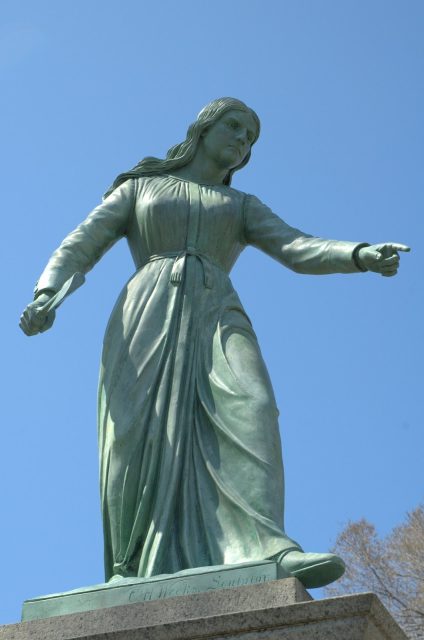
Detail of the hatch-wielding Hannah
It is difficult to imagine today scalping a person. There is adhesive tissue under the dermis of the skull which must be cut and pulled off by the hair. The scalp bleeds exceedingly freely, and the instrument of destruction, especially if crude like a hand-forged iron knife, would be clumsy and slippery when wet.

And what of the revulsion one might feel at handling a dead human in this way? Had Hannah’s life prepared her for that? She was certainly used to wringing chickens’ necks, helping with the slaughter of cows and pigs. Further, she must have been rather angry when she scalped the ten Abenaki Indians who had recently been her captors. They had, after all, attacked her farm, dragged her from her bed, and burned her house. They had taken her captive, and almost immediately killed her week-old infant by bashing the infant’s head against a tree because the baby was crying. Having taken her captive, the Abenaki Indians forced Hannah and her aunt Mary to walk many miles north in March while wearing only their nightclothes. And, for all she knew, the rest of her family was dead.
Hannah and her family were no strangers to horror. She had been captured at the end of King William’s War, in an era distinguished for its savagery on both sides; many outlying British settlements—this was still colonial Massachusetts Bay—had already been plundered and burned.
This is important: When we read Hannah’s story, the context of the late 17th Century is paramount. If Hannah is to be judged at all, then we must judge her in the light of the history that preceded her, not the history, including our present day, which followed. One simply cannot fully understand any events and personalities of the past through the context of the 21st Century.
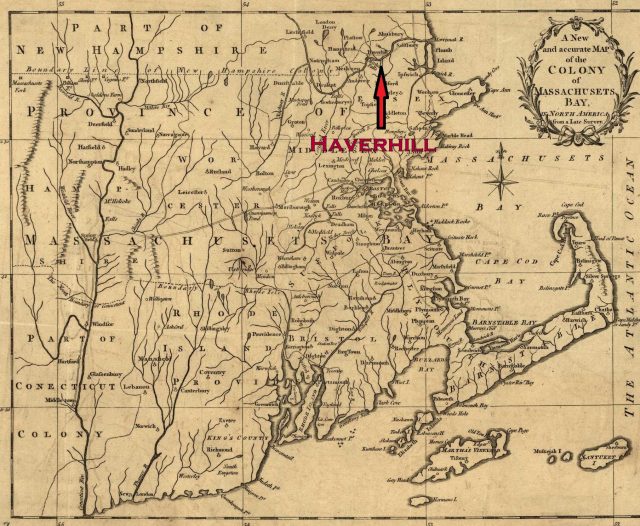
Map of the Massachusetts Bay Colony, showing Haverhill.

It was the 15th of March in the year 1697. There was still snow on the ground, though it had melted away in sunny spots from the bases of bushes and trees. To the northwest of the main town of Haverhill, in the Colony of Massachusetts Bay, there were six or so buildings, surrounded by fields and meadows. This was where Hannah Duston lived in a small brick house, with her husband Thomas, a brick-maker and farmer, and their eight children. Hannah was forty years of age at the time and had just given birth six days before to her eighth child, a girl called Martha. Her capture occurred during the Raid on Haverhill by the Abenaki people from Québec during King William’s War, in which 27 colonists were killed.
On the day of the Raid, Hannah was lying in bed. She was talking with Mary Neff, her aunt, and also the local midwife. Hannah had borne a girl child just six days before. She was wearing her nightclothes and the babe was nursing well; she was a strong infant, according to Hannah later. The other children were outside playing; they ranged in age from 3 to 18. There was not much work to do in March, other than splitting wood. The fields were not ready to be plowed, and the stock had been cared for in the barn.
Thomas Duston was out in the fields at the time of the Raid. Likely he was wary, and had his gun with him, the long rifle; the previous Summer in Haverhill, four of his neighbors were killed by Indians while in their fields, picking beans. It is believed, according to documents about the Raid, that Thomas caught a movement out of the corner of his eye. Ten Abenaki Indians stepped from behind the trees in the distance. A series of shots broke the morning stillness, and Thomas leaped on his horse and galloped toward the house, screaming as he rode, “Indians! Run to the Marsh Garrison! Now!”

“Her husbands’ defense of their children against the pursuing savages”

The children dropped what they were holding and grabbed the younger ones. The walled garrison was nearly a mile away; the Indians are already close. The chances of reaching the garrison were slim. Hannah related later that Thomas rushed into the house while she was getting out of bed. Aunt Mary grabbed Martha, the infant, and ran outside. Hannah told her husband to run and escape with the other children. There was no time for any good-byes, as the Indians had just captured Mary Neff and the infant, and were apparently distracted while Thomas escaped.
The other children had run some six hundred feet, with the older ones carrying the younger children. Thomas rode up among them; his plan was to snatch up one or two of the younger children and ride away with them to save a few. The Indians were in pursuit, and Thomas stopped his horse, dismounted, and using the horse as a shield, threatened the small group of pursuers with his rifle. The Indians took cover and fired, but neither Thomas nor his horse was hit. Thomas jumped back on the horse and rode up to his children; the Indians had reloaded their guns and renewed the pursuit. Once more, Thomas dismounted and menaced his pursuers. Again the Indians fired, and again, neither Thomas nor his horse was hit. The Indians apparently gave up; there were easier spoils back at the group of undefended houses where the attack began.

“Was captured by the Indians in Haverhill the place of her nativity March 15, 1697″
The Indians did not kill Hannah and Mary. Hannah related that twenty-seven of her friends and neighbors were killed, and thirteen taken hostage. The captives were collected into a group with some twenty Indians. The victors carried things taken from the now-burning house, including a large piece of cloth torn from Hannah’s loom. Hannah was huddled beside Mary; in the ensuing confusion when she was captured, Mary had lost a shoe. With the hostages, Indians turned to the north, away from the garrison, to get away with what they had.

According to Hannah’s later statements, Aunt Mary was carrying baby Martha when she stumbled. The infant began crying, and suddenly one of the Indians grabbed Martha from Mary, and, swinging the infant by her feet, smashed her head against a tree, killing her. Hannah and Mary have pushed ahead. Hannah stated later that she believed that the Indians were annoyed by the crying. Hannah and the others traveled about 12 miles that first day, through swamps and some snow, up hills and over brooks. The Indians placed the household goods they had confiscated on the backs of the captives, making travel difficult. Hannah said that several of the prisoners are not able to keep up the grueling pace, and were taken aside and tomahawked. Their scalps were added to the collection already carried on poles or packs.
The first night, when the party stopped to rest, Hannah and Mary held each other for warmth and comfort. Hannah said they slept that night with a piece of rawhide pressed over their torsos and tucked under them.
For fifteen days they traveled north. Finally, near present-day Boscawen, New Hampshire, north of present-day Concord, the Indians conducted the party to an island in the Merrimack River at the junction of the Contoocook River to rest for a few days. It was easier to keep watch from the island for any pursuing militia and other Indian raiding parties.
Hannah related later that the Indians Hannah and Mary were with prayed three times a day in Latin, having been converted by the French to Catholicism. Hannah’s immediate captor told her in broken English that he had lived for some years with a preacher named Rowlandson he had captured, and been taught to pray in the English. He did not allow Mary and Hannah to pray openly; they had to do it in secret while gathering wood or water. Years later Hannah said, in her belated Confession of Faith: “I am Thankful for my Captivity, ’twas the Comfortablest time that ever I had; For In my Affliction God made His Word comfortable to Me.”

After another two weeks, the Indians split up. Hannah and Mary were parceled out to a group whose eventual destination, Hannah was able to determine, was a place called St. Francis in Canada. This smaller group consisted of two warriors, three adult women, and seven children. Also among them was a 14-year-old English boy named Samuel Leonardson, taken from Worcester, in the western part of Massachusetts Bay, some 18 months before. He has been with the Indians so long he had learned to speak their language, and so was considered almost a member of the tribe. Despite not trying to escape in all that time, by one account, Samuel was moved by the plight of these new captives, and “a longing for home had been stirred in him by the presence of the two women.”
From what he overheard, Samuel related to Hannah and Mary that when they reached St. Francis, they would be stripped of their clothes and forced to “run the gauntlet”, as apparently was the custom with new captives. Before the band of Indians and captives set out on the next leg of their journey, it was apparently here that Hannah saw her only chance to escape. She observed that, while on the island. her captors had let down their guard and had grown careless. In Hannah’s words later, she reasoned that the Indians believed that the two women were too weak to attempt an escape, especially on an island with the river in flood. Guards were no longer posted at night. Hannah determined that, with Samuel and Mary, she might overwhelm the small band of Indians, particularly if there was added the element of surprise. She related later that she persuaded Samuel to ask Bampico, the only Indian of the party whose name is known, how he killed the English quickly. Bampico pointed to the temple of his head and stated how to strike quickly and kill the victim.
Hannah’s plan was simple, she related later. At night, when the Indians were asleep, she and Mary and Samuel, having hidden some hatchets earlier, would position themselves at the heads of two of the Indians. At the signal from Hannah, they would begin the attack. Only one Indian was to be spared, a young boy. Hannah decided to take him back to Haverhill with her if she could make it back to her home.
It was very late on the night of the 30th March 1697. With only the light from two fires and the Moon, Hannah, Mary, and Samuel stood ready to strike. The sound of the rushing river made for a good cover, and then, at Hannah’s signal, the three captives struck their opponents by sharply bringing the blades down into the temples on the sides of their heads. Suddenly, Hannah related later, all was confusion. After the first blows, Mary and Samuel did not continue to dispatch the Indians; it was Hannah who raised her hatchet again and again. When she was done, and all of the Indians were still, Hannah paused, out of breath, covered in blood. Hannah later said that Samuel had killed just one; Mary agreed to kill one of the three Indian women—she was a badly wounded squaw who had managed to survive and escape, and she took the Indian boy Hannah had intended to take back to Haverhill.

“Her slaying of her captors at Contoocook Island March 30, 1697, and escape”

Junius Brutus Stearns: “Hannah Duston Killing the Indians” (1847). Oil on canvas.
Hannah did not scalp the dead right away. She said later that she was terrified that her plan will fail. The wounded squaw was making her way to the other Indian band, only a bit farther upriver. A white captive with the other band later reported that he saw the squaw stagger in, bleeding “from seven wounds of the head and face,” and told the ghastly story of Hannah’s attack.
Hannah gathered up what food was at hand, and told Mary and Samuel to dress in Indian clothes. She took her bloody hatchet and her dead captor’s flintlock rifle and carried all this to the bank of the Merrimack River, where she packed one of the Indians’ canoes and scuttled the others. Hannah related that they were moving away from the island when she suddenly stopped rowing, turned the canoe around, and returned to the island, leaving Samuel and Mary at the edge of the river in the canoe. Thinking about what the Indians did to her six-day-old infant daughter, Martha, Hannah went back to the scene of the bloodbath, took a knife she found among the belongings of the camp and scalped all ten of the Indians, including six children. Then she found the large piece of cloth that had been taken from her loom in Haverhill and wrapped the ten scalps into the cloth. In the river, she washed her hands, the hatchet, and the knife, and got back into the canoe for the journey south; they traveled only at night to avoid detection and capture.

Statue placed on the island at the scene of the attack on the Indians.
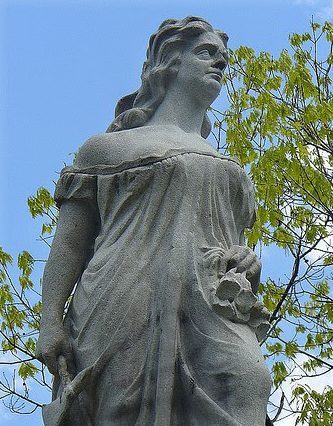
Detail of the statue, showing a determined Hannah holding ten Indian scalps
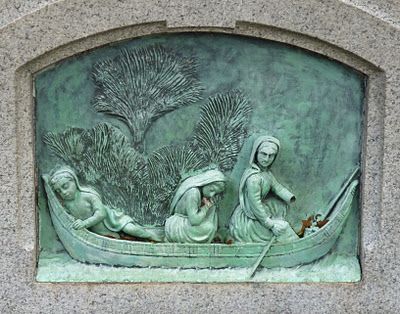
“Her return”
With Mary and Samuel, Hannah reached Haverhill several days later. Her husband and children were overjoyed to find her and Mary alive. Hannah related the story of Martha’s death, and of her journey with the Abenakis, and she displayed the contents of the bloody cloth. A few weeks later, Hannah, Mary, Samuel, and Thomas traveled to Boston, where they petitioned the General Court for money for the scalps. The Colony of Massachusetts Bay had posted a bounty of 50 Pounds per scalp in September 1694, which was reduced to 25 Pounds in June 1695, and then entirely repealed in December 1696. Wives had no legal status in those days, so Thomas petitioned the Legislature on behalf of Hannah Duston, requesting that the bounties for the scalps be paid, even though the law providing for them had been repealed:
“The Humble Petition of Thomas Duston of Haverhill Sheweth That the wife of ye petitioner (with one Mary Neff) hath in her Late captivity among the Barbarous Indians, been disposed of and assisted by heaven to do an extraordinary action, in the just slaughter of so many of the Barbarians, as would by the law of the Province which [only] a few months ago, have entitled the actors unto considerable recompense from the Publick. That tho the [want] of that good Law [warrants] no claims to any such consideration from the publick, yet your petitioner humbly [asserts] that the merit of the action still remains the same; and it seems a matter of universal desire thro the whole Province that it should not pass unrecompensed… Your Petitioner, Thomas Duston.”
On the 16th June 1697, the Massachusetts Bay General Court voted to give them a reward for killing their captors; Hannah Duston received 25 Pounds, and Mary Neff and Samuel Leonardson split another 25 Pounds:
“Vote for allowing fifty Pounds to Thomas Duston in behalf of his wife Hannah, and to Mary Neff, and Samuel Leonardson, captives escaped from the Indians, for their service in slaying their captors. Voted, in concurrence with the representatives, that there be allowed and ordered, out of the public treasury, unto Thomas Duston of Haverhill, on behalf of Hannah his wife, the sum of twenty-five Pounds; to Mary Neff, the sum of twelve Pounds ten Shillings; and to Samuel Leonardson, the sum of twelve Pounds ten Shillings as a reward for their service.”
It was in Boston that Hannah was invited to meet Samuel Sewell, the prominent judge of Massachusetts Bay, and Cotton Mather, a prominent Puritan clergyman, and writer who had been involved in the Salem Witch trials five years before, in 1692. Hannah related to Cotton Mather the entire story of the Haverhill Raid and of her capture, the journey with the Abenakis north, her killing and scalping of the Indians, and the journey back to Haverhill with Mary and Samuel. Mather was a prolific author; he was highly impressed with Hannah, and he related Hannah’s entire story in his Magnalia Christi Americana, which was widely read in all of the American colonies. The governor of the Colony of Maryland later sent Hannah a pewter tankard in honor of her miraculous escape from the Abenakis.

The historic 1700 Duston residence today in Haverill, Mass.
Hannah and Thomas used the scalp money to buy more land on the river, and in 1700, Thomas built the brick house to replace the one the Abenakis burned in the Haverhill Raid. It still stands today and is on the Register of Historic Places.
In the Haverhill Historical Society, one can find, in a glass case, the hatchet, the knife, the bloody loom cloth, and a teapot belonging to Hannah. On the walls behind glass are Hannah’s Confession of Faith, and Cotton Mather’s description of Hannah’s capture, escape, and the killing and scalping of the Indians.
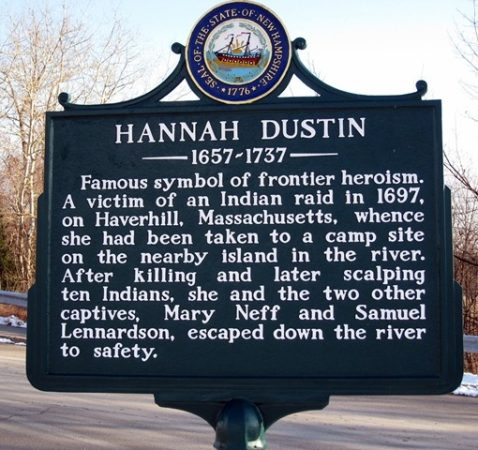
New Hampshire historical marker at the site where Hannah killed & scalped the Abenakis.
Following her return from captivity, Hannah soon gave birth to a daughter, Lydia, in October 1698. Ultimately, Hannah had given birth to thirteen children; three died in infancy including the murdered Martha. Hannah Duston is believed to have died in Haverhill on the 6th of March in 1737 or 1738, at the age of 90.
So closes the tragedy which ended with A Mother’s Revenge.




Three Common Myths About STBBIs Explained

Standing Counts, but Walking Counts More

VDOT: Warren County Traffic Alert for September 28 – October 2, 2026

Virginia Health Committee Considers Mandating Licensed Nurses in Every School

After Obama-Era Chesapeake Bay Executive Order Rescinded, Environmental Groups Brace for Fallout

Federal Judge Strikes Down SNAP Deadline That Put Virginia at Risk of Added Costs

Children Activities by Samuels Public Library for the Month of October

$5,000 Match Challenge to Support Warren County Children on Give Like Dolly Day

October 23rd Set for Post-Discovery Motions Hearing in Bradley Treece Gunfire Incident With Neighbors

Virginia State Police Seize More Than $1 Million in Drugs During Weeklong Operations

Jolissa Steele Shifflett Mathews (1944 – 2026)

False Birth Control Claims are Proliferating, Survey Says

Business Growth Series: Your Work Environment Is Affecting Your Growth

Frog Hunting Offers Virginians a Different Kind of Outdoor Adventure

How the Tech Bros Shop for a House

County Supervisors Fill Vacant Planning Commission Seat, Look to Future on Processes and Capital Improvements

America 250: ‘I Only Regret That I Have but One Life to Lose for My Country’

Building Gas Plants More Important Than Dominion Sale, Data Center Politics

Home Inspectors Help Buyers and Sellers Understand a Property’s Condition

Bowling Together: Why Work Is More Than a Paycheck

This Week’s Showtimes at Royal Cinemas as of September 24th

POLICE: 7 Day FRPD Arrest Report 9/21/2026

Blue Ridge Wildlife Center Patient of the Week: Eastern Cottontail

UVA Health Review Examines Real-World Results of Incisionless Liver Tumor Treatment
