
Community Events
A Walk Through History: Virginia Society Sons of the American Revolution Revisits the Declaration’s Origins and Impact
On 28 July 2023, compatriots from the speaker’s bureau of the Colonel James Wood II Chapter of the Virginia Society Sons of the American Revolution gave presentations to two senior living facilities on the Declaration of Independence. Chapter President Chip Daniel, along with compatriots Dale Corey, Richard Tyler and dual member Bill Schwetke (Culpeper Minutemen) told the residents of Hidden Springs and Greenfield Senior Living Facilities how the declaration came about and it’s impact around the world. The Colonel James Wood II Chapter is available to provide presentations to all age groups on various subjects that meet the goals and objectives of the Sons of the American Revolution. This includes the colonial era and the support of veterans.
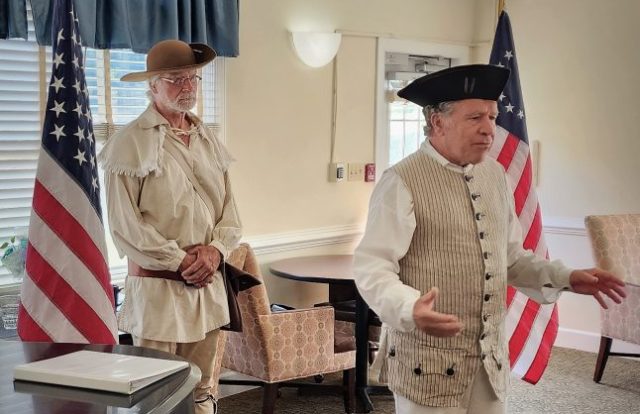
Richard Tyler and Dale Corey at Greenfield Senior Living Facility.

Richard Tyler at Hidden Springs Senior Living Facility.
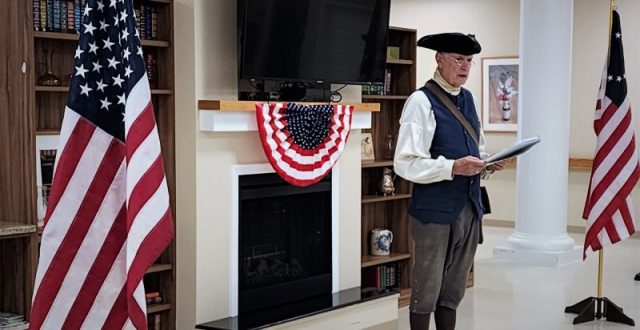
Bill Schwetke at Hidden Springs Senior Living Facility.

The French and Indian War had created a significant debt to Great Britain. King George III and the British Parliament decided the American colonies should pay the crown for the defense of the colonies during the previous war.
In 1764, they passed the Sugar Act, placing a tax on sugar and molasses imported into the colonies. This was a huge disruption to the Boston and New England economies because they used sugar and molasses to make rum, a main export in their trade with other countries.
In March of 1765, the Stamp Act was passed. This placed a tax on printed materials in the colonies which had to be paid in British Sterling. This included every printed paper, playing cards, dice and newspapers. This along with the Sugar Act taxed the Americans without their consent.
The Townsend Act was passed in 1767, placing a tax on glass, lead, paint, paper and tea imported from Great Britain. The colonies were not allowed representation in Parliament and felt it was unconstitutional for Parliament to place taxes and laws without representation. It was more about the principle than the tax. The taxation acts resulted in riots and colonists boycotted British goods. By 1773, the British had repealed most of the Townshend Act.

On 19 May 1773, a law was passed, taxing tea and creating the British East India Company monopoly on the import of tea into the colonies. As an act of protest, in December 1773, colonists posing as Indians dumped 342 chests of tea into the Boston Harbor which became known as the Boston Tea Party. The British wanted to punish the Massachusetts Colony. This resulted in the Coercive Acts of 1774, which closed Boston Harbor until restitution was made for the destroyed tea. It gave sweeping powers to the British military governor, General Thomas Gage. This act forbade town meetings without approval, protecting British officials from being charged with capital offenses in Massachusetts, demanding accommodations for troops in unoccupied houses and buildings and forced colonists to pay for British soldiers expenses.
In March 1770, tensions had come to a head when an apprentice wigmaker and a British soldier got into a disagreement. A crowd of 200 colonists surrounded seven British soldiers. The Americans began taunting and throwing things at the soldiers who then fired into the crowd. Five Americans were killed and three injured in the Boston Massacre. In April 1775, General Gage sent a force from Boston to Lexington to capture Sam Adams and John Hancock and then to Concord to seize gunpowder and arms. This led to the Battle of Lexington, where seven colonists were killed and then the Battle of Concord, where at the North Bridge, the “Shot Heard Round the World” was fired. This was the beginning of the American War of Independence.
At this time, the colonies were considered in a state of rebellion, with most wanting to remain British subjects after reconciliation from the King and Parliament. In October 1775, the British attacked and burned Falmouth, Massachusetts (now Portland, Maine). George Washington called the this attack as “exceeding in barbarity and cruelty every hostile act practiced among civilized nations.”
On 1 January 1776, as a retaliation for Norfolk’s refusal to supply provisions for British ships, British Royal Governor of Virginia, Lord Dunmore ordered the fleet to bombard the town and burn the town. After these attacks, it became apparent to the colonies they must secure their rights as an independent nation. In 1776, a Continental Congress was formed to determine the next course of action from the colonies.

On 7 June, Virginia Richard Henry Lee presented to Congress a motion “that these United Colonies are, and of right ought to be, free and independent States”. The motion was seconded by John Adams of Massachusetts. On 11 June, a committee consisting of John Adams, Benjamin Franklin, Thomas Jefferson, Robert R. Livingston and Roger Sherman was chosen to prepare a statement justifying the right to independence. Jefferson as asked to prepare the document to which small changes were made by Adams and Franklin.
The declaration was presented to the Congress and after additional changes were made, it was endorsed by 12 colonies on 2 July with New York abstaining. On this day, Congress resolved that “these United Colonies are, and of right ought to be free and independent States.” With revisions and deletions, it was officially adopted on 4 July 1776. On that day, Congress President John Hancock and secretary Charles Thomson signed the document with the remaining members signing in August of 1776.
The Declaration of Independence was influential around the world. Hungarian nationalist, Lajos Kossuth declared “the Declaration was nothing less than the noblest, happiest page in mankind’s history.” This document gave credence to the belief in the purpose of government is to secure the people’s rights and that government gets its power from “the consent of the governed”. If that consent is betrayed, then “it is the right of the people to alter or abolish” their government. The idea the people could reject a monarchy and replace it with a republican government was a revolutionary change.



America 250: ‘I Only Regret That I Have but One Life to Lose for My Country’

Building Gas Plants More Important Than Dominion Sale, Data Center Politics

Home Inspectors Help Buyers and Sellers Understand a Property’s Condition

Bowling Together: Why Work Is More Than a Paycheck

This Week’s Showtimes at Royal Cinemas as of September 24th

POLICE: 7 Day FRPD Arrest Report 9/21/2026

Blue Ridge Wildlife Center Patient of the Week: Eastern Cottontail

UVA Health Review Examines Real-World Results of Incisionless Liver Tumor Treatment

Maximilian James Donora (1995 – 2026)

Dollars for Dolly Campaign Aims to Turn Small Gifts Into Big Community Impact

Clean Virginia: NextEra’s Utility Takeover Attempts, Alleged Political Moves Relevant to Merger Case

Commentary: If You Enjoy Virginia’s Wildlife, Thank a Hunter or Angler

Spanberger Presses Congress for AI Guardrails as States Forge Ahead

‘Drive Them Into Hell’: Trump Ponders Destruction of Iran at United Nations

National Chicken Month Celebrates a Versatile Source of Protein

Face Paint That Can Read Your Heartbeat

Leisa Wood (1961 – 2026)

GO VOTE: Because Complaining Alone Isn’t a Good Strategy
The Third Most Important Gift Is Laughter

Skates, Treats and Safety: Warren County Sheriff’s Office Foundation Pack October with Community Events

Celebrate Kids Day Returns Sept. 27 With Family Fun, Activities and a New Train Ride

Survey Finds That More Than Half of Virginia Families With Children Face Food Insecurity

Could Virginia’s New Law Allowing 1% Sales Tax for School Construction Need a Fix?

Now They Want to Rein It In
