
Local Government
County approves Town-adjusted building inspection MOA without a minimum timeframe; rescinds coyote bounties
On Tuesday evening, March 15, as part of its Consent Agenda the Warren County Board of Supervisors approved a Memorandum of Agreement (MOA) with the Town of Front Royal to retake responsibility for building inspections and permitting within the town limits. And while the supervisors’ original agenda packet draft MOA included the minimum 5-year timeframe the County had sought as a compromise to its original draft 10-year minimum duration, County Administrator Ed Daley verified that the MOA approved by the board Tuesday was the adjusted one approved by town council following its Monday Special Meeting discussion. That adjustment was no minimum timeframe other than a 60-day notice of intent to withdraw from the agreement by either party.
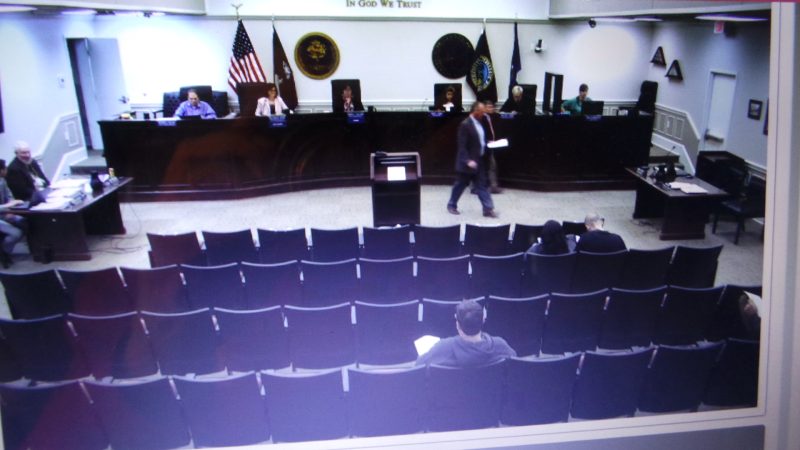
Interim County Attorney Jason Ham and County Administrator Ed Daley return to staff table as Tuesday’s meeting is poised to begin. Perhaps they were clarifying exactly which draft Building Department MOA would be on the table for a vote that evening. Royal Examiner Photos by Roger Bianchini
The County initially sought a 10-year minimum for the agreement for assurances of some stability in the arrangement impacting its building department’s workload and staffing requirements. But with the Town’s plan continuing to be in flux with no definitive timeframe for reestablishing its own building permitting function, council has insisted on no guarantee of a longer-term agreement. As was pointed out on the County side as the town government reacted to the local building community’s negative reaction to its higher fees designed to make its building department self-supporting without general tax revenue assistance, the building permitting situation on the Town side has changed since the original County oversight of all building permitting in the county, including the Town of Front Royal, was established.
That change is that by state code with its population having surpassed 14,000, the Town is now legally required to provide a building inspection function either internally or by contract. But it appears at this point that the County is re-assuming that function without financial or staffing support from the town government, though such support was discussed by the town council at one point following its decision to reverse course on building permitting for an undetermined timeframe.

Contacted, Daley indicated the County’s primary concern was to stabilize the permitting and inspection situation for the county’s builders. It was noted during discussion prior to the vote approving the two-item Consent Agenda that builders would be able to seek inspections and permitting at County Building Official David Beahm’s department Wednesday morning. However, Daley indicated that inspections already scheduled by the Town would be completed by whoever the Town had contracted to perform them, so builders and their clients wouldn’t have to repeat the application process.
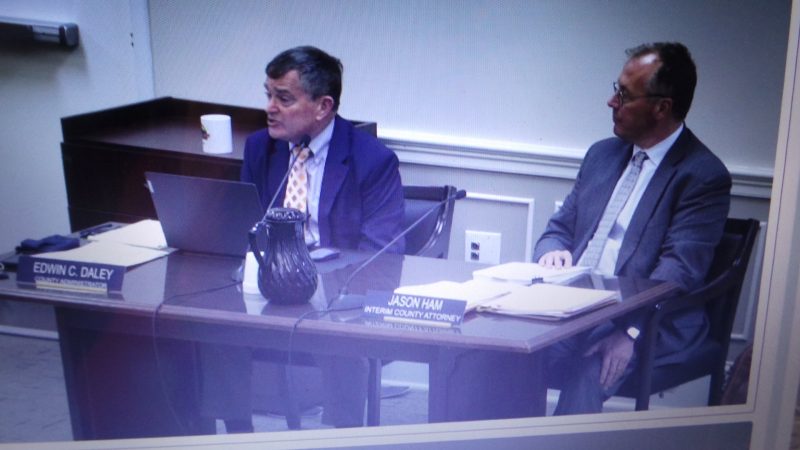
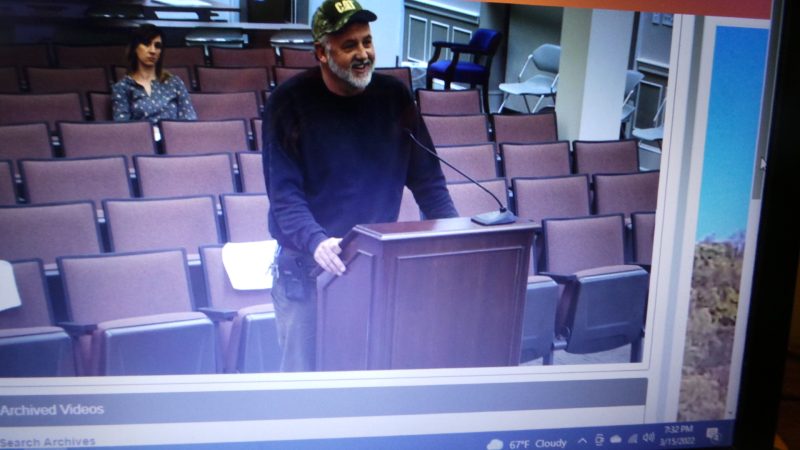
Daley, who later noted the board’s primary concern in approving a building inspections MOA was clarity for the building community moving forward, clarifies a point for the board during his administrator’s report. Below, WC Builders Assn. President George Cline was happy to hear builders would be able to return to County Building Official David Beahm’s WCGC office the next morning for permitting and inspection applications.
As reported in our related story “Despite worries over political ‘ping pong’ town council returns draft Agreement on Building Department to County – with one more change …” with designs on eventually re-establishing its own building inspections department, town council balked at being locked into any long-term agreement. Council discussion Monday indicated the potential of a 50% subsidy from general Town tax revenues to decrease the inspection and permitting fees from the levels builders considered exorbitantly high compared to the County’s, when council revisits its own department.
Removed from the supervisors Consent Agenda Tuesday was a vote on approval of an MOA with the Town on its Joint Tourism effort involving the Joint Tourism Committee and establishment of the 501 c6 non-profit Destination Marketing Organization (DMO) “Discover Front Royal” to improve access to grant funding sources. The matter will be revisited at a future meeting, as town council has raised questions about the level of autonomy the DMO would have.

Board ends coyote bounty program
The board went through nine public hearings with little public comment other than CUP applicant responses to questions in fairly rapid fashion, and planning staff summaries of the items. Leading off those public hearings was approval of an ordinance repealing the awarding of $50 bounties for the killing of coyotes. The board unanimously reversed a decision late last year to maintain the bounties despite being told by legal and animal control staff that as much as 150 years of experience indicated the isolated killing of coyotes had no positive impact on reducing pack numbers in any give location. Citing $39,250 in bounties having been awarded, Board Chair Cullers said the board had come to the conclusion that money could be better spent elsewhere.
As to a desire for an alternative path to coyote management going forward, a hint may have been given in the staff report presented to the board on November 10 of last year when Michael L. Fies of the Virginia Department of Game and Inland Fisheries (VDGIF) was quoted stating: “Since coyote bounties are ineffective, our Department has consistently recommended against these programs in favor of targeted control efforts around farms with a history of coyote damage. This approach has been successfully used by USDA Wildlife Services to reduce livestock losses in other portions of the state.”

As long as they stay away from livestock, county coyotes may not have to be looking over their shoulders as much in the wake of the board’s decision to stop paying bounties for their killing. County animal control and legal staffs have explained long-term research indicates random coyote killing can actually have a counter effect of increasing their pack numbers due to females being thrown into heat at the death of pack males.
Other approvals granted Tuesday, all but one on unanimous votes, were an Ordinance Amendment regarding the Floodplain Overlay District encouraging higher standards of community management to help foster lower insurance rates for citizens requiring insurance through the National Flood Insurance Program; a Zoning Ordinance Amendment adding “Family Day Home” as a land use to permit day-care service for up to 12 children in Agricultural, Residential-1, Residential-2, Rural Residential, Village Residential, and Suburban Residential Districts; And six Conditional Use Permits (CUPs) for Short-Term Tourist Rentals for: Aaron Hike (Pineview Drive); Jana and Aaron Bricco (179 Cliff Road); Rachel Ward and Simon booth (627 Vesey Drive); Karen Thompson (535 Sunset Village Road); Michael Ney (207 Riverview Shores Drive); and Alvand Khoshgavar (668 Old Dam Road).

All votes of approval were unanimous except for Khoshgavar’s, which Board Chair Cullers cast the lone dissenting vote on due to a required 100-foot setback exemption. However, the board majority seemed satisfied at Planning Director Petty’s explanation of the property’s 75-foot setback as not uncommon on older properties like the applicants; as well as the planning commission’s unanimous recommendation of approval.
The board kicked its evening off with a 6 p.m. closed session to discuss EDA-related litigations and new litigation cited as “One Team Flight LLC, et al vs. CassAviation LLC, et al” involving alleged misuse of the County-owned Front Royal Airport (FRR) by its current management, which no longer includes CassAviation founder Reggie Cassagnol, who has retired.




Mayor Lori Athey Cockrell Looks to Water, Economic Development and Rail Trail in Another Term

WCHS vs. Brentsville HS – Girls Volleyball – October 6, 2026

BMI Is Only One Piece of the Health Picture

The Eye Surgery Factory That Could Not Expand

Ancient Ownership of Israel

VDOT: Warren County Traffic Alert for October 5 – 9, 2026

Reaching Out Now Expands Programs and Opportunities for Warren County Youth

Dance and Arts VA Finds New Home, New Opportunities on Water Street

Ann L. Shuman (1933 – 2026)

Wendy Lee Whitacre-Stout (1966 – 2026)

Spanberger’s Energy Plan Keys in on Clean Energy to Meet Growing Demand and VCEA Goals

Jean Elizabeth Grubbs Fogle (1939 – 2026)

Feds Provide Guidance on New Federal K-12 Scholarship Tax Credit Program

Why Wait Till November? Mid-Term Election Early Voting Processes in Place Now

US Senate Leaves Nation’s Capital in Advance of Midterms With Much Still Undone

Business Growth Series: If You Don’t Control Your Day, It Controls Your Business

The End of a 20-Year Monopoly on the Credit Score
Voltron and Immigration

States OK Solar Panels for Balconies. Safety Guidelines Haven’t Caught Up

Trump TV Ads Paid for with $20M in Homeland Security Funds, Dems Find

Blue Ridge Wildlife Center Patient of the Week: Gray Treefrog

Birthday Twins: See Which Famous Face Shares Your Big Day

Meet-and-Greet Set Sunday for Republican-Endorsed Front Royal Candidates

Barbara Ann Mathews Smelser (1943 – 2026)
