
State News
Amid climate change pressures, Virginia reexamines septic regulations

A flooded property on Windmill Point in Lancaster County with a mound septic system, circled in red, in October 2021. (Photo courtesy of John Bateman via Wetlands Watch)
A photograph shows a stretch of residential properties at Windmill Point in Lancaster County that is completely flooded to the point of appearing to be marshlands. In the middle of one is a red circle.
“I think it pretty succinctly sums up the issue,” Lance Gregory, director of the Virginia Department of Health’s Division of Onsite Water and Wastewater Services, told members of the state’s Joint Subcommittee on Recurrent Flooding earlier this month. “In that red circle, you can see a nice mound where that homeowner’s aboveground alternative system that probably cost them $30,000 to $40,000 dollars to install is sitting.”
The system Gregory was referring to was a septic system, the regulation of which is a major focus for VDH.

The agency must issue a permit for a septic system if property owners don’t have access to a public sewer or water system, and counties require septic permits to issue a building permit. Septic is particularly in demand among rural property owners, who tend to be located miles away from public sewer infrastructure, whether on the coastline or inland.
The increased availability of alternative septic systems, along with greater flooding from sea level rise and intensifying rainfall linked to climate change, is leading the department to reexamine its sewage handling and disposal regulations following legislative changes.
“It’s been 20 years since we’ve revised the regulations, so we’re opening them wide open,” Gregory told The Virginia Mercury.
Technologies
There are about 1.1 million septic systems statewide, with the majority of them classified as conventional.

Conventional systems work by storing wastewater that leaves a building in a septic tank before sending it through a distribution box. The waste is then emptied into the ground before eventually trickling down into groundwater.
The idea is that the ground will absorb the waste, or effluent, and filter out bacteria or other pollutants before the wastewater enters the waterway.
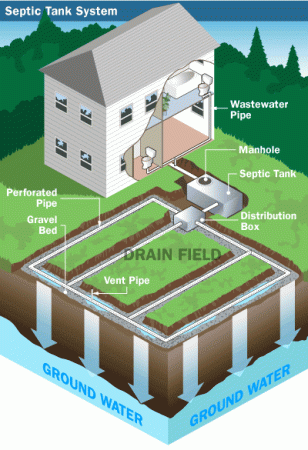
A diagram of a conventional septic system. (Courtesy of cliftonpark.org via VDH)
But about 35% of Virginia’s systems are of a newer alternative style, which can include a mound or pressure disbursement, Gregory said.

The former elevates the area where the waste is released into the ground, creating more earth for it to travel through before reaching the groundwater, while the latter sends waste to a separate drain field. A third approach uses ultraviolet light to treat waste.
But while alternative systems effectively treat wastewater, they can be up to three times more expensive than conventional ones.
Under current regulations, all septic systems must be 70 feet or more from waters that contain shellfish. Now, however, with the emergence of systems more flexible than conventional designs, the department is considering reducing that requirement.
It can be challenging to install conventional systems within the 70-foot constraint for smaller properties near waters where shellfish live. Gregory said alternative systems coupled with conventional ones located closer to shellfish waters can still effectively treat waste while creating flexibility for property owners.

“If you were able to move 60 feet away and put in some treated effluent, maybe you can get into a sandier soil that would be more accepting of the effluent and be able actually to disperse it,” Gregory said.
Because waste entering the ground can have environmental impacts, any change to setback requirements that is proposed will need to be backed by research, Gregory said.
Climate change
As more and more areas of Virginia’s shoreline are subjected to increased flooding from rising tides and increased rainfall, the new technologies provide some flexibility to property owners adapting to the evolving environment.
One 2018 Virginia Coastal Policy Center report warned that rising sea levels from climate change can submerge septic systems, causing backups that can pose environmental and health concerns.

“The basic problem is that an increasing number of properties will have their septic systems inundated as flooding increases, and we need to recognize that and have a plan and funding to address that,” said Elizabeth Andrews, director of the center.
Skip Stiles, executive director of the nonprofit Wetlands Watch, warned waste from failed septic systems could also impact the aquaculture industry.
“This is not just a public health problem, it’s an economic problem,” Stiles said.
Data from the Virginia Institute of Marine Science’s Adapt Virginia tool show that waters south of Onemo on the Middle Peninsula will see an average increase of 1.07 feet by 2040 and 2.98 feet in 2080 under an “intermediate” sea level rise scenario. Hog Island off the Eastern Shore will see an increase of 2.9 feet and 4.81 feet over the same periods.

A screengrab of the Adapt Virginia Map showing expected future sea level rise on part of the Middle Peninsula. (Courtesy of Adapt VA).
For regulators working to ensure that septic systems in areas facing flooding don’t cause widespread problems, “the issue that we’re talking about at least with climate change is timing,” Gregory said.
In Virginia, most septic permits don’t expire until the system fails, although alternative onsite sewage systems must get an annual maintenance inspection. For large alternative onsite sewage systems, defined as those that disperse at least 1,000 gallons per day or serve three or more homes, permits must be renewed every five years.
A working group convened under a 2021 law that ordered VDH to incorporate climate change considerations into the septic regulations is considering requiring the state to evaluate permits every 10, 15 or 20 years.
“If things haven’t changed, renew the permit and continue using it. Or, if there is some setback and maybe the setback is reduced [because of sea level rise] maybe there’s a condition to add treatment to ensure that system is protective,” Gregory said.
Andrews proposed another way Virginia could ensure periodic inspections of systems in flood-prone areas: requiring a septic system inspection at the sale of a home to inform buyers of what they are getting.
Other states have adopted that approach, she said. But she cautioned, “you don’t want to penalize homeowners who can’t afford to repair their septic systems and make it so they cannot sell their homes and end up renting them instead. So funding assistance needs to be available for repair.”
Several funding programs to help homeowners are already managed by VDH. But they face rising demand: One well and septic repair program that was allocated $11.5 million in American Rescue Plan Act funds stopped accepting applications due to an “unprecedented level” of demand. Gregory said 35% of the applications were from the Northern Neck, Middle Peninsula, and Eastern Shore.
Legislation
Septic systems have increasingly become a focus of legislation in Richmond.
In 2021, the General Assembly passed a bill from Sen. Ghazala Hashmi, D-Chesterfield, requiring state septic regulations to consider climate change. The law also allowed Virginia’s Onsite Sewage Indemnification Fund to provide grants and loans to property owners at or below 200% of the federal poverty level to repair failing septic systems.
“The catastrophic flooding that we are seeing in many parts of Virginia poses a serious threat to failing septic systems; these floods are a part of climate change, and we need to anticipate that these dangers will continue to accelerate over the next decade,” said Hashmi in an email. “Environmental and public health hazards will be severe if we do not address these concerns in advance.”
Other legislation from Del. Keith Hodges, R-Urbanna, transferred authority for regulating septic pump outs, which remove sludge from the bottom of a septic tank to ensure the system can work properly, from local commonwealth’s attorney offices to the Virginia Department of Health.
Hodges explained that the agency can work with property owners to correct issues before dropping the hammer on them.
Both delegates stopped short of saying septic permits should be outright denied because of climate change.
“[We’ve got to] drill down to the problem and solve what’s in front of you,” Hodges said. “Let’s get down and get an actual system that’s going to work in those areas.” If people are denied septic permits to live in climate change-impacted areas, he said property values will plummet, hurting local tax revenues.
Hashmi said local governments and VDH “will need to develop policies for issues that develop from increased flooding.”
But Jay Ford of the Chesapeake Bay Foundation said the state should start denying septic permits for areas that are subject to known flooding linked to sea level rise.
“We clearly have areas that will be unusable in any reasonable sense of the word,” Ford said, adding that failed systems directly impact waterways and the Bay.
Stiles said that while permit denial would be contentious, it should be part of the discussion alongside more frequent inspections.
“The big challenge,” he said, is crafting regulations that are forward-thinking when it comes to climate change impacts.
Stiles noted that environmental justice concerns related to African American communities living on land have historically tended to be of poorer draining quality.
According to Gregory, VDH will unveil proposed new regulations next year as part of a Notice of Intended Regulatory Action review, which includes public comment.
by Charlie Paullin, Virginia Mercury
Virginia Mercury is part of States Newsroom, a network of news bureaus supported by grants and a coalition of donors as a 501c(3) public charity. Virginia Mercury maintains editorial independence. Contact Editor Sarah Vogelsong for questions: info@virginiamercury.com. Follow Virginia Mercury on Facebook and Twitter.




The Famous Last Words No One Wrote Down

US Supreme Court Again Urged to Permit Trump Vote-by-Mail Restrictions

President Trump’s Beef Policy May Help Food Prices, But At What Cost?

Virginia Attorney General Creates Worker, Federal Accountability Units as Office Highlights Meta Settlement

VDOT: Warren County Traffic Alert for September 7 – 11, 2026

Twenty-Five Years Later, Remembering When We Stood Together

U.S. Adds 162,000 Jobs in August as Manufacturing and Construction Hiring Rises

Spanberger Taps Daniel Young to Lead Government Watchdog Office

Update: Cline Appears Without Democratic Opponent at Winchester Congressional Event

UVA Health Experts Urge Athletes to Recognize Concussion Warning Signs as Fall Sports Begin

Bumblebees Solve Puzzle Without Training, Study Finds

Business Growth Series: “What If” Thinking Is Costing You Money

Blue Ridge Area Food Bank Calls on Community to Take Action Against Hunger in September

Virginia State Police Seize Guns, Nearly $200,000 in Cash During Weekly Crime Operations
The Queen is Gone. There Will Never Be Another

WC Public Schools Gets Engineers Status Assessment on E. Wilson Morrison Physical Plant Issues

Virginia House Speaker Details ‘Concerns’ About NextEra-Dominion Merger in Letter to State Regulators

Consumer Sentiment Tumbles as Virginians Feel Pressure from Inflation, New Poll Finds

Engineers Find Façade Failure at E. Wilson Morrison, Main Structural System Shows No Visible Distress

Buy It in Virginia, Consume It in Virginia, and Leave It in Virginia: The Golden Rule for 2027

Dawson Sheen Academy Plans New Shenandoah Valley High School for 2027

Wittman Voted 60 Times to Undo the Affordable Care Act. Then He Backed Extending Its Subsidies

As Sports Betting Surges, Virginia Weighs How to Curb Gambling Harms

USPS Whistleblower Predicts ‘Catastrophic’ Effect on Elections Under Trump Vote-by-Mail Order
