
Local Government
Topography Complicates Automobile Graveyard Application at Town Planning Commission Work Session
Before the Town Planning Commission, for their consideration at a June 3 work session, was an application for a special-use permit to operate an automobile graveyard on Kendrick Lane, at a site already occupied by a towing concern. Real problems arise from the topography of this site, located as it is near the Shenandoah River, a sinkhole, and cavernous underground regions. With fluids from retired vehicles potentially leaking and running downhill, it really matters where the operation takes place on the approximately six-acre property.
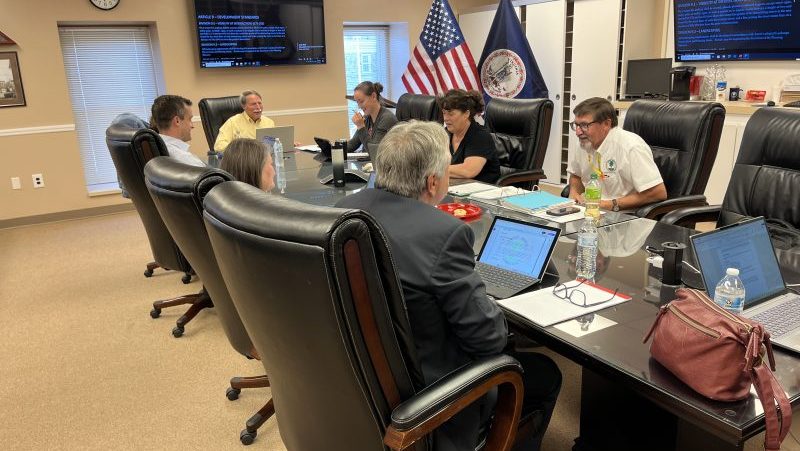
The Town Planning Commission met for a work session on June 3. Royal Examiner Photo Credits: Brenden McHugh
This proposed business, featuring a tenant-landlord relationship and employing six people, would salvage parts in a zone designated industrial. How the business will manage safety concerns related to fluids and overall environmental protection is a consideration grave enough to the commissioners that Chairman Allen Neel affirmed that a list of questions will be assembled, which staff can then convey to the applicant, who will address them at the regular meeting of June 17, where the matter will be voted upon and the recommendation made to the Town Council.
Next, a special exception application was acknowledged in passing, with Planning Director Lauren Kopishke explaining that the applicant will withdraw it at the June 17 meeting, since it has been advertised and must go forward to that point, although extenuating circumstances prevent it from going to a vote. The commission then turned to a draft zoning ordinance, reviewing Article 9 on development standards. They paid close attention to fencing, aiming for what Town Attorney George Sonnett identified as “uniformity”. That involved preserving the height not to be exceeded while negotiating setbacks, variables that, depending on interpretation, coincide with where the fence is in relationship to the house.

What the commissioners wanted to avoid was erratic fence spacing within any given neighborhood, or a situation in which visibility is reduced by a fence parallel to the front plane of the house being too high, creating what Neel called a “fortress” appearance. Of course, one does not want the fence to be so low that a pet dog could jump over it.
Before adjourning after a work session that exceeded two hours, in which the commissioners covered development standards for shopping centers, townhouses, and took a closer look at issues like parking that were tangential to those categories, Neel determined that, in the interest of time, the review would not be completed that evening.




The Platypus: A Truly Amazing Animal!

A Thing of the Heart: Two-Fold Outreach to Children and Award Presentation Brings Hike Kidz to Stone Branch Arts Center

Virginia State Police Seize Drugs Valued at More Than $830,000, Recover 13 Firearms

Commentary: We Hate Technology. Please Like and Share

One Medicare Open Enrollment Decision That Can Be Hard to Undo

Constitution 101: The Postal Clause

VDOT: Warren County Traffic Alert for October 12 – 16, 2026

UVA Poison Expert Warns of Emerging Synthetic Opioids That Fentanyl Tests May Miss

Pumpkins Will Take to the Skies at Front Royal Warren County Airport Oct. 24

Front Royal Remains Under Mandatory Water Conservation As Shenandoah River Flow Drops

Front Royal Women’s Resource Center Opens 2027 Dare to Dream Grant Applications

Warner, Mizusawa Outline Competing Approaches to Disability Policy

Fable Greenhouse and Gardens Breathes New Life into Former Horton’s Nursery

Louise Virginia “Mom” Messer (1936 – 2026)

Business Growth Series: Doing Everything Yourself Is Slowing You Down

The Mystery of the Purple Seal

Front Royal Outdoors Founder Don Roberts Named 2026 Protector of the Shenandoah

Front Royal Man Held Without Bond Following Child Sexual Abuse Material Investigation

Performing Arts Center Pointing to 2027 Opening as Local Entertainment, Business, and Educational Partner

Town Planning Commission Continues to Prepare for the Arrival of Cannabis on the Local Market

Warren County Schools Improve, But Federal Rules Lower Seven Ratings

Spanberger Announces $1.3 Million in Scholarships and Incentives for Nursing Students

The First Long-Distance Phone Call Came With Receipts
Middletown Man Killed In I-81 Crash In Frederick County
