
State News
Data Center Tax Exemption Changes Still Holding Up Virginia Budget
RICHMOND, Va.—Virginia’s Democratic lawmakers failed to make a deal on the budget again on Thursday due to disagreements over whether data centers should continue to receive tax breaks on their computer equipment.
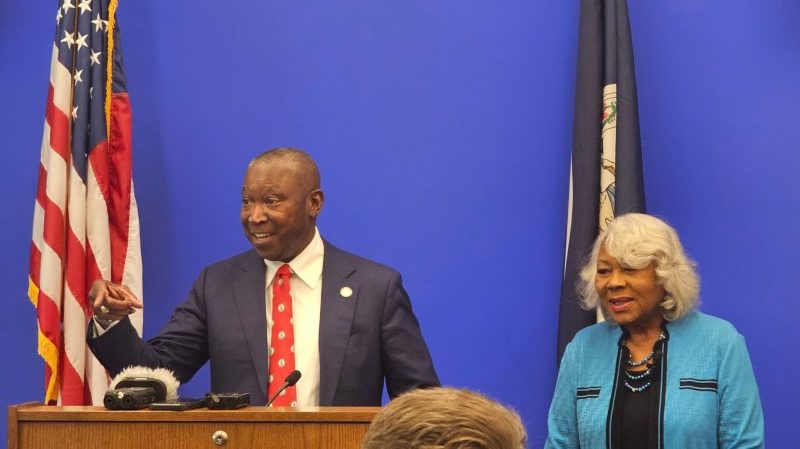
Virginia House Speaker Don Scott (left) and Senate President Pro Tempore Louise Lucas speak with reporters on Wednesday. (Photo by Charles Paullin/Inside Climate News)
Virginia lawmakers recess special session without a budget deal
Lawmakers gaveled in and out of a one-day special session that was set to vote on a budget that they failed to pass in March at the end of the 2026 legislation session.
“Let’s take our time and do this thing right,” Senate President Pro Tempore Louise Lucas, D-Portsmouth, said in a brief interview Wednesday when no deal had been made.

Lucas and many Senate Democrats want to end a $1.9 billion tax exemption for data centers to generate revenue for social programs. Their counterparts in the House and newly elected Governor Abigail Spanberger, a moderate Democrat, are more beholden to the industry’s desires to keep the exemption so Virginia remains attractive as the data center capital of the world. An option to tie the exemption to clean energy requirements still exists.
At issue is ending a sales and use tax on data centers’ computer equipment that is waived for a data facility when $150 million is invested and 50 jobs are created in a community. The tax ranges from 5.3 percent to 7 percent, depending on the locality.
Created in 2008 after the housing crisis, the incentive was intended to lure the industry to the state to stimulate economic development. At the time, lawmakers forecast an estimated $1.5 million in tax revenues would be waived.
Now, Virginia has bloomed into the data center capital of the world, with more of the server farms than any other state or country. Residents’ electricity bills have been rising, and environmental groups are concerned about water availability and air quality. Meanwhile, in 2025, the industry reported the state waived $1.9 billion in sales taxes from data centers.

With rising land values in Northern Virginia where many data centers want to build, and a need to buy replacement computer equipment typically every three to five years, the state’s exemption is beneficial to improving tech companies’ bottom lines.
Lucas wants to end the exemption in January, eight years before it’s set to expire in 2035. She initially asked for the $1.9 billion in revenue the industry would have to pay for an array of social programs. Now, she’s lowered that request to $1.6 billion.
“There’s not going to be a cap, I want it to be perpetual and ongoing,” Lucas said of the revenue from data centers. Other states, she said, “are going to feel the same way we do about them taking money from the voters and giving it to these large, large corporations.”
“We got the infrastructure, we got the water, we got the land. Where are they going?” Lucas said. “They’re not going to go anywhere.”

House Speaker Don Scott, D-Portsmouth, urged more caution.
“We have to make sure that we do everything that we can to help Virginia keep its competitive advantage,” Scott said. “We are the leader in the world, not only the country, in the world. Texas and others, they want to have what we have.”
The Senate’s plans for spending the data center tax revenue across the next two years include $1.1 billion for general fund programs, with about $440 million for education. About $300 million would go toward transportation, $324.1 million would be remitted to localities and about $190 million would go toward other regional needs.
Broader initiatives in the budget include making up for less federal funding for the food assistance program known as Supplemental Food Nutrition Assistance Program, or SNAP, and health care under Medicaid. Those losses resulted from President Donald Trump’s One Big Beautiful Bill Act, which also gave tax breaks to the wealthy.

For their part, leaders of the data center industry contend that Lucas is asking for too much and say companies could easily spend funds to quickly move projects to other parts of the country. Data centers still pay local tax revenue, and trade unions covet the steady stream of temporary construction jobs they create.
Since negotiations began in February over the data center tax exemption, a compromise put forth by the industry has been through several iterations. The industry wants to only contribute $1.1 billion over two years, which is what Senate budget documents said would go to the state’s general fund. In March, industry representatives, including government relations specialists from Microsoft and Amazon, and Josh Levi, the Data Center Coalition president, met in closed-door meetings with lawmakers.
The industry and Lucas haven’t come to an agreement on how much revenue could be provided to the state. Those industry representatives declined to comment Thursday during a gathering in the Virginia General Assembly Building.
State Del. Terry Kilgore of Wise County, the House minority leader, said he wants to keep the exemption but is interested in more revenue from data centers. Rural communities in Virginia, starving for economic development, want to remain competitive, he added.

“We need data centers in the commonwealth,” Kilgore said. “My issue with all this is we’ve made promises to these data centers when they came here to have this tax credit. We as Virginians need to fulfill our promises.”
Democrats in the House of Delegates and officials in the governor’s office remain concerned about how ending the exemption could harm the state’s business-friendly reputation by going against awarded contracts granting the exemption. Beyond the data center debate, the party is worried about federal workforce cuts made early in President Trump’s second term by Elon Musk and his Department of Government Efficiency (DOGE), upending the Northern Virginia economy that serves to lift the entire state.
The House came closer to alignment with Lucas in the Senate after Del. Luke Torian, D-Prince William, joined her in March to say it’s up to the industry to come back to lawmakers with an acceptable budget contribution, whether it’s from a change in the tax exemption or some other new mechanism. Scott, the House speaker, told Inside Climate News in a brief interview at the end of the regular session that “we’re all on the same page, we’re going to be able to claw back.”
Spanberger, though, appears more dug in. At an April 9 groundbreaking for a manufacturer of data center computer racks, Spanberger said “the fact that Virginia is a reliable partner matters as much as the incentives we put on the table, and we intend to protect that reputation aggressively.”
Governor amends bills that shift costs onto data centers. Critics say her tweaks weaken them.
In a session with reporters Wednesday morning, after previously suggesting an electricity consumption tax to have data centers pay their “fair share,” she reiterated that it’s up to budget negotiators to come up with an agreement on a plan, including the amount of revenue from data centers, to present to her.
“At this step, I’m actively engaging, but…I’ll defer to them to answer that question,” Spanberger told Inside Climate News.
The governor has vetoed a gambling measure expected to generate revenue, and wants to delay until next year the establishment of a legal retail marijuana market, which could also provide revenue. But the legislature sent the bill on marijuana back to the governor without the delay. Spanberger has until May 22 to make any final signatures or vetoes on bills.
A politically tense Congressional redistricting fight has also taken up oxygen in the legislative process. Virginia voters settled the debate on Tuesday by voting yes to change Virginia from having a 6-5 Democratic majority in the U.S. House of Representatives to one with an expected 10-1 Democratic majority, pending a legal challenge. Negotiations on the budget may soon be more streamlined. Scott, the speaker, said a deal could be hashed out by June.
“I’m going to see what she’s going to do,” Lucas said, referring to the governor’s action on bills. “At this point it could cause us to probably lose some money in the budget, so I want to wait until she’s done.”
Lost in the data center debate is an alternative included in the House of Delegates budget proposal to keep and possibly extend the data center tax exemption, and tie it to banning the use of fossil fuels as a primary source of power, matching energy needs with clean energy sources, transitioning from diesel backup generators to batteries, and using energy more efficiently. Data centers that chose to avoid those clean energy requirements in favor of fossil fuel energy sources would forego the tax exemption, thus generating some tax revenue for the state. Illinois has a tax credit for data centers that are carbon neutral or have a green building certification.
Asked if there’s interest in placing the clean energy requirements on the exemption, Lucas said, “I have not had that conversation with my caucus, so I can’t answer that.”
by Charles Paullin, Virginia Mercury
Virginia Mercury is part of States Newsroom, a nonprofit news network supported by grants and a coalition of donors as a 501c(3) public charity. Virginia Mercury maintains editorial independence. Contact Editor Samantha Willis for questions: info@virginiamercury.com.




States OK Solar Panels for Balconies. Safety Guidelines Haven’t Caught Up
Trump TV Ads Paid for with $20M in Homeland Security Funds, Dems Find

Blue Ridge Wildlife Center Patient of the Week: Gray Treefrog

Birthday Twins: See Which Famous Face Shares Your Big Day

Meet-and-Greet Set Sunday for Republican-Endorsed Front Royal Candidates

Barbara Ann Mathews Smelser (1943 – 2026)

Kathleen Frances Elar (1956 – 2026)

Happy Creek Crossing to Hold Vendor Interest Meeting Oct. 8 in Front Royal

If the Car Name Fits, Drive It

Front Royal Begins Smoke Testing Sewer System; Residents May See Smoke Around Homes

Trump Orders Federal Agencies to Replace ‘Artificial Intelligence’ With ‘Super Intelligence’

Town-Wide Weed Spraying Underway in Front Royal Through Oct. 6

Southbound I-81 Lane Closure Near Strasburg Expected to Cause Significant Weekend Delays

Virginia Democrats Warn More Healthcare Strains Loom After November Election

Legislation to Force Virginia Traffic Camera Fine Payments Will Make ‘Nightmarish’ Court Workloads

CDC’s Latest Youth Behavior Report Offers a Narrower Look at Teen Health

News Organizations Banned from White House Accuse Trump of First Amendment Violation

Virginia Education Board Approves New Rules for Local Student Assessments

FCC Halts Automatic Approval of Verizon Plan to End Legacy Landline Service in Virginia

Women in Agriculture Continue to Face Barriers as Their Role Grows

This Week’s Showtimes at Royal Cinemas as of October 1st

Surveillance, Outdoor Dining, and Other Community Concerns at Town Council Meeting

When Elected Officials Cross the Line

Trump Administration Revokes $810M Approved by Congress for Refugee Aid and More
