Opinion
Exploring America’s faith-based politics from Chester Street to Vatican City
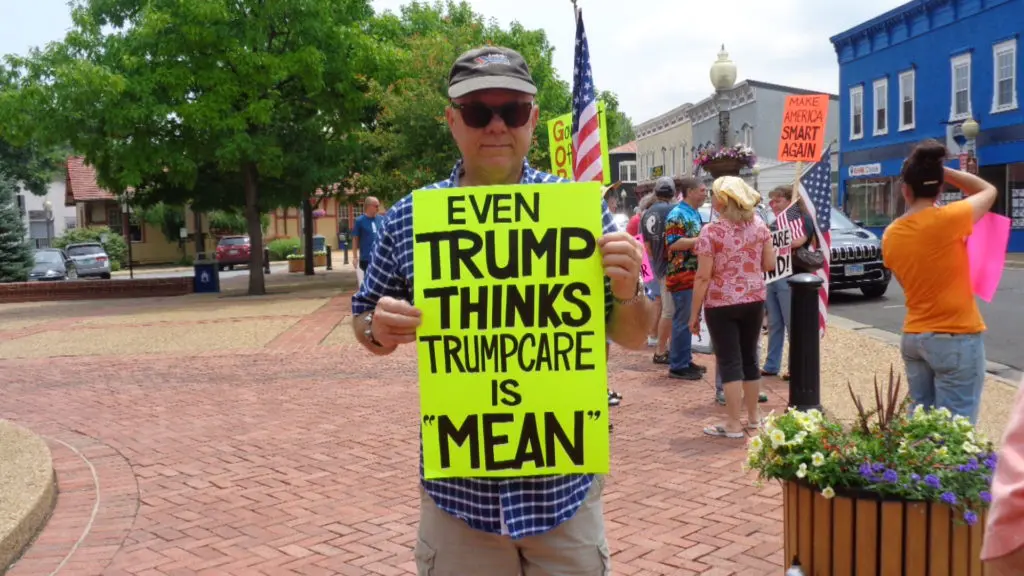
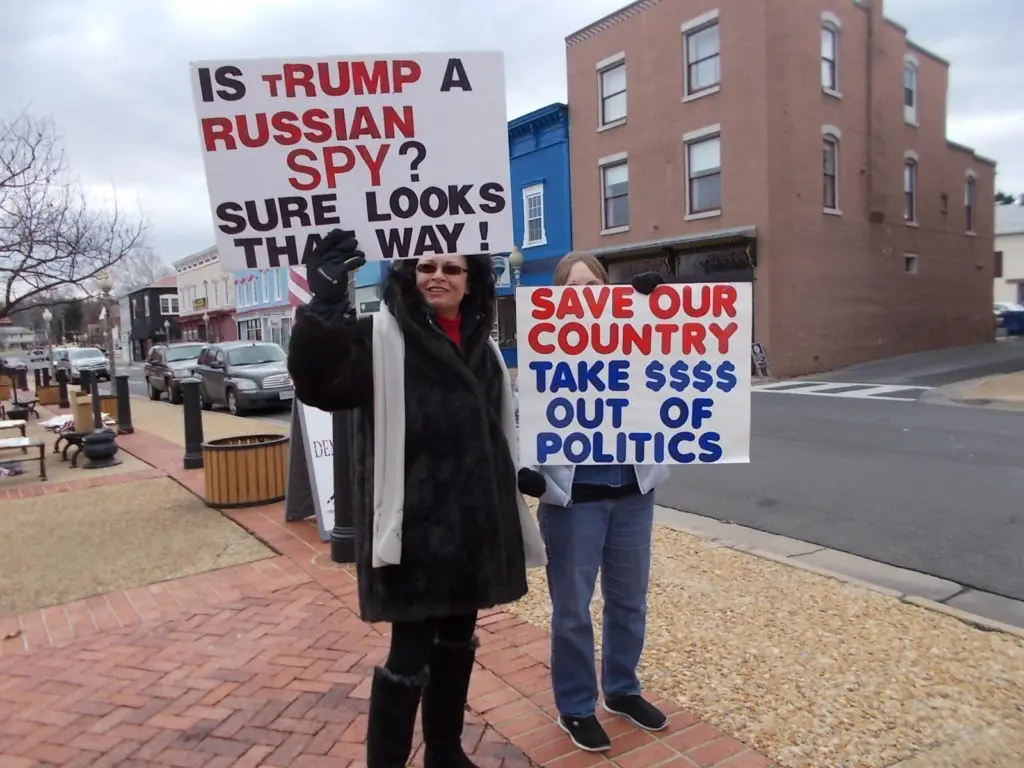
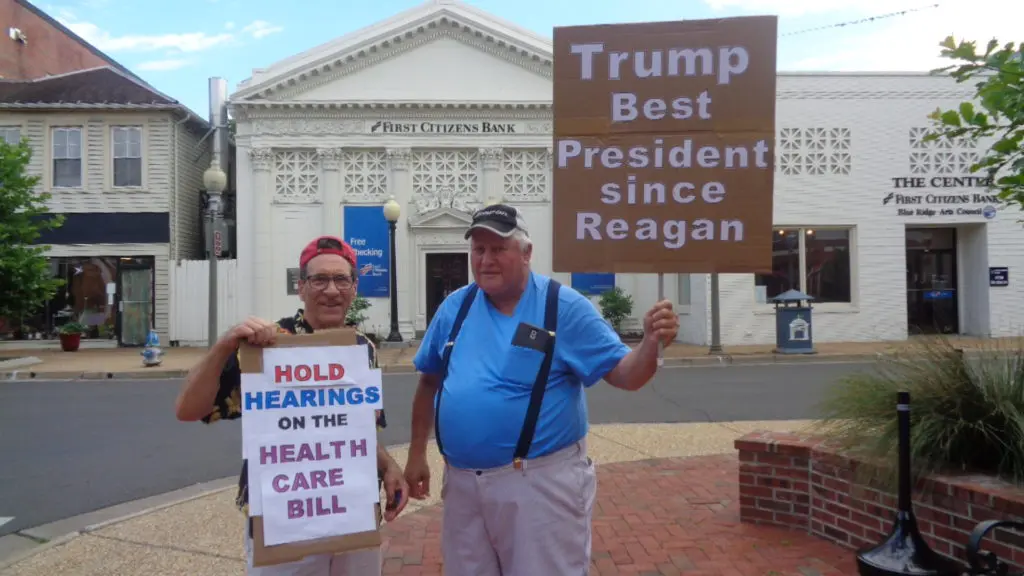
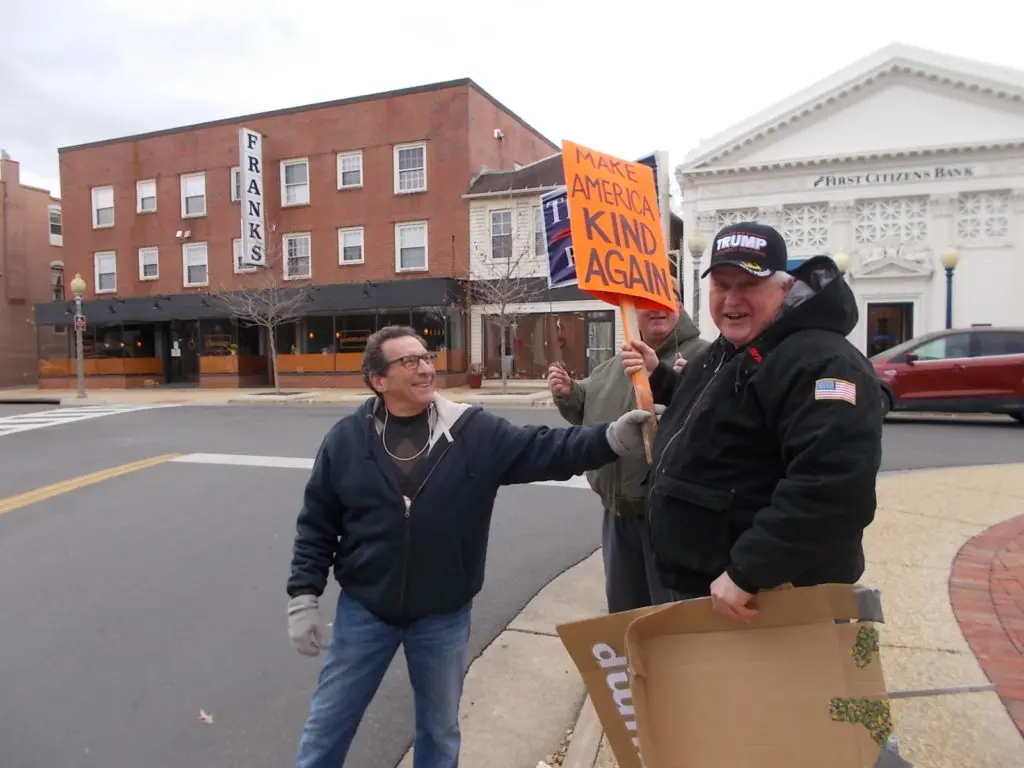
Above, Ralph Waller crosses Chester St. to engage the opposition in dialogue; below, Bob Hill returns the gesture from the other side as the discussion continued. The pro-and anti-Trump sides did find common ground on a concern for the environment. Photos/Roger Bianchini unless otherwise noted
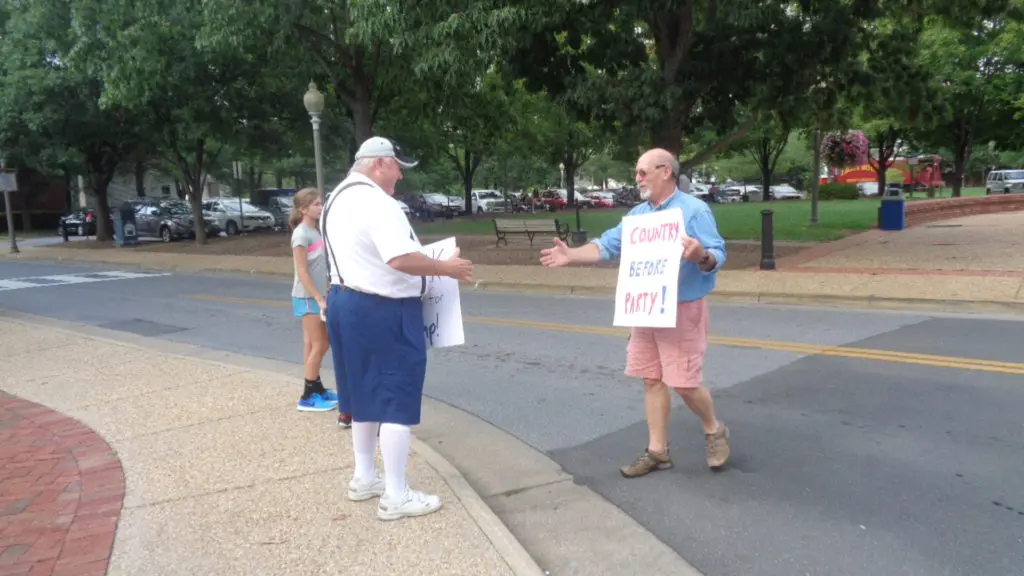
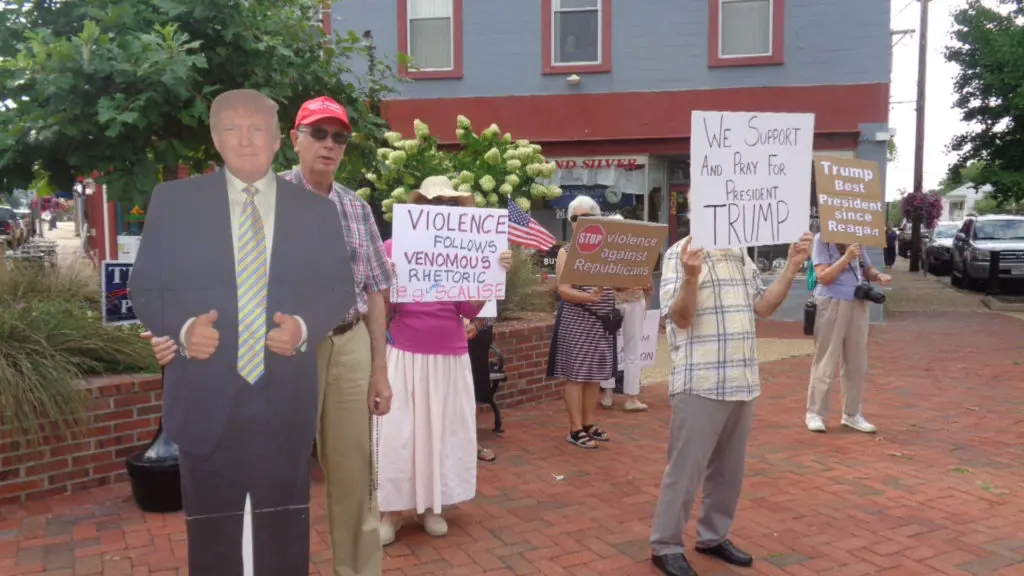
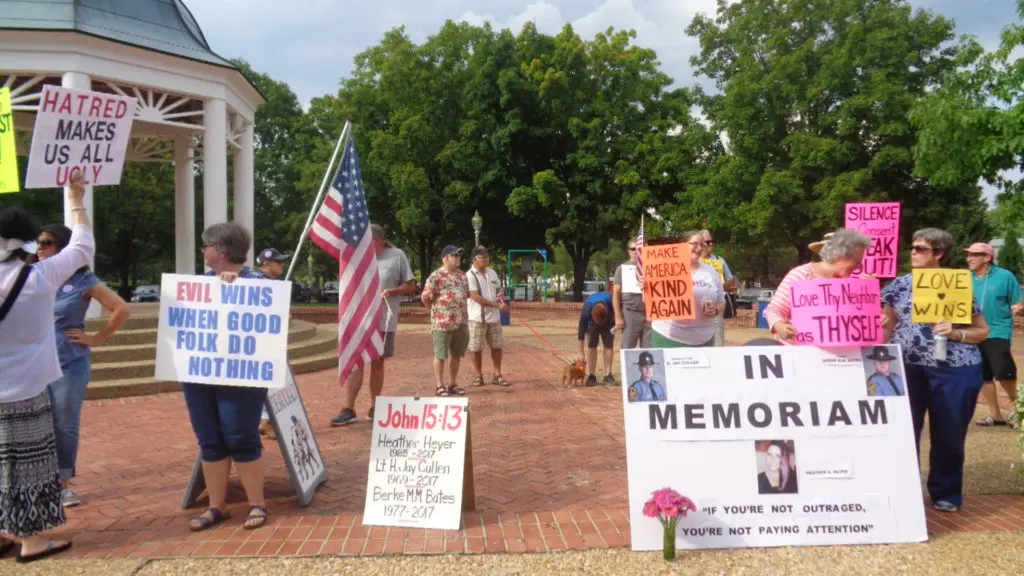
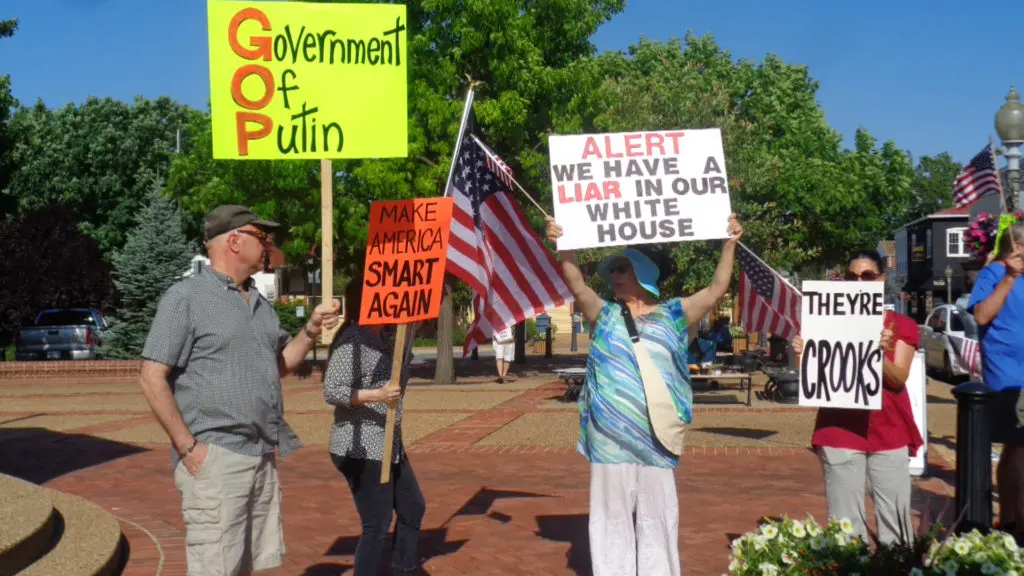
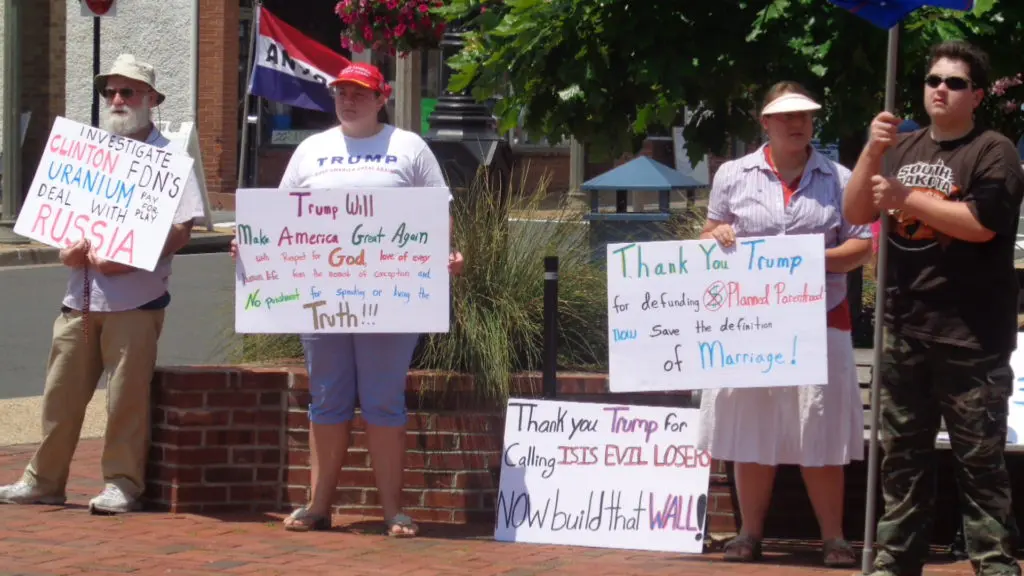
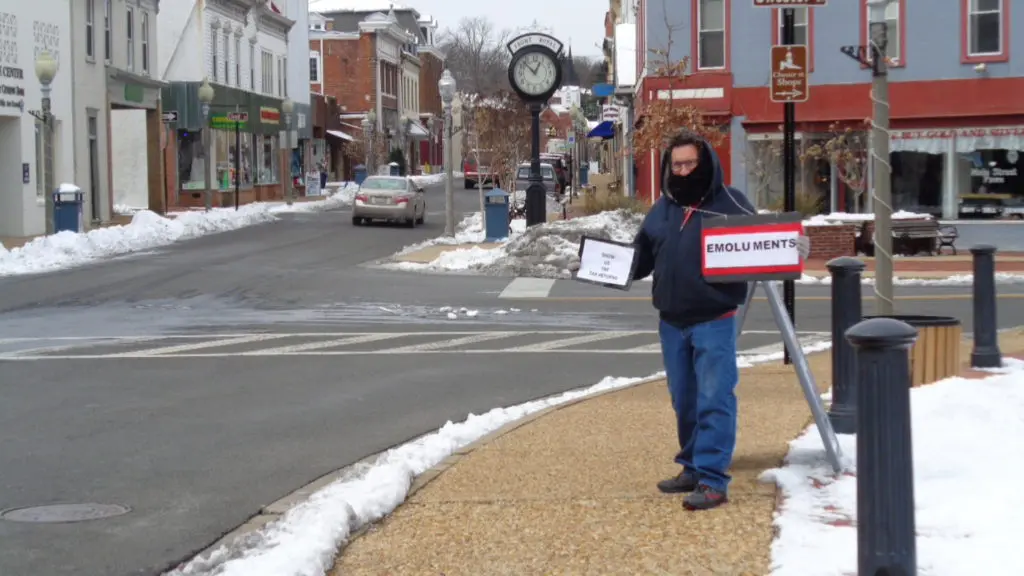
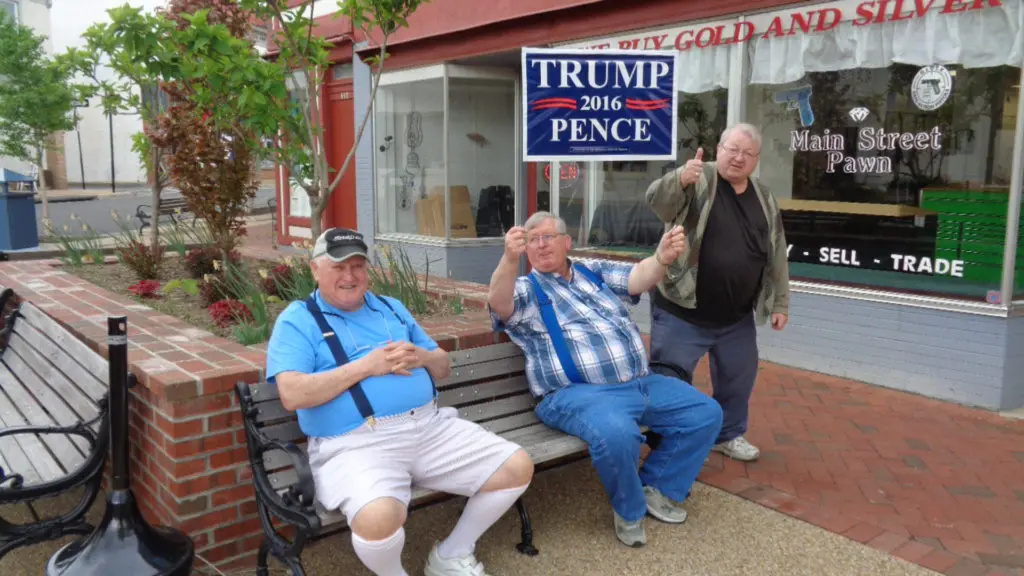
We have reported that at times the common-ground dialogue that began in April across party lines – and Chester Street – between anti-and pro-Trump supporters gathered in downtown Front Royal on Wednesdays seemed to be on the wane. That observation coincided with the arrival of a faith-based pro-Trump contingent focused on prayerful public support of the president and reproductive rights issues.
Some friendly, even playfully hostile dialogue between original pro-Trump supporters Michael and Ralph Waller and Vigil for Democracy, anti-Trump agenda organizer Len Sherp and other vigil participants continues. However, we have been told attempts to expand that dialogue to the new pro-Trump arrivals have been either rebuffed or met with an impenetrable ideological wall of rhetoric. In fact, this reporter was stonewalled in an attempt to get on-the-record comments from the new group on the nature of their support of the president and week-to-week perspectives on some of the more dramatic political developments surrounding the president over the second half of 2017.
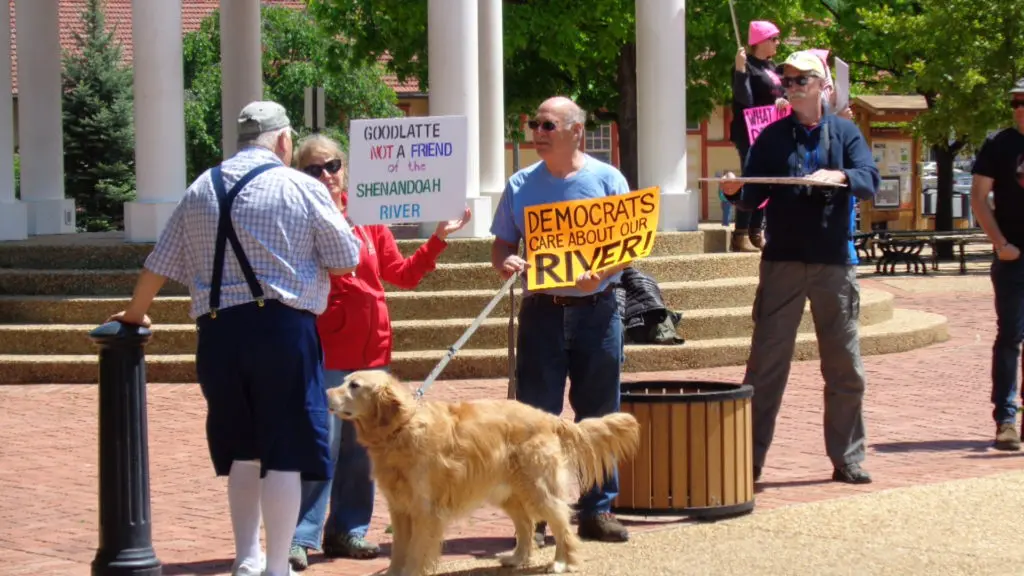
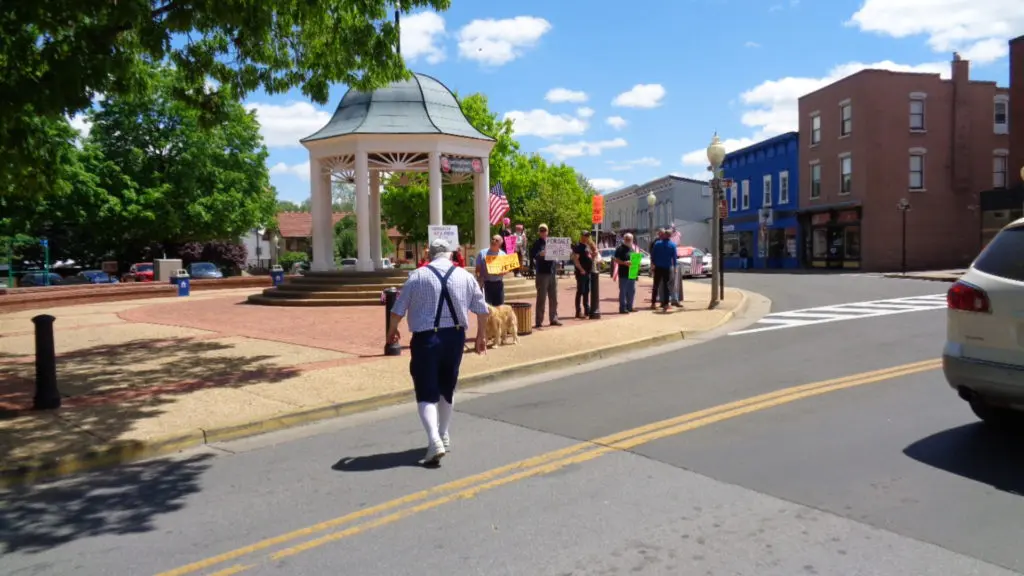
Above, in early May 2017 Ralph Waller was still crossing the street to engage in dialogue with anti-Trump Vigil for Democracy demonstrators. Later that month the Wallers were joined by a faith-based, pro-Trump contingent of about 8 to 10 people more prone to prayer than dialogue with the other side.
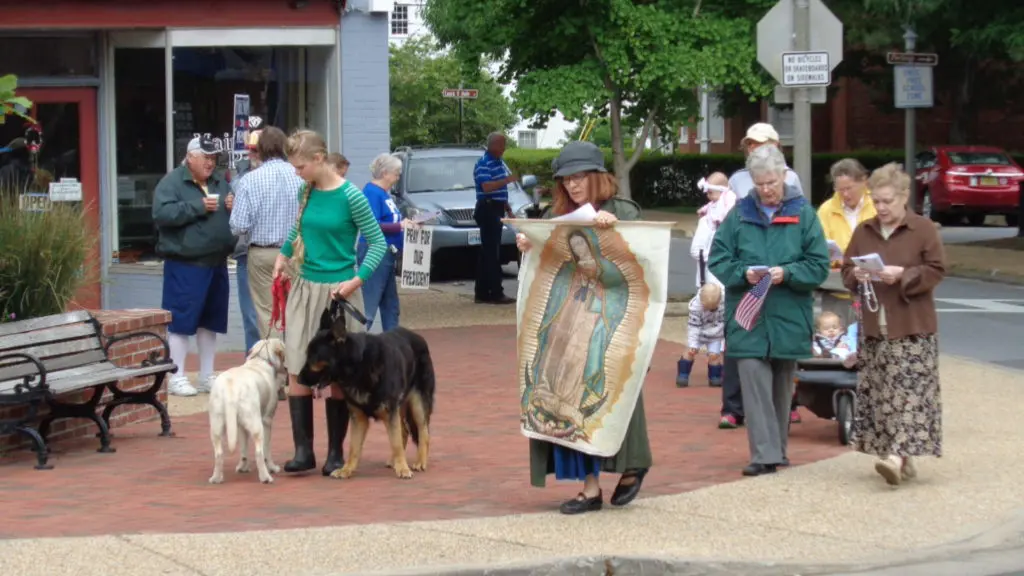
Coincidentally as these situations were developing, this reporter was apprised of a commentary in the Catholic journal La Civilta Cattolica published last July. After reading the spiritual-socio-political analysis titled “Evangelical Fundamentalism and Catholic Integralism in the USA: A Surprising Ecumenism” we contacted staff of what is described as a Rome-based, Jesuit-run, Far Eastern journal to inquire about reprint rights in part or total. We were given reprint authority with attribution and publication of a link to the original article.
Why were we interested in reprint rights? – Because of reports that some Vigil for Democracy participants were experiencing the very symptoms of this politically-driven “surprising new ecumenism” on Wednesdays, right here in Front Royal, Virginia.
First, a little background:
Ecumenism is defined as “a movement promoting worldwide unity among religions through greater cooperation and improved understanding”.
According to multiple online sources, what sets Protestant evangelicals apart from others of their respective faiths is a core, generally “born again” conversion belief in Jesus Christ as the lone path to salvation. This “faith above acts” belief is so stringent that evangelicals believe that even a good life full of good acts is futile without the corresponding “conversion belief” in Christ as the path to spiritual salvation.
Rather than good works being the groundwork for human redemption, the evangelical believes “true Christian faith” is at the root of a good life, which is therefore reduced to a consequence of faith, rather than a cause or justification for redemption and heavenly reward.
Online research identifies “Catholic Integralism” as an “anti-pluralist trend” born in 19th century Spain, France and Italy seeking to assert “a Catholic underpinning to all social and political action,” with a corresponding attempt “to minimize or eliminate any competing ideological actors”.
While falling short of criticizing the philosophy, The Josias website notes Integralism within the context of Catholicism is now “largely associated with hyper-traditionalist reactionaries who refuse to recognize the ideological realignment of the Catholic Church following the Second Vatican Council.” Vatican II is generally recognized as an effort, circa 1962-1965, to refocus and keep the Catholic Church relevant to the modern world. One of its primary directives was ecumenical dialogue and cooperation with other faiths.

Second Vatican Council, the 21st Ecumenical Council of the Catholic Church, the second held at the Vatican (1962-65): it is the move toward inter-faith dialogue and respect forwarded from this council that Catholic Integralists reject. – Public Domain Photos/St. Peters exterior Wolfgang Stuck; inside Lothar Wolleh

The La Civilta Cattolica commentary on the emergence of a fundamentalist ecumenical alliance between U.S. Catholics and Protestants is co-authored by the journal’s Editor Father Antonio Sparado and Reverend Marcelo Figueroa. Figueroa is a Presbyterian minister and editor-in-chief of the Argentine edition of L’Observatore Romano, a daily newspaper based in Vatican City.
Their analysis describes this strange, new ecumenism as an increasingly dogmatic and apocalyptic vision of politics as a battle of ultimate good versus ultimate evil. It is a view of politics and the world that does not leave much room for dialogue or compromise to achieve mutually satisfactory ends. This distinctly American brand of fundamentalist ecumenism is described by Sparado and Figueroa as an “ecumenism of hate”.
Introducing a new dynamic
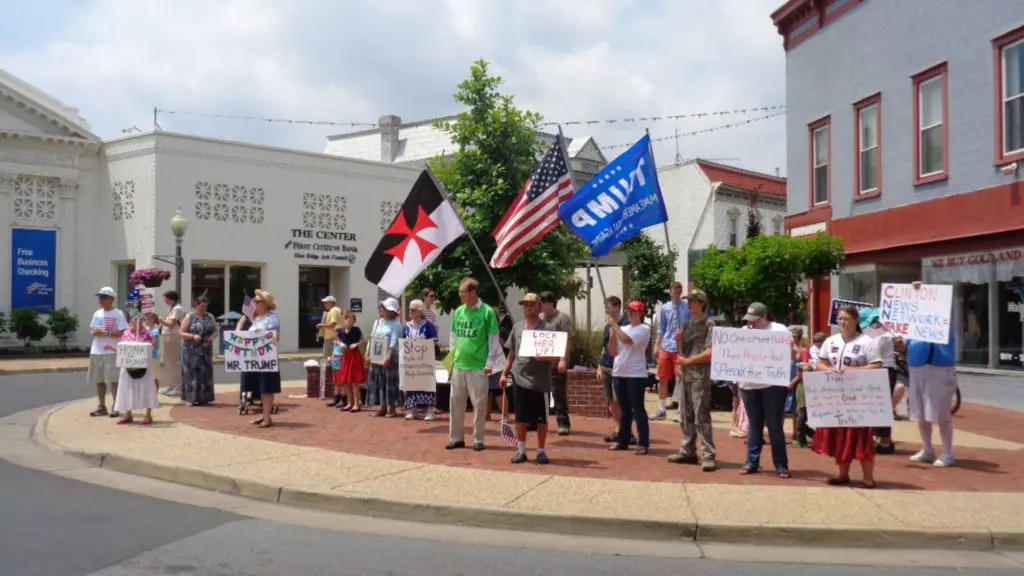
Above, the faith-based group eventually grew to about 15 to 20, with varying numbers of children and teens joining the adults week to week. Prevalent through the summer and fall of 2017 were flags representing the Knights Templar and President Trump flanking the American flag. Below, as the 2017 counter demonstrations progressed reproductive rights issues served as a basis for tying the president to faith and God.
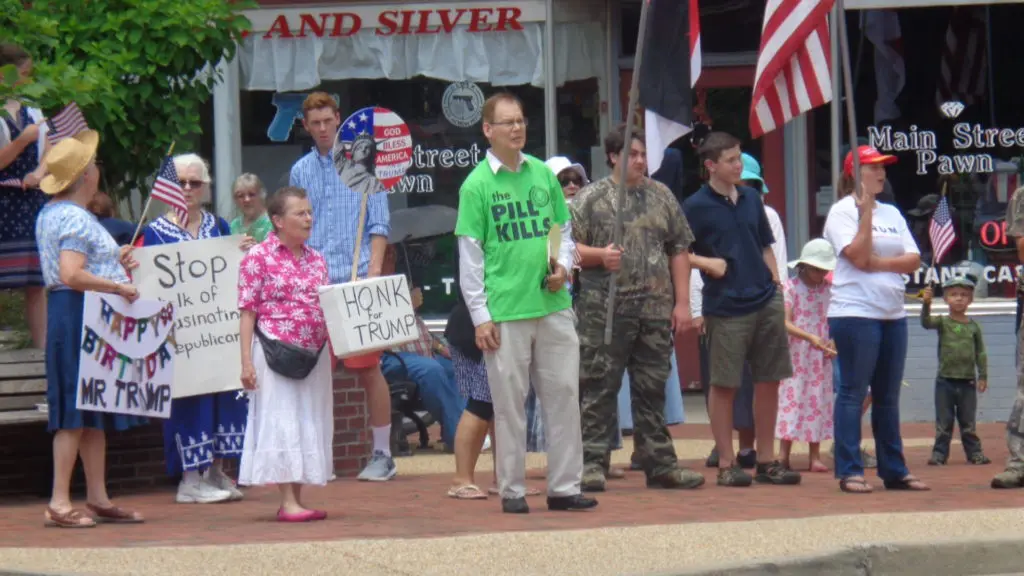
After that foray into religious perspectives, we find ourselves back at the intersection of East Main and Chester Streets in Front Royal, Virginia, on Wednesday afternoons. What symptoms of La Civilta Cattolica’s “strange new ecumenism” were being experienced here?
We were told an increasingly hostile, even angry attitude emanating from the faith-based, pro-Trump demonstrators, as well as anti-Semitic and racist comments made in direct conversations – conversations overheard by people from both sides of the street.
Vigil organizer Len Sherp initially told us of a conversation with a regular faith-based female pro-Trump demonstrator, off the record. He later went on the record when we explained our interest in an exploration of the “strange new ecumenism” described in La Civilta Cattolica.
During one of the efforts to dialogue with the newer pro-Trump contingent that originally appeared marching behind a portrait of Mary, mother of Jesus, in late May 2017, Sherp reported being questioned about his faith. He said a woman he later identified at subsequent demonstrations asked if he was “a Jew”. Somewhat taken aback, Sherp said he thought the question irrelevant, adding, “But yes, I happen to be Jewish.
“She replied along the lines of ‘I thought so. You’re all a bunch of Bolsheviks, and the Jews are responsible for everything that’s wrong in the world today.’ I asked her if we Jews in the U.S. – all 7 million of us – should pick up and move to Israel or maybe Canada. And though she confessed to not having considered it, it would be fine with her if we did,” Sherp recalled.
He reported one of the original pro-Trump demonstrators, Ralph Waller, as taken off guard by the exchange; later telling Sherp “how much he respected Jewish people.” Waller later confirmed overhearing the conversation, verifying Sherp’s account.
Several other Vigil for Democracy participants reported a subsequent conversation with another woman with what was described as a thick Australian accent. One woman from the vigil side asked her opinion of Australia’s native Aborigine population, to which she is reported to have replied, “They are hawff human, hawff beast,” after which she crossed the street to the pro-Trump side.
Sherp elaborated he could not be sure if the pro-Trump contingent was her intended destination or she had been a passerby who decided to engage both groups. However, another vigil regular said they were sure they had seen the woman in question on the pro-Trump side during a few more mid-2017 demonstrations, without again interacting on the vigil side of the street.
During this same period of time Sherp also noted a generalized level of hostility emanating from the faith-based Trump supporters that led some vigil participants to disengage.
“The hostility and anger emanating from the Trump side on occasion was off-putting to say the least, and down-right frightening to some. One of our usual participants, who had brought his grandson with him, has indicated that he won’t be coming anymore, because he couldn’t explain to his grandson why those people were so angry; and he feared what it might lead to,” Sherp told us.
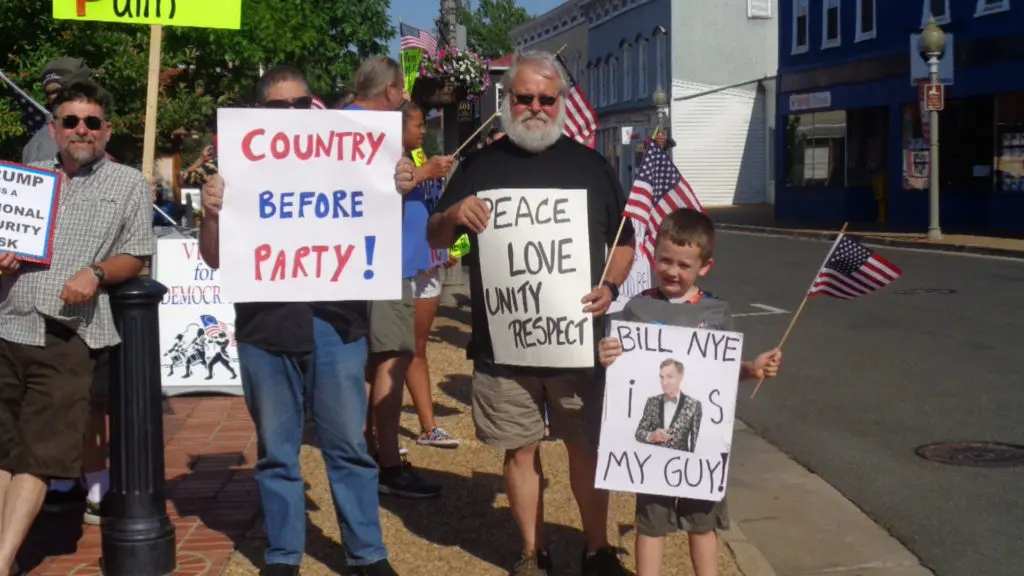
Children have participated on both sides, though in larger numbers with the pro-Trump contingent (note: these photos were NOT taken the day of the referenced ‘Hate Makes Us All Ugly’ incident.)

This reporter observed that as the faith-based pro-Trump demonstrations continued into the summer, they increasingly appeared focused directly across Chester Street toward the anti-Trump vigil group. At the same time, for the most part Vigil for Democracy demonstrators appeared to continue their focus on passing foot and vehicular traffic. And while Sherp himself occasionally engaged in across-the-street political banter with the Wallers, he eventually cautioned his fellow “vigilites” working traffic along Chester Street from direct responses to taunts from demonstrators on the other side of the street due to the potential for rising tensions of a less than playful nature.
One incident from this period reflective of a generalized hostility, involving a perhaps 12-year-old girl accompanying the pro-Trump adults, was also observed by this reporter. While speaking with Ralph Waller on the Trump side of the street, trying to identify a spokesperson for the newer pro-Trump contingent, the girl brandishing a “Honk for Trump” sign came up to a nearby pro-Trump adult and reported, “They have a sign that says ‘Hate makes us all ugly’ – maybe that’s why they’re all so ugly.”
And while a glance across the street identified no one this observer would identify as physically “ugly”, the comment appeared to be taken in stride by the adult male the girl was reporting to.
Back to the Vatican
The type of conflict-oriented “we’re good, you’re evil” political stances described above are exactly what the La Civilta Cattolica article on faith-based American politics is about.
“Theirs is a prophetic formula: fight the threats to American Christian values and prepare for the imminent justice of an Armageddon, a final showdown between Good and Evil, between God and Satan,” the La Civilta Cattolica authors write, adding, “In this sense, every process – be it of peace, dialogue, etc. – collapses before the needs of the end, the final battle against the enemy … Such a unidirectional reading of the biblical texts can anesthetize consciences or actively support the most atrocious and dramatic portrayals of a world that is living beyond the frontiers of its own ‘promised land’.”
What do the authors make of this Americanized phenomena of a radicalized political alliance across Christian denominational lines? They call it a “paradox” that transforms a once vibrant spiritual tradition of religious cooperation and inclusion into a “xenophobic and Islamophobic vision that wants walls and purifying deportations.” So transformed, the word ecumenism transforms into a spiritual paradox, into “an ecumenism of hate” Father Sparado and Reverend Figueroa assert.
As one U.S. terrorism expert said of the 1979 revolutionary Islamic student siege and hostage-taking at the American Embassy in Iran, “They believe they have God on their side – THAT is a powerful delusion.”
“Intolerance is a celestial mark of purism,” Sparado and Figueroa write, “This meeting over shared objectives happens around such themes as abortion, same-sex marriage, religious education in schools and other matters generally considered moral or tied to values. Both Evangelicals and Catholic Integralists condemn traditional ecumenism and yet promote an ecumenism of conflict that unites them in the nostalgic dream of a theocratic type of state.”
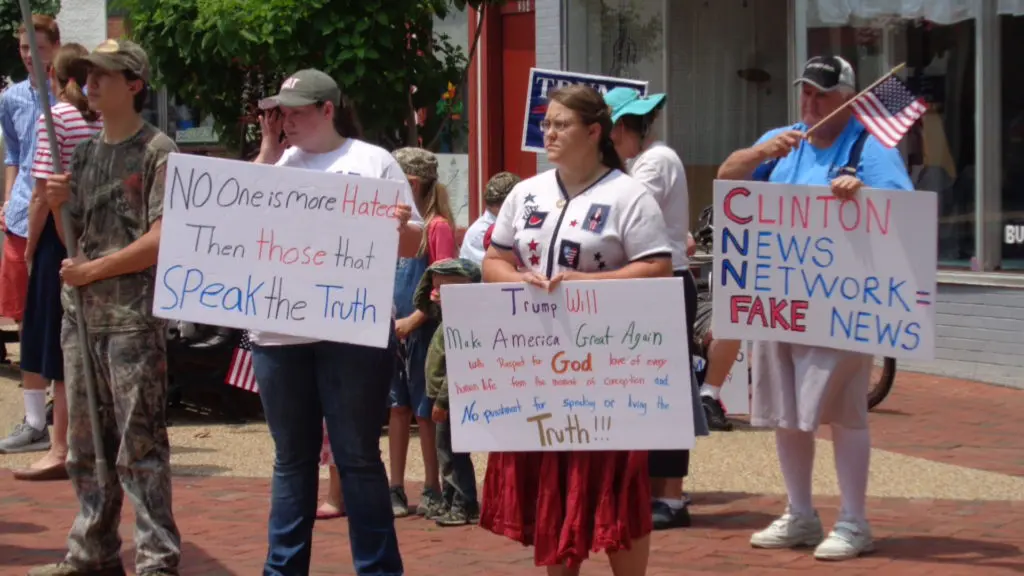
‘Intolerance is a celestial mark of purism’ the La Civilta Cattolica authors write. – That sense of divinely-inspired purism doesn’t leave much room for dialogue or compromise. The radically-different perspectives on ‘truth’ across the Chester Street political divide reflect a growing political mood across the nation.
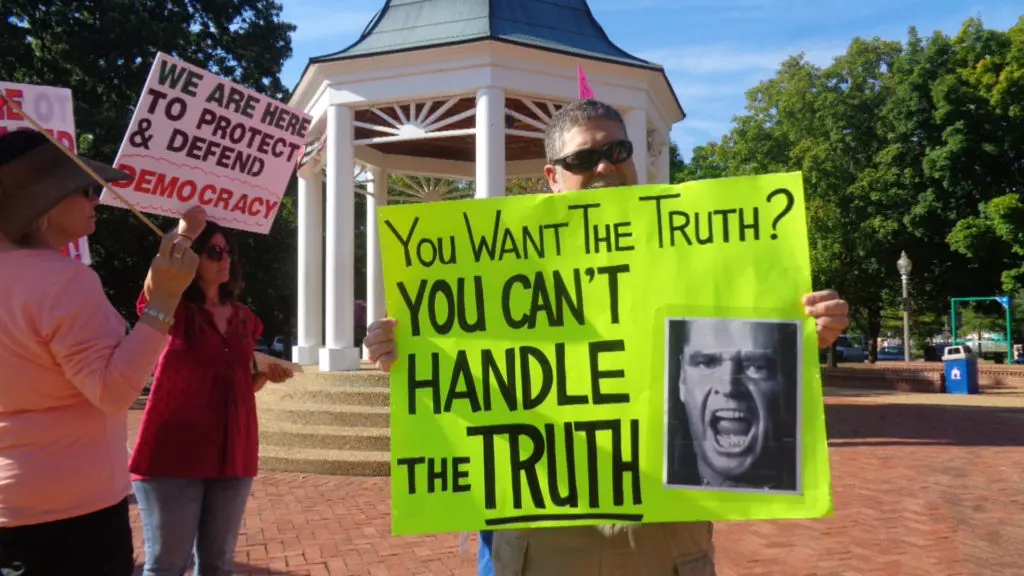
It is a political vision that is incompatible with a secular and democratically-based system of government as outlined by America’s Founding Fathers in the U.S. Constitution. Perhaps that helps explain the faith-based support for Trump – a shared dream of a non-democratic, non-pluralistic, authoritarian State as America’s future. However, it is a vision also incompatible with the beliefs and practice of faith urged by the current spiritual leader of world Catholicism.
The La Civilta Cattolica authors, both reported with close ties to Pope Francis, write, “Clearly there is an enormous difference between these concepts and the ecumenism employed by Pope Francis … His is an ecumenism that moves under the urge of inclusion, peace, encounter and bridges … Francis wants to break the organic link between culture, politics, institution and Church. Spirituality cannot tie itself to governments or military pacts, for it is at the service of all men and women.”
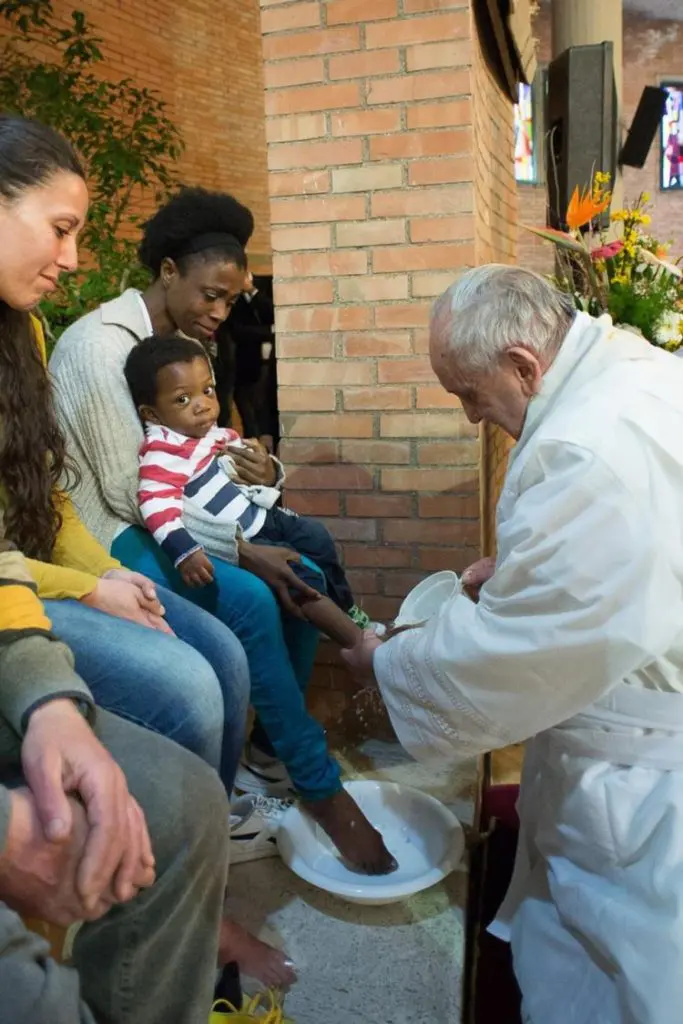
Pope Francis has emphasized faith as a tool of service to, rather than dominance over, others. He often has washed the feet of the sick and suffering, from lepers to prisoners and African and Muslim immigrants, as seen here. Public Domain Photo/Vatican-frankanswers.com
The 2016 election as ‘spiritual war’
However, the authors point to one platform of the new ecumenism that asserts just such a tie between politics and spirituality.
“There is a shocking rhetoric used, for example, by the writers of “Church Militant”, a successful US-based digital platform that is openly in favor of a political ultra-conservatism and uses Christian symbols to impose itself,” Spadaro and Figueroa write. “This abuse is called ‘authentic Christianity.’ And to show its own preferences, it has created a close analogy between Donald Trump and Emperor Constantine, and between Hilary Clinton and Diocletian. The American elections in this perspective were seen as a ‘spiritual war.’
“This warlike and militant approach seems most attractive and evocative to a certain public, especially given that the victory of Constantine – it was presumed impossible for him to beat Maxentius and the Roman establishment – had to be attributed to a divine intervention: in hoc signo vinces.
“Church Militant asks if Trump’s victory can be attributed to the prayers of Americans. The response suggested is affirmative … This is a very direct message that then wants to condition the presidency by framing it as a divine election.” (Well, maybe if you are prone to mistaking Vladimir Putin for Divinity)
Of a movement claiming to unite faith and politics to a supposedly spiritual end, the authors write that it is a LIE – a lie clearly recognized by Pope Francis, as it appears to have been some 2000 years ago by Jesus Christ.
“Give to Caesar what is Caesar’s and to God what is God’s,” Christ is quoted to have said. It is a statement on face value that appears to draw a clear line in the sand between the political state and the spiritual journey of mankind seeking a path to and understanding of its Creator.
“Francis radically rejects the idea of activating a Kingdom of God on earth as was at the basis of the Holy Roman Empire and similar political and institutional forms, including at the level of a ‘party.’ Understood this way, the ‘elected people’ would enter a complicated political and religious web that would make them forget they are at the service of the world, placing them in opposition to those who are different, those who do not belong – that is the ‘enemy’ …”

The La Civilta Cattolica authors point to an ultraconservative faith-based effort to tie Donald Trump’s election victory to that of Constantine becoming emperor in a long-shot victory over the Roman establishment. While one side of Chester St. may have bought into that notion, the other side has not – though that latter side may see similarities between Constantine and Trump that eludes that duo’s supporters. Constantine-‘By this sign conquer’ statue/Public Domain
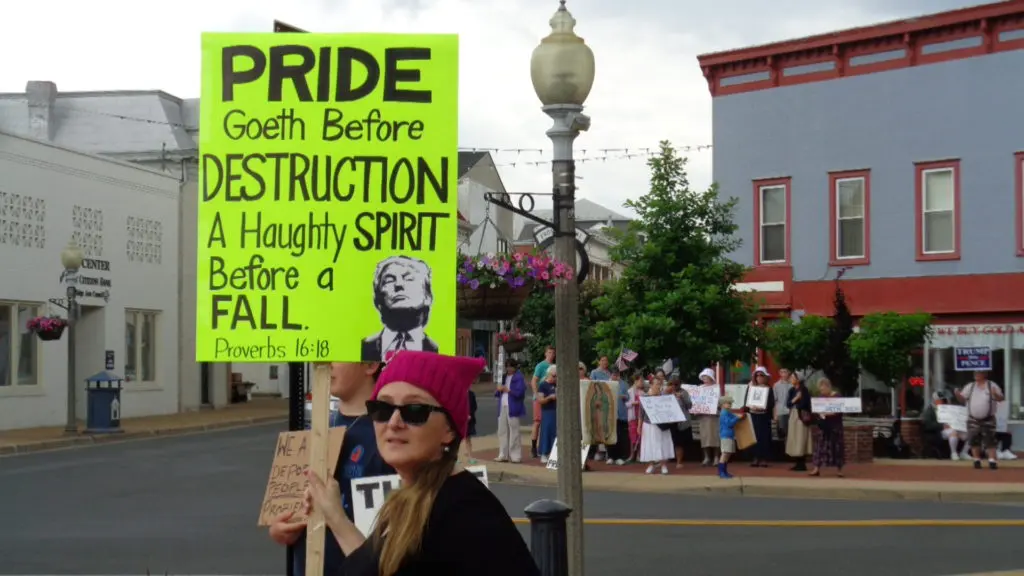
But for the Protestant Evangelical and the Catholic Integralist it is a natural step – for all “non-believers” are perceived as enemies who would not be tolerated in the theocratic state they desire. But how strange is it that such religious fundamentalists have tied their political wagon to Donald Trump, by reputation and action one of the least spiritual men to ever occupy the White House?
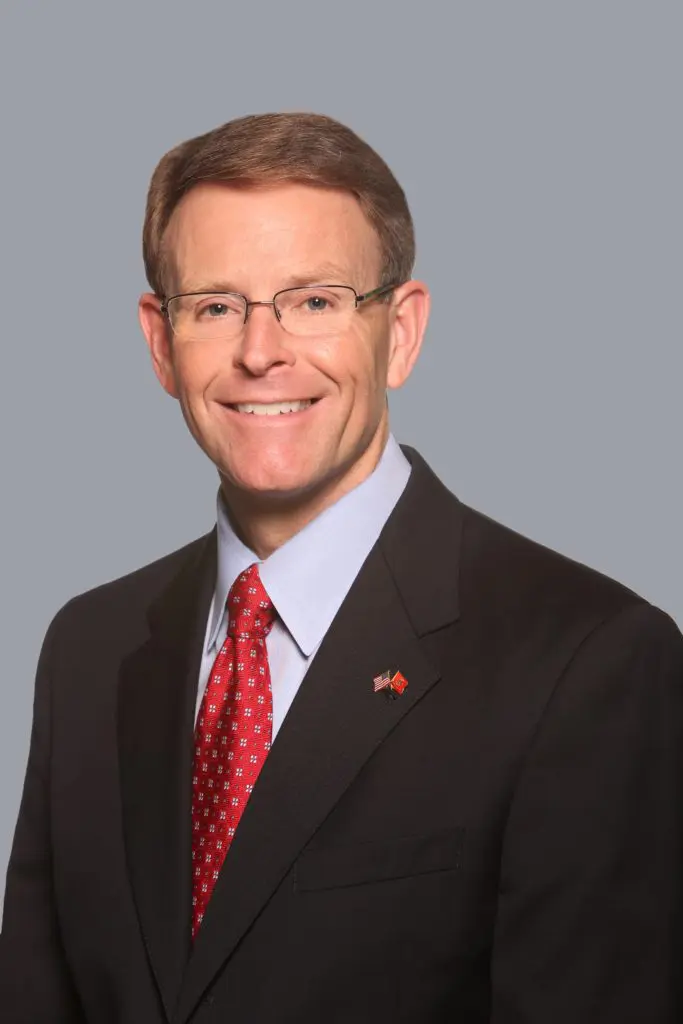
An example of this tenuous relationship may be illustrated in how the American Christian right reacted to the 2017 reports of an extra-marital affair Donald Trump had with a porn star. Queried about the phenomena, one Vigil for Democracy participant pointed to the “mulligan” (a golfing term for a do-over) offered up by the Family Research Council’s Tony Perkins regarding Trump’s reported encounter with Stephanie Clifford, aka adult film star Stormy Daniels, shortly after Melania Trump gave birth to the president’s youngest child.
The Family Research Council (FRC) is a Christian-based advocacy group, which the Southern Poverty Law Center identifies as an “extremist group” with a primary anti-LGBT agenda. It was founded in the early 1980’s and bills itself as the leading American voice for “traditional family values”. The FRC website identifies Perkins as its longest-serving president (since 2003), an ordained minister and former “leading pro-life voice” in the Louisiana State Legislature. According to its website, FRC’s mission is “to advance faith, family and freedom in public policy and the culture from a Christian worldview.”
Family values hypocrisies aside, the promise of movement in their direction on birth control, abortion and religious rights fronts by the president seem to be enough to hold the faith-based Trump line through any kind of scandal. As Trump himself observed of his “base” during his improbable 2016 run to the presidency, “I could stand in the middle of 5th Avenue and shoot somebody and I wouldn’t lose voters.”

Above, Stephanie Clifford, aka porn-film star Stormy Daniels, who received a $130,000 payment from Donald Trump’s personal attorney Michael Cohen during 2016 presidential campaign, ostensibly to remain quiet over an alleged sexual affair with Trump shortly after his third wife Melania gave birth to their son. Below, Evangelical-based Family Research Council President Tony Perkins, who gave Trump a ‘mulligan’ (do over) on his alleged extra-marital affairs. Stormy Photo/Public Domain-Facebook, Perkins Photo/FRC website
Of the $130,000 of alleged hush money paid by Trump’s personal lawyer Michael Cohen to Stormy Daniels during the 2016 campaign, one sage observer commented, “At least there is one storm Trump will pay for.”
More seriously – well there is a VERY serious point to that “storm” payment observation, especially if you are Puerto Rican, Floridian or Texan – Catholic Sparado and Presbyterian Figueroa write, “There is a need to flee the temptation to project divinity on political power that then uses it for its own ends … Religions cannot consider some people as sworn enemies nor others as eternal friends. Religion should not become the guarantor of the dominant classes. Yet it is this very dynamic with a spurious theological flavor that tries to impose its own law and logic in the political sphere … Triumphalist, arrogant and vindictive ethnicism is actually the opposite of Christianity.”
Sparado and Figueroa reference a May 9, 2017 interview published in the French daily La Croix where Pope Francis points to the example of Christ (the cross as a symbol of sacrifice), not Constantine (the cross as the hilt of a sword of conquest), as the model for true Christian values in the world:
“The contribution of Christianity to a culture is that of Christ washing the feet, or the service and the gift of life. There is no room for colonialism,” the pope told the French journal, adding, “The only crown that counts for the Christian is the one with thorns that Christ wore on high.”
Sparado and Figueroa observe that for the spiritual leader of world Catholicism, true spirituality and true faith must ultimately be used as a check on abuses of power by any socio-political elite, rather than co-opted as the tool of a political establishment seeking to elevate itself to the position of earthbound deity, above the rule of any law or beholding to any sense of a common, universal good or tolerance.
As they conclude, Sparado and Figueroa explore “fear” at the root of what they describe as a political perversion of faith. “It is fear of the breakup of a constructed order and the fear of chaos … The political strategy for success becomes that of raising the tones of the conflictual, exaggerating disorder, agitating the souls of the people by painting worrying scenarios beyond any realism.”
Boy, does that sound familiar to anyone on, say, the fronts of immigration or LGBT rights?
“The appeal to the apocalypse justifies the power desired by a god or colluded in with a god.* And fundamentalism thereby shows itself not to be the product of a religious experience but a poor and abusive perversion of it,” La Civilta Cattolica’s authors conclude.
Back home

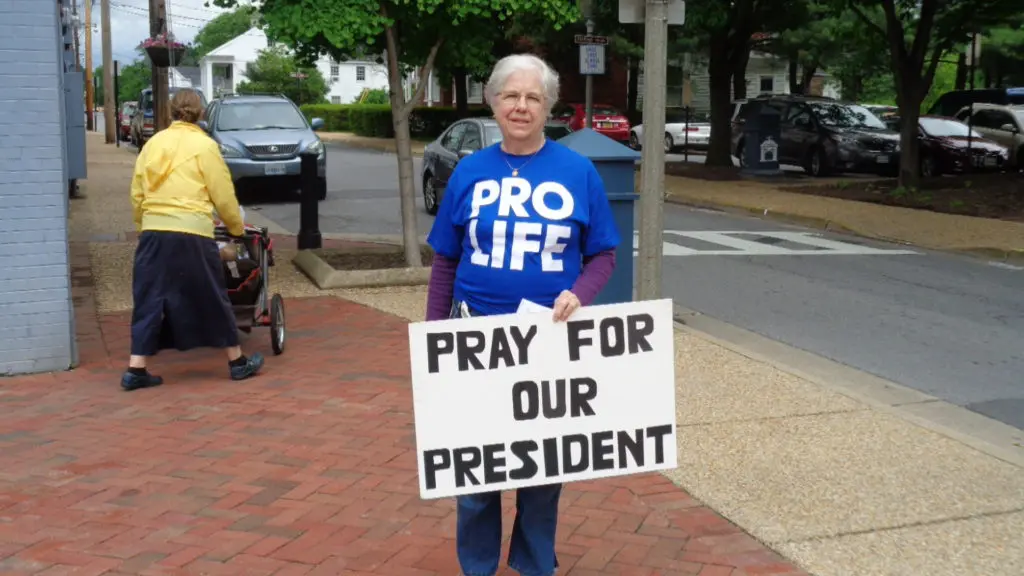
‘Pray for Our President’ to keep his hands off any beautiful women in the neighborhood; but that one below looks prepared for any celebrity glad hands.
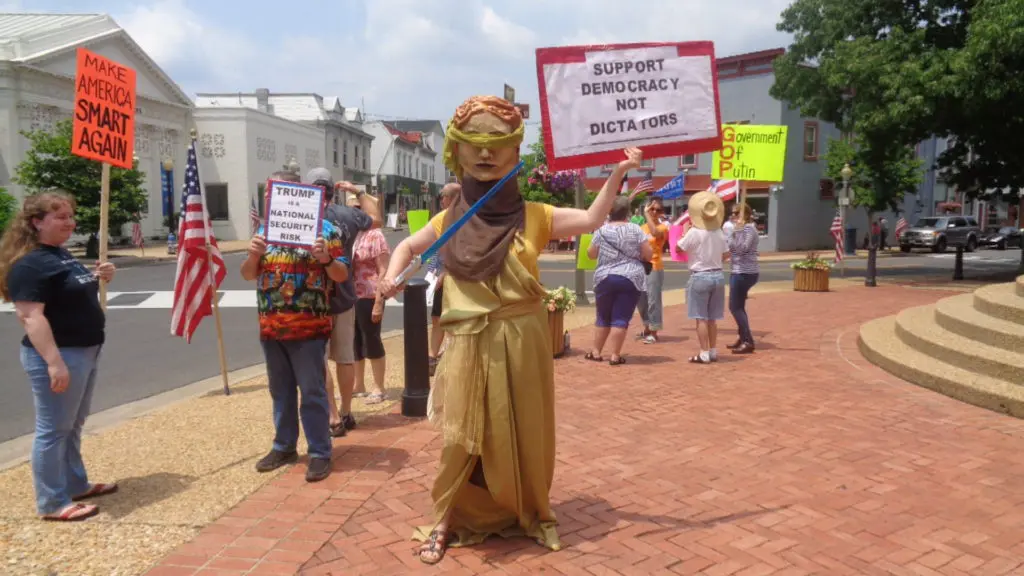
And so after this long detour through Vatican and European history, as well as La Civilta Cattolica’s pages where we encountered “Evangelical Fundamentalism and Catholic Integralism in the USA: A Surprising Ecumenism”, we again find ourselves back at the intersection of East Main and Chester Streets, in Front Royal, Virginia, USA.
So, what is to be made of such faith-based political hostility and encounters described along Chester Street reflective of anti-Semiticism, notions of racial superiority, and stereotypical vilification of political opponents passed on to the children?
One might say it indicates that we are part of a world becoming not only smaller due to technological advances, but unfortunately no less mean-spirited than past empires history tells us were built upon bigotry, lies and the stereotyping of “others” as somehow less human, less worthy, less “holy” than the ruling elite and its devotees. – Devotees hypnotized by clinging to the cloak, not of Christ, but to that of an Emperor and the power of the State.
*FOOTNOTE: observe that the La Civilta Cattolica authors write “god” in this passage with a small “g” indicating their belief the “new ecumenism’s” faith is in a false god.