
Local Government
In Cannabis Ordinance Review, Commissioners Identify Direction from Town Council as Critical
For those who knew her, Lauren Kopishke was not only a fountainhead of institutional knowledge but a loyal friend. Recently, she left her role as planning director and zoning administrator for the Town of Front Royal and moved to Frederick County for work, while continuing to live in the greater Front Royal area. Her departure was preceded by significant policy differences with the Town Council regarding the best way to protect the town from the arrival of a data center. While the council has favored a ban, she took a nuanced approach that would allow a special-use permitting process to regulate the arrival while also respecting Virginia’s status as a Dillon Rule state, where the state’s overall policy on data centers might dictate how localities respond to developer applications.
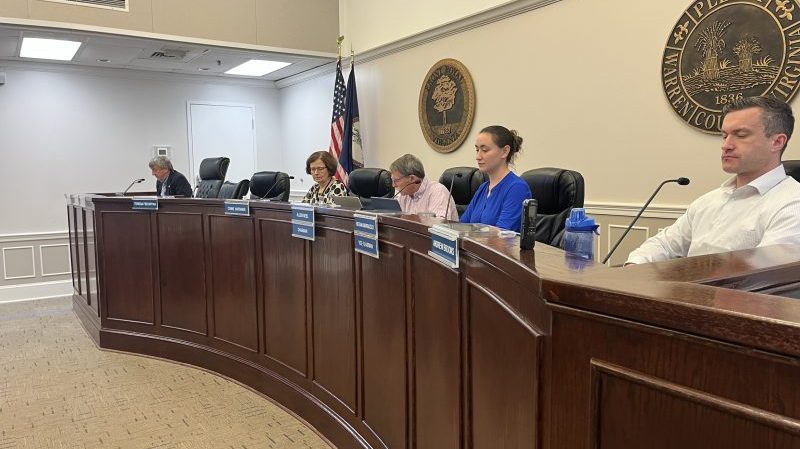
The Town Planning Commission met for a regular meeting followed by a work session on September 16. Royal Examiner Photo Credits: Brenden McHugh
The regular meeting of the Town Planning Commission on September 16, followed by a work session, was the commissioners’ first meeting after Kopishke’s departure. Deputy Zoning Administrator John Ware assumed her responsibilities, presenting the monthly director’s report, capably covering the usual data of permits granted and walk-ins served, as well as key details like the momentum of Marshall’s Glen development going forward. The regular meeting was followed by a work session to address the urgent need for an ordinance controlling the 2027 arrival of retail cannabis and potentially production.

Deputy Zoning Administrator John Ware presented an application for a short-term rental to the commissioners. He also presented the planning director’s monthly report in the absence of the recently resigned Lauren Kopishke.

In May of this year, Governor Abigail Spanberger struck down a motion that would have fast-tracked retail cannabis to arrive in early 2027. Her decision came as a surprise to many, as she has been a proponent of a regulated cannabis market under the Virginia Cannabis Control Authority. She said an undertaking of this magnitude must be done right, allowing time for all necessary preparations. The Front Royal commissioners have begun that preparation process, targeting a February 1 start date for the authority to receive license applications and a July 1 start date for open business.
The authority is capping retail licenses at 350 statewide. Realistically, Front Royal could see two such enterprises within its limits. While it cannot prohibit such use, the Town can certainly regulate it from a land use perspective. Most critically, it can regulate the distance between the vendor and any school, daycare, or other space dedicated to children, as well as any substance disorder facility. If it may be a location for substance recovery meetings like Alcoholics Anonymous, a church could also be a candidate for that special distance. The commissioners are examining and developing a map of the town delineating where zoning would allow the use while not falling within the 500-to-1000-foot radius of a protected establishment. In some circumstances, signage also submits to that distance consideration.
The question before the commission and the council is how stringently to regulate the local cannabis market. The commission is in consensus to maintain the special-use permitting process for all appearances of cannabis, retail or production, but before commencing intensive work on the ordinance, the commissioners want direction from the council on whether the council favors by right or SUP as a regulatory framework. Town Attorney George Sonnett favors a by-right process, at least for retail, based on zoning authority. However, he expressed a desire not to impede the commissioners’ work and therefore counseled them according to their preference. To save time, the town manager will be asked to expedite the council’s review at its first work session in October.




Warren County Schools Improve, But Federal Rules Lower Seven Ratings

Spanberger Announces $1.3 Million in Scholarships and Incentives for Nursing Students

The First Long-Distance Phone Call Came With Receipts

Middletown Man Killed In I-81 Crash In Frederick County

Cline Backs Veteran Cancer Screening Effort, Highlights Sixth District Programs

Sheriff Cline Details Flock Safeguards, Uses and Limits at Warren County Work Session

Flock Safety: A Tool for the Common Good

Melissa Ichiuji Studio Gallery Reopens With Two Fall Exhibitions

Just Hours Away: Festival Of Leaves Returns To Downtown Front Royal Saturday

Sheriff’s Office Addresses Use of ‘ALPR’ Cameras – Health Insurance, 4-H Week, and Parks & Rec Events Also Presented

Before Relying on a Model, Look at the Assumptions

The Question Is Not Which Apple Tastes Best

Brian Anthony Lamb (1980 – 2026)

Mary Brinham Walton (nee Arnold) (1947 – 2026)

Sandra Jo Alger (1941 – 2026)

All Warren County Schools Fully Accredited as State Releases New Performance Results

This Week’s Showtimes at Royal Cinemas as of October 9th

Samuels Public Library to Expand ‘Library of Things’ With $2,000 Grant

Ask Stewart: Why Do Leaves Turn Different Colors in the Fall?

After Statewide Tour, Virginia Lt. Gov. Hashmi Officially Opposes Dominion-NextEra Merger

Virginia Republicans Urge Spanberger to Call Special Session for Fuel-Tax Holiday

Kratom, 7-OH Laws Diverge Amid the Spread of Potent Synthetic Products

WCHS vs. Manassas Park – Varsity Football – October 9, 2026

A Golf Hazard With an Appetite
