
State News
Large Solar Farms in Virginia Can Produce ‘Rapid’ Stormwater Runoff, Researchers Find
Stormwater runoff has become part of a growing, contentious debate around solar energy development in Virginia.
Some residents and officials in rural areas complain of flooding and pollution around large solar sites. Developers argue that there are already requirements in place to mitigate the problem.
Virginia Tech is in the midst of an effort to collect on-the-ground data to help inform state leaders how to move forward.

Dominion Energy’s Whitehouse solar farm in Louisa County. (Courtesy of Dominion Energy)
The Department of Environmental Quality gave the school $6 million for a six-year study. About two years in, the research team recently published initial findings.
“What we found is, these areas that have solar development happening tend to produce runoff more quickly,” said Ryan Stewart, associate professor at Virginia Tech’s School of Plant and Environmental Sciences. “In many cases, though not all cases, we tend to see higher peak flows coming off the solar areas.”
Stormwater runoff happens when rain falls on impervious surfaces, such as roadways and parking lots, which do not absorb water. That can cause flooding, contribute to erosion and allow pollutants to wash into waterways.
Utility-scale solar projects in Virginia are often built on former farmland, which absorbs water. But glass panels on top allow water to run off.
What happens next “is kind of an open question,” Stewart said.
Some people believe that when the water falls from below the panels, it keeps flowing, eventually running off the site. Others argue that once the water drips off, it infiltrates into the soil beneath adjoining panels downhill.

His team measured runoff at three utility-scale solar sites, one in Surry County and two in the Piedmont region, each spanning hundreds of acres.
Researchers installed metal structures, called flumes, in the channels lining the solar sites to monitor water flow during storms.
The devices are hooked up to data loggers with cellular connections that upload data to the cloud every 30 minutes, along with rainfall data from local weather stations.
For comparison, the group measured runoff at reference points around the solar sites, such as grass or cropland, to represent their previous land use.
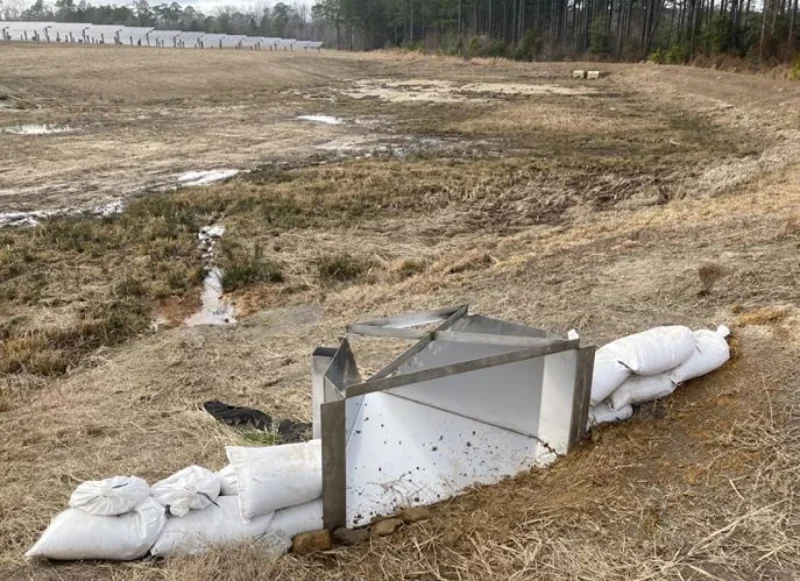
A flume was installed in a stormwater ditch that drains into a permanent stormwater pond at one of the studied solar sites in Virginia. (Photo courtesy of Virginia Tech)
Between January 2024 and October 2025, the group recorded between 39 and 76 storms at each site, most with less than an inch of rain accumulation.
The results showed that the spots within solar arrays often saw “rapid, and at times substantial,” amounts of surface runoff.
“I think that points out that solar development is having an effect on hydrology,” Stewart said. “We can’t just assume that the landscape is how it was before the solar construction.”
Last year, Virginia Tech published research on how to best manage land while building and decommissioning utility-scale solar sites. The paper states such facilities could impact 350,000 acres of the state’s agricultural and forested landscapes by 2045.
Recommendations included using conservative estimates for potential runoff, using sensors to trigger panels to move into vertical positions during heavy rainfall and minimizing the removal of topsoil.

Solar developers are required to address stormwater runoff, often using constructed ditches or retention ponds to store water, which then evaporates or slowly trickles into soil and streams.
Much of the regulatory debate comes down to a technical definition. The state previously considered only the foundations of solar panels to be impervious surfaces.
But Gov. Glenn Youngkin’s administration rolled out changes to classify panels as 100% impervious, saying stronger standards were needed to stem pollution in the heavily regulated Chesapeake Bay watershed.
The change “has caused a lot of consternation among some of the developers who think that’s overkill,” Stewart said. “That’s something we hope to get a better handle on through this project: What’s actually happening with water that’s coming off the panels.”
The Virginia Tech researchers plan to gather more information in the remaining years of the project, such as expanding to six sites, figuring out what the runoff contains, and any changes to the soil itself.
Stewart said he’s mindful of the “strong interest on both sides.”
“We’re just trying to collect information in the best way we can and analyze it in a transparent way,” he said. “So that everybody involved can take a look and see this is actually what’s going on, versus what we assume or hope is happening.”
By Katherine Hafner/WHRO
Virginia Mercury is part of States Newsroom, a nonprofit news network supported by grants and a coalition of donors as a 501c(3) public charity. Virginia Mercury maintains editorial independence. Contact Editor Samantha Willis for questions: info@virginiamercury.com.




Debbie’s Lighthouse Combats Food Insecurity While Helping Small Businesses Grow in Front Royal

Decision on ‘EagleView’ Contractual Oversight of Photographic Assessment Technology Delayed to November 17

Dominion-NextEra Merger Hits Turbulence, Faces Opposition from Virginia Leaders, SCC Staff

Cheaper Manufactured Homes Could Be Having a Moment, If Only States Can Catch Up

Sight & Sound’s JOSHUA LIVE! Comes to Royal Cinemas — Limited Run, October 29 – November 4

You Are Not Wasting the AI’s Time

The ‘Beer Belly’ Isn’t Really About Beer

Virginia State Police Launch Two-Day Interstate 81 Safety Enforcement Campaign October 21–22

Everybody Is a Leader Somewhere

Warren County Wildcats Host Meridian in Girls Volleyball Match Tuesday Night – October 20

Closing Virginia’s Childcare Affordability Gap Could Cost Up To $4.5B a Year

New Coalition Aims to Keep Virginians Covered as Medicaid Rules Tighten

General Assembly Calls Off Oct. 26 Special Session to Elect Judges

Trump Order Sets Up New Women’s Health Research Initiative at NIH, White House Task Force

What Is Puberty?

First New Class of Pain Medicine in Decades Comes with A 14-Day Limit

Front Royal Man Charged with Two Counts of Forcible Sodomy Following RSW Regional Jail Investigation

James Edward “Jimmy” Mahoney (1953 – 2026)

Ask Stewart: Are There Any Scary Trees?

Janet Denny Casarotti (1933 – 2026)

Virginia Breeders Championship Series Opens at Shenandoah Downs with Impressive Performances

Clark Preston “Lucky” Cameron (1961 – 2026)

Commentary: Data Centers and AI – A Rare and Raw Issue in Virginia for This Midterm Election

Douglas MacArthur “Dougie” Green (1964 – 2026)
