
State News
Mice May Drive Lyme Disease More Than Deer
For more than three decades, researchers have been tracking ticks, mice, oak trees and other wildlife in a New York forest to better understand what makes Lyme disease more likely to spread.
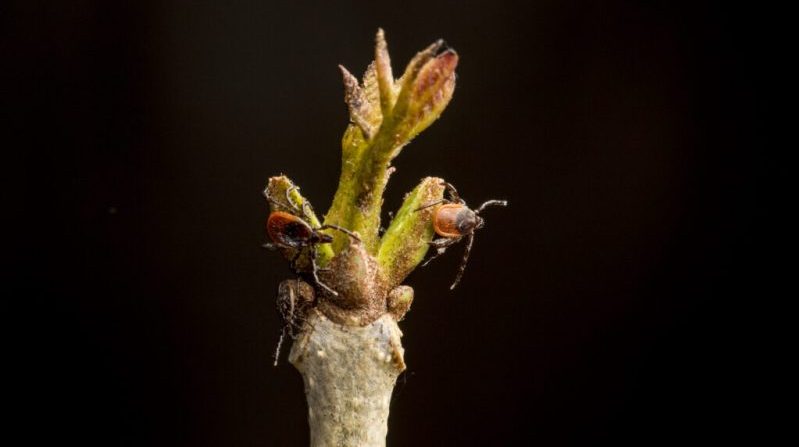
Several ticks rest on top of a plant. New research suggests that mice, not deer, are closely linked to increases in young ticks, while large acorn crops can help predict higher tick numbers two years later. (Photo courtesy of Robin Moore/Cary Institute of Ecosystem Studies)
Their latest findings challenge some long-held assumptions — including the idea that deer are a major driver of Lyme disease risk.
Researchers at the Cary Institute of Ecosystem Studies, a nonprofit environmental research group, found that white-footed mice, not white-tailed deer, are closely linked to the number of young blacklegged ticks, the life stage most likely to infect people with Lyme disease.

A year with a large mouse population was followed by about a 40% increase in nymphal ticks the following year. But more mice don’t necessarily mean a higher percentage of ticks carrying Lyme bacteria. Researchers initially expected the two to rise together because white-footed mice are especially good at transmitting the bacteria to ticks.
The researchers found that other animals, including skunks, squirrels, and opossums, also feed larval ticks. Because those animals are less efficient at transmitting the bacteria, the mix of hosts can affect how many ticks become infected.
In other words, mouse populations can help predict how many ticks there will be, but not necessarily how many will carry Lyme bacteria.
The researchers also found that large crops of acorns can set off a chain reaction: More acorns mean more food for mice, which can mean more ticks two years later.

The findings come as tick-borne diseases are an increasing public health concern. Lyme disease is the most commonly reported tick-borne disease in the United States, with nearly half a million people diagnosed each year, according to the federal Centers for Disease Control and Prevention.
The study, published in the peer-reviewed Proceedings of the National Academy of Sciences journal, draws on data collected since 1991 at a 2,000-acre research site in Dutchess County, New York.
The researchers also found that extreme heat and cold don’t necessarily kill blacklegged ticks in the wild. The ticks appear able to shelter in soil and leaf litter during extreme temperatures. The team plans to continue monitoring how ticks, wildlife, trees and climate interact — and what those changes could mean for human health, according to a news release.
This new research comes as scientists and public health officials are also watching ticks expand into new parts of the country.

Lone star ticks, once primarily associated with the Southeast, are now established across much of the South, Midwest and Northeast. An adult female is distinguished by a white dot or “lone star” on her back. The ticks can transmit several diseases and are associated with alpha-gal syndrome, an allergy to a molecule found in red meat and other products from mammals.
As lone star tick populations have spread, more states are paying attention to alpha-gal syndrome, which experts believe is significantly underdiagnosed.
Massachusetts, Missouri and Oklahoma have expanded surveillance or public education efforts in recent years, and all three have joined the growing list of states that require alpha-gal syndrome to be reported to public health officials.
At least 14 states have added or will soon add alpha-gal syndrome to their lists of reportable diseases, according to the Alpha-gal Alliance Action Fund, a nonprofit advocacy group. In those states, health care providers and laboratories must report cases to state health departments.

Lawmakers in Ohio are also considering a similar measure that would make alpha-gal syndrome a reportable disease. The bill has passed the House and remains under consideration in the Senate. The legislature will adjourn in December.
Unlike Lyme disease, alpha-gal syndrome is not required to be reported nationwide, making it difficult to determine how common the condition is or how its prevalence is changing. The CDC estimates that as many as 450,000 people in the United States may have the disease.
Stateline reporter Amanda Watford can be reached at awatford@stateline.org.
This story was originally produced by Stateline, which is part of States Newsroom, a nonprofit news network that includes Virginia Mercury, and is supported by grants and a coalition of donors as a 501 (c) (3) public charity.

by Amanda Watford, Virginia Mercury
Virginia Mercury is part of States Newsroom, a nonprofit news network supported by grants and a coalition of donors as a 501c(3) public charity. Virginia Mercury maintains editorial independence. Contact Editor Samantha Willis for questions: info@virginiamercury.com.




Warren County Volleyball Set to Host Fauquier Tuesday Night – September 8

Virginia Voters to Decide Reproductive Freedom Amendment in November

South Fork Fly Fishing Tournament Set for Sept. 12 at Shenandoah River State Park

Stone Branch Center for the Arts Welcomes Artist-in-Residence Linda L. Anderson

Amtrak to Suspend Virginia-to-D.C. Service for Critical Track Upgrades Oct. 16–26

Commentary: The Energy Virginia Needs is the Energy We Can Build Now

Labor Unions Are Growing, But Where Depends On State Politics

Phillip Ray Knight (1953 – 2026)

Governor Spanberger Believes Tariffs Are Taxes, Until Virginia Cattlemen Want Tariff Protection

Avtex Remembrance Walk: A Solemn Theme for Labor Day Weekend

Pitch Burst Volunteers Support Warren Coalition Children’s Programs

Never Forget: Front Royal Marks 25 Years Since 9/11 — A Time to Gather, Reflect and Pass It On

National Preparedness Month: How to Get Through a Multi-Day Power Outage

From Workers’ Parades to Backyard Cookouts: How Labor Day Began

Is It Too Late to Sign Up for the All About Trees Class This Year?

The Envelope That Decides Next Year

The Emergency Fund You’ll Actually Build

Stronger, Not Bigger: Rethinking Economic Development in Warren County

Kenneth Lewis Smith (1939 – 2026)

Strong Families Build a Stronger Warren County

The Science Prizes That Make You Laugh, Then Think

Grill the Perfect Corn on the Cob, Then Dress It Up

The Famous Last Words No One Wrote Down

US Supreme Court Again Urged to Permit Trump Vote-by-Mail Restrictions
