
Seasonal
Mom’s greeting card is unreadable to young people
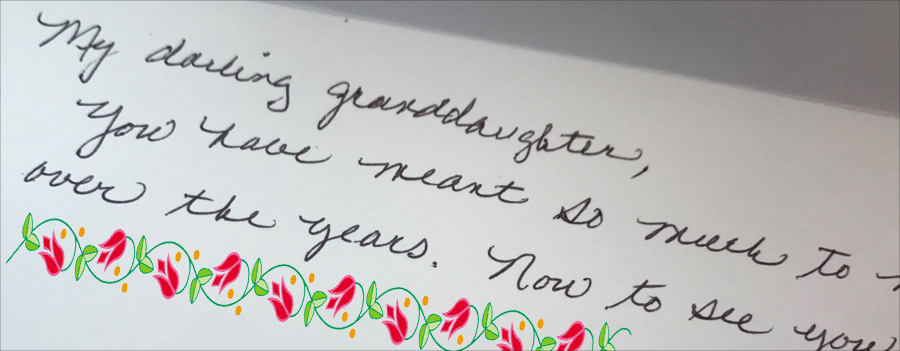 A plaintive email posted on Yahoo Answers: A questioner says her mother gave her a beautiful Valentine’s Day card with a lovely written message.
She couldn’t read a word. It was written in cursive, a foreign language to young people, who were never taught the script used for a thousand years in their language, the script of their parents and grandparents. Was she missing something not learning cursive?
The answers from kids pointed out they were faced with cursive writing in letters and in school and they couldn’t read it either. Some urged the questioner to learn on his/her own.
Cursive writing was taken out of school curriculum in 2010, a dying, unnecessary art to be replaced by keyboarding.

Problem is people still use cursive. They send handwritten letters and cards to their children and grandchildren. Do they know their sentiments are in language foreign to the recipient?
Will it become, as some joke, a secret language?
Despite studies that show handwriting improves fine motor skills and enhanced the composition of ideas, schools have all but made cursive obsolete. Cut to June 2016, however, and Louisiana had passed a law requiring public and public charter schools to teach cursive writing to children from the 3rd to the12th grade. It joined 10 other states including Virginia, California and Texas where the teaching of cursive script is a state education requirement.
The fact is, cursive still exists and a generation of smart kids can’t read it.
According to Abigail Walthausen, in her article, “Learning Cursive is a Basic Right’, for instance, “running hand’ is tied to being able to sign one’s name and “the signature, the ability to sign one’s own name,” she says, “has long been an essential marker of society.” Walthausen says students understand the pedigree that it represents, “has become a status marker.”

Catherine Romano and Mike Ayers agree and in their December 2016 article in the Washington Post, “The New Status Symbol? Think Ink,’ they wrote that the disappearance of joined-up handwriting is a gentle reminder of “the status and class that being able to sign a document with more than an X” once represented.
After typewriters, handwriting became an intimate act of respect in letters and cards. Handwriting then became a choice, but now it is a choice older people can’t afford to make when communicating with the young.




Why Wait Till November? Mid-Term Election Early Voting Processes in Place Now

US Senate Leaves Nation’s Capital in Advance of Midterms With Much Still Undone

Business Growth Series: If You Don’t Control Your Day, It Controls Your Business

The End of a 20-Year Monopoly on the Credit Score

Voltron and Immigration

States OK Solar Panels for Balconies. Safety Guidelines Haven’t Caught Up

Trump TV Ads Paid for with $20M in Homeland Security Funds, Dems Find

Blue Ridge Wildlife Center Patient of the Week: Gray Treefrog

Birthday Twins: See Which Famous Face Shares Your Big Day

Meet-and-Greet Set Sunday for Republican-Endorsed Front Royal Candidates

Barbara Ann Mathews Smelser (1943 – 2026)

Kathleen Frances Elar (1956 – 2026)

Happy Creek Crossing to Hold Vendor Interest Meeting Oct. 8 in Front Royal

If the Car Name Fits, Drive It

Front Royal Begins Smoke Testing Sewer System; Residents May See Smoke Around Homes

Trump Orders Federal Agencies to Replace ‘Artificial Intelligence’ With ‘Super Intelligence’

Town-Wide Weed Spraying Underway in Front Royal Through Oct. 6

Southbound I-81 Lane Closure Near Strasburg Expected to Cause Significant Weekend Delays

Virginia Democrats Warn More Healthcare Strains Loom After November Election

Legislation to Force Virginia Traffic Camera Fine Payments Will Make ‘Nightmarish’ Court Workloads

CDC’s Latest Youth Behavior Report Offers a Narrower Look at Teen Health

News Organizations Banned from White House Accuse Trump of First Amendment Violation

Virginia Education Board Approves New Rules for Local Student Assessments

FCC Halts Automatic Approval of Verizon Plan to End Legacy Landline Service in Virginia
