
State News
Officials got rid of an abandoned road culvert. Now migrating fish can swim freely

An aerial view of workers from the James River Association, DWR, USFWS, and the Virginia Department of Forestry planting live stakes, trees, and herbaceous vegetation where Nobles Road used to intersect Flowerdew Hundred Creek. (James River Association)
Flowerdew Hundred Creek weaves through a forested landscape in Prince George County on the south bank of the James River. Surrounded by land often examined by archaeologists due to its rich cultural history, the creek contains a story of its own that wildlife officials are working to preserve.
Earlier this year, officials took steps to benefit Flowerdew Hundred Creek’s unique ecology by removing a culvert, or small tunnel that funnels water underneath a roadway, that was identified as a barrier to fish passage.
In March, the Virginia Department of Transportation decommissioned Nobles Road, and workers removed the culvert and replaced it with a natural stream channel, allowing the unrestricted passage of aquatic wildlife.
The project, which was funded with a $50,000 grant from the U.S. Fish and Wildlife Service, led to the reconnection of nearly 2 miles of potential river herring spawning habitat.
“With road-stream crossings, it’s more of a cumulative impact when you add them all together,” said Alan Weaver, the fish passage coordinator for the Virginia Department of Wildlife Resources (DWR). “Then, as you do each project, one by one, you’re making a difference, but it takes several until you really open up a whole lot of habitat.”
Facilitating a great migration
River herring, American shad, and hickory shad are anadromous species, meaning they travel upstream to spawn in the spring and spend most of their lives at sea. The fish are historically and culturally valued in Virginia for their critical sustenance to communities and ecosystems over 100 miles inland from the sea.
But a growing list of threats has combined to block river herring and shad from reaching much of their historic spawning habitat. Losses have also been known to occur as a result of native and introduced predators, habitat degradation, and pipes that act as water intakes for drinking, irrigation, and cooling, said Weaver, adding that the percentage of losses due to each threat is unknown.

Alewife and blueback herring (also called river herring), along with American shad, are classified by Virginia as species of greatest conservation need. A moratorium on their fisheries has been in place in Virginia for roughly a decade as a result of low populations.
Cumulatively, road steam crossings are “a big one for the disruption of aquatic connectivity,” said Weaver. That was the case in Flowerdew Hundred Creek, where an undersized road culvert was acting as a possible barrier to river herring trying to make it upstream.

“It was small, and because it was undersized, there would be a lot of tree limbs and branches that would block up the culvert,” said Erin Reilly, a senior staff scientist at the James River Association.
By removing the culvert and replacing it with a natural stream channel, “the best possible outcome was achieved for the fish,” said Lisa Moss, a fish biologist with the U.S. Fish and Wildlife Service. “So I’m hoping we can find some more roads that want to be abandoned.”
A groundbreaking project
The Flowerdew Hundred Creek culvert isn’t the only one officials have identified as an obstacle to fish and other aquatic species’ movement.
A 2016 Fish and Wildlife Service regional assessment found over 100 road-stream crossings limited aquatic species’ passage, while over 50 allowed no passage at all.
The James River Association used the 2016 assessment in selecting Flowerdew Hundred Creek as a pilot project. According to Moss, researchers also knew river herring used the creek as a spawning ground.
Once the culvert and 100 feet of roadway were removed from each side of the creek, staff from the James River Association, U.S. Fish and Wildlife, DWR, and the Virginia Department of Forestry planted trees and vegetation at the site. Shenandoah Streamworks was hired to regrade the banks of the creek.
“It demonstrated that you could have an NGO, a federal agency, two state agencies, and some private sector work done that pulled everyone together for a relatively inexpensive project and sort of lays the groundwork for doing other projects,” said Weaver. “That’s a really big value of the Flowerdew Hundred. It was truly a pilot project in herring waters.”
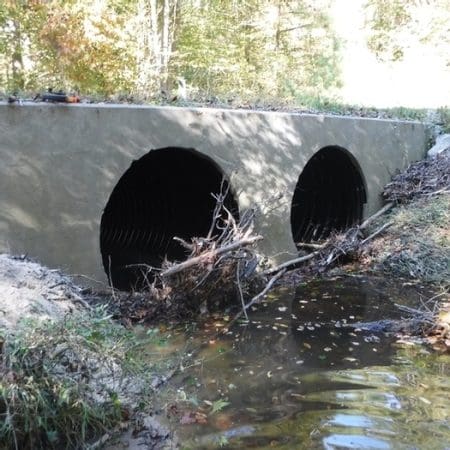
The Nobles Road culvert was known to fill with debris due to its small size, potentially blocking the passage of aquatic wildlife in Flowerdew Hundred Creek. (James River Association)

Nobles Road was transformed into a wildlife habitat after the James River Association, DWR, USFWS, and Virginia Department of Forestry planted live stakes, trees, and herbaceous plants at the site. (James River Association)
A flood of funding
More funding may be on the way for projects like Flowerdew Hundred that aim to reduce the impacts of roadways on aquatic wildlife.

The Bipartisan Infrastructure Law provides billions of dollars to grant programs that aim to improve fish passage and aquatic connectivity, including a brand new U.S. Department of Transportation Culvert Removal, Replacement, and Restoration Grant Program over a five-year period and a Wildlife Crossing Pilot Program.
“Our Fish Passage Program, we’re limited, we’re not getting nearly as much money as the DOTs are,” said Moss, referring to the National Fish Passage Program’s $200 million five-year budget. “We want to encourage VDOT to take advantage of all this other money that’s out there.”
Daniel Redgate, a water resources program manager with VDOT, said the agency is evaluating funding opportunities as well as investigating “potential aquatic passage project sites.”
Many of the federal programs that serve to benefit fish passage also benefit flood resiliency.
“When we’ve talked with a lot of the districts, there’s a lot of undersized culverts they want to replace for resiliency issues that, if they replace for resiliency issues, will also tackle these aquatic connectivity issues,” said Reilly.
However, she warned, “having more funding available does not necessarily make the perfect project appear.”
“What I’m hoping over the next several years is that we find some quality projects and get those done rather than just trying to spend the money,” said Weaver. Instead, he added, it’s “about how many good quality projects we can get done.”
by Evan Visconti, Virginia Mercury
Virginia Mercury is part of States Newsroom, a network of news bureaus supported by grants and a coalition of donors as a 501c(3) public charity. Virginia Mercury maintains editorial independence. Contact Editor Sarah Vogelsong for questions: info@virginiamercury.com. Follow Virginia Mercury on Facebook and Twitter.




Trump: Execution of Fort Hood Shooter Will Not Be Livestreamed

Harmony Hollow Holler Music Festival Brings Appalachian Music to Front Royal October 17

Winsome Earle-Sears Warns of Consequences of Virginia’s Proposed Constitutional Amendments

Federal Emergency Order Aims to Prevent Power Outages Across Mid-Atlantic, Including Virginia

Warren County Grand Jury Returns 17 Indictments Against 10 Individuals in October Session

Text Amendment for Aging in Place Community Succeeds at County Planning Commission Meeting

Virginia Lawmakers, Spanberger Grapple With Loss of Federal Healthcare Funds for Trans Youth

Virginia Sees Gains in Kindergarten Readiness, But Gaps Persist for Underserved Students

One Health: Why Animal Health Is Also Your Health

The Real Winnie-The-Pooh Was a Girl from Ontario

Defense Counsel and Special Prosecutor Reach Plea Agreement on Carter DUI Cases

Betty Jean Menefee (1937 – 2026)

Trump Administration Appeals Judge’s Order Blocking White House Ban of 3 News Outlets

Town Council Discusses a Potential Joint Town-County Tourism MOU in Advance of Liaison Meeting

Loudoun Superintendent Pushes Back After Virginia Delegate Slams LGBTQ+ History Acknowledgment

Chesapeake Bay Gets a C+ in Overall Health, Virginia and Maryland Leaders Say Work to Protect It Must Continue

Allen Neel Says Front Royal Needs More Than Plans — It Needs Action

Warner Seeks a Final Term as Mizusawa Makes His Case for Change

New Homes Stopped Shrinking. The Rooms Didn’t Stop Changing

Lord Fairfax Health District Urges Residents To Prepare For Respiratory Virus Season

Blue Ridge Wildlife Center Patient of the Week: Ruddy Duck

This Week’s Showtimes at Royal Cinemas as of October 15th

POLICE: 7 Day FRPD Arrest Report 10/12/2026

Trial Date of January 6, 2027, Set in Misdemeanor Assault & Battery Case Against Hugh Henry
